“Quote Unquote”
June 1, 2018 § Leave a comment
“It occurred to him that his scarcely perceptible attempts to struggle against what was considered good by the most highly placed people, those scarcely noticeable impulses which he had immediately suppressed, might have been the real thing, and all the rest false. And his professional duties and the whole arrangement of his life and of his family, and all his social and official interests, might all have been false.” — Leo Tolstoy, The Death of Ivan Ilych
“If there is any fixed star in our constitutional constellation, it is that no official, high or petty, can prescribe what shall be orthodox in politics, nationalism, religion, or other matters of opinion, or force citizens to confess by word or act their faith therein.” — Robert H. Jackson, West Virginia State Board of Education v. Barnette, 319 U.S. 624, 642 (1943).
“To sum it all up, I must say that I regret nothing.” — Adolf Eichmann

“QUOTE UNQUOTE”
January 13, 2012 § Leave a comment
“Every trial presents its own field of maneuver, with issues rising up in different places on the terrain. Some issues reach commanding heights, others are just a gentle rise; some have evidence arrayed densely on each side, others have evidence more thin. Whatever the layout, the district court knows the ground better than we do. Its understanding comes from the front lines, whereas we are back in a headquarters tent. And thus we defer a great deal to the district court’s judgment as to whether a particular piece of evidence aligns with one issue, or another, or instead does not belong on the field at all.” — US v. Clay, 09-5568 6th Cir. (2012), KETHLEDGE, Circuit Judge, dissenting.
“There is in each of us a stream of tendency, whether you choose to call it philosophy or not, which gives coherence and direction to thought and action. Judges cannot escape that current any more than other mortals. All their lives, forces which they do not recognize and cannot name, have been tugging at them — inherited instincts, traditional beliefs, acquired convictions; and the resultant is an outlook on life, a conception of social needs. … In this mental background every problem finds it setting. We may try to see things as objectively as we please. None the less, we can never see them with any eyes except our own.” — U.S. Supreme Court Justice Benjamin N. Cardozo.
“When we went to school we were told that we were governed by laws, not men. As a result of that, many people think there is no need to pay any attention to judicial candidates because judges merely apply the law by some mathematical formula and a good judge and a bad judge all apply the same kind of law. The fact is that the most important part of a judge’s work is the exercise of judgment and that the law in a court is never better than the common sense judgment of the judge that is presiding.” — US Supreme Court Justice Robert H. Jackson
“QUOTE UNQUOTE”
August 6, 2010 § Leave a comment
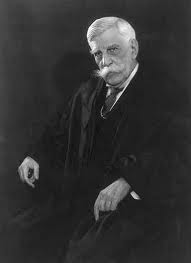
Justice Holmes
“If there is any principle of the Constitution that more imperatively calls for attachment than any other it is the principle of free thought — not free thought for those who agree with us but freedom for thought that we hate.” — Oliver Wendell Holmes, Jr.
“They [the makers of the Constitution] conferred, as against the government, the right to be let alone — the most comprehensive of rights and the right most valued by civilized men.” — Louis Brandeis
“It is not the function of our Government to keep citizens from falling into error; it is the function of the citizens to keep the Government from falling into error.” — Robert H. Jackson
 The Better Chancery Practice Blog