EVER IS A LITTLE OVER A DOZEN YEARS
September 12, 2010 § Leave a comment
 W. Ralph Eubanks is publishing editor at the Library of Congress and a native of Covington County, Mississippi. His book, EVER IS A LONG TIME, is a thought-provoking exploration of Mississippi in the 1960’s, 70’s, and the present, from the perspective of a black child who grew up in segregation and experienced integration, and that of a young black man who earned a degree from Ole Miss, left Mississippi vowing never to return, achieved in his profession, established a family, and eventually found a way to reconcile himself to the land of his birth.
It was his children’s inquiries about their father’s childhood that led Eubanks to begin to explore the history of the dark era of his childhood. In his quest for a way to help them understand the complex contradictions of that era, he came across the files of the Mississippi Sovereignty Commission and found his parents’ names among those who had been investigated, and he became intrigued to learn more about the state that had spied on its own citizens.
Eubanks’ search led him to Jackson, where he viewed the actual files and their contents and explored the scope of the commission’s activities. He had decided to write a book on the subject, and his research would require trips to Mississippi. It was on these trips that he renewed his acquaintance with the idyllic rural setting of his childhood and the small town of Mount Olive, where, in the middle of his eighth-grade school year, integration came to his school.
There are three remarkable encounters in the book. The author’s meetings with a surviving member of the Sovereignty Commission, a former klansman, and with Ed King, a white Methodist minister who was active in the civil rights movement, are fascinating reading.
The satisfying dénouement of the book is Eubanks’ journey to Mississippi with his two young sons in which he finds reconciliation with his home state and its hostile past.
If there is a flaw in this book, it is a lack of focus and detail. The focus shifts dizzyingly from the Sovereignty Commission, to his relationship with his parents, to his rural boyhood, to life in segregation, to his own children, to his problematic and ultimately healed relatiosnhip with Mississippi. Any one or two of these themes would have been meat enough for one work. As for detail, the reader is left wishing there were more. Eubanks points out that his own experience of segregation was muted because he lived a sheltered country existence, and his memories of integrated schooling are a blur. For such a gifted writer whose pen commands the reader’s attention, it is hard to understand why he did not take a less personal approach and expand the recollections of that era perhaps to include those of his sisters, or other African-Americans contemporaries, or even the white friends he had.
This is an entertaining and thought-provoking book, even with its drawbacks. I would recommend it for anyone who is exploring Mississippi’s metamorphosis from apartheid to open society.
The title of this book has its own interesting history. In June of 1957, Mississippi Governor J. P. Coleman appeared on MEET THE PRESS. He was asked if the public schools in Mississippi would ever be integrated. “Well, ever is a long time,” he replied, ” [but] I would say that a baby born in Mississippi today will never live long enough to see an integrated school.”
In January of 1970, only twelve-and-a-half years after the “ever is a long time” statement, Mississippi public schools were finally integrated by order of the Fifth Circuit Court of Appeals, a member of which, ironically, was Justice J. P. Coleman, former governor of Mississippi.

Eubanks
THE LAST BATTLE OF THE CIVIL WAR
August 28, 2010 § 2 Comments
Through the spring and summer most of my reading has been books dealing with the South in general and Mississippi in particular in the last half of the twentieth century, the era of the struggle for civil rights I still have a few more to read on the topic before I move on to other interests.
One of the seminal events of the civil rights era was the admission of James Meredith as a student at the University of Mississippi in 1962. The confrontation at Ole Miss between the determined Meredith, backed by the power of the federal government, and Mississippi’s segregationist state government culminated in a bloody battle that resulted in two deaths and a shattering blow to the strategies of “massive resistance,” “interposition,” and “states rights” that had been employed to stymie the rights of black citizens in our state.
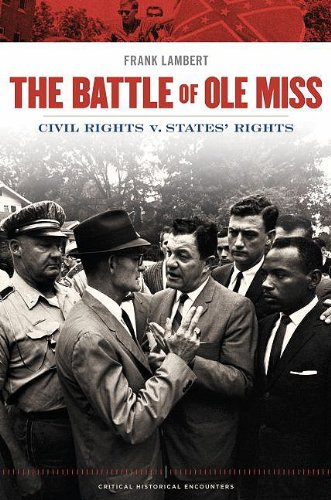 Frank Lambert has authored a gem of a book in THE BATTLE OF OLE MISS: Civil Rights v. States Rights, published this year by the Oxford University Press. If you have any interest in reading about that that troublesome time, you should make this book a starting point.
Lambert, who is a professor of history at Purdue University, not only was a student at Ole Miss in 1962 and an eye-witness to many of the events, he was also a member of the undefeated football team at the time, and his recollection of the chilling address delivered by Governor Ross Barnett at the half-time of the Ole Miss-Kentucky football game on the eve of the battle is a must-read.
This is a small book, only 193 pages including footnotes and index, but it is meticulously researched. As a native Mississippian and eyewitness, Lambert is able not only to relate the historical events, he also is able to describe the context in which they happened.
The book lays out the social milieu that led to the ultimate confrontation. There is a chapter on Growing Up Black in Mississippi, as well as Growing up White in Mississippi. Lambert describes how the black veterans of World War II and the Korean conflict had experienced cultures where they were not repressed because of their race, and they made up their minds that they would challenge American apartheid when they returned home. Meredith was one of those veterans, and he set his sights on attending no less than the state’s flagship university because, as he saw it, a degree from Ole Miss was the key to achievement in the larger society. He also realized that if he could breach the ramparts at Ole Miss, so much more would come tumbling down.
The barriers put up against Meredith because of his race were formidable. He was aware of the case of Clyde Kennard, another black veteran who had tried to enroll at what is now the University of Southern Mississippi, but was framed with trumped-up charges of stolen fertilizer and sentenced to Parchman, eventually dying at age 36. And surely he knew of Clennon King, another black who had managed to enroll at Ole Miss only to be committed to a mental institution for his trouble. Even among civil rights leadrs, Meredith met resistance. He was discouraged by Medgar and Charles Evers, who were designing their own strategy to desegregate Ole Miss, and felt that Meridith did not have the mettle to pull it off. Against all of these obstacles, and in defiance of a society intent on destroying him, Meredith pushed and strove until at last he triumphed.
But his triumph was not without cost. Armed racists from throughout Mississippi, Alabama and other parts of the South streamed to Oxford in response Barnett’s rallying cry for resistance. The governor’s public rabble-rousing was cynically at odds with his private negotiations with President John Kennedy and US Attorney General Bobby Kennedy, with whom he sought to negotiate a face-saving way out. The ensuing battle claimed two lives, injured 160 national guardsmen and US marshals, resulted in great property damage, sullied the reputation of the university, tarred the State of Mississippi in the eyes of the world, led to armed occupation of Lafayette County by more than 10,000 federal troops, and forever doomed segregation. Ironically, the cataclysmic confrontation that Barnett and his ilk intended to be the decisive battle that would turn back the tide of civil rights was instead the catalyst by which Ole Miss became Mississippi’s first integrated state university. It was in essence the final battle of the Civil War, the coup de grace to much of what had motivated that conflict in the first place and had never been finally resolved.
As for Meredith, the personal cost to him was enormous. He was subjected to taunts and derision, as well as daily threats of violence and even death. He found himself isolated on campus, and did not even have a roommate until the year he graduated, when the second black student, Cleveland Donald, was admitted. Meredith described himself in 1963 as “The most segregated Negro in the world.”
The admission of James Meredith to Ole Miss not only opened the doors of Mississippi’s universities to blacks, it also helped begin the process in which Mississippians of both races had to confront and come to terms with each other as the barriers fell one by one. As former mayor Richard Howorth of Oxford recently told a reporter: ” … other Americans have the luxury of a sense of security that Mississippi is so much worse than their community. That gives them a sense of adequacy about their racial views and deprives them of the opportunity we’ve had to confront these issues and genuinely understand our history.”
Meredith’s legacy is perhaps best summed up in the fact that, forty years after his struggle, his own son graduated from the University of Mississippi as the Outstanding Doctoral Student in the School of Business, an event that Meredith said, ” … vindicates my entire life.” His son’s achievement is the culmination of Meredith’s singular sacrifice. What Meredith accomplished for his son has accrued to the benefit of blacks and whites alike in Mississippi, and has helped our state begin to unshackle itself from its slavery to racism.
 The Better Chancery Practice Blog