A MODEST PROPOSAL FOR A FUTURE FREEDOM SUMMER
June 8, 2011 § 13 Comments
I posted here about the events of 1964 Freedom Summer in Meridian. Mark Levy of New York, director of Meridian’s Freedom School that summer, sent a reply that I posted here.
Mississippi’s history, and by extension that of Meridian, is intertwined inextricably with issues arising out of relations between the races. The major historical forces that shaped much of the modern south, including the culture of slavery, the Civil War, Reconstruction, Populism and the Revolt of the Rednecks, Vardaman and Bilbo, sharecropping and peonage, the great emigration north, Jim Crow, the Klan and lynching, the Civil Rights Movement, the southern strategy, all had race at their root. It is essential that Mississippians of all races know and understand how these forces evolved and continue to influence us if we hope to know and understand how we can grow beyond them and explore how best to make room for each other in our common life. The only way to do this is to do it purposefully, with reflection and care, preserving the history so that we will not be doomed to relive its mistakes.
As Mark pointed out in his response, and Richelle Putnam in her comment, the voices of the civil rights era are aging. Already many of the most significant figures of the Civil Rights Movement have passed. Who will carry their story and its understanding forward to the leaders of the future?
The year 2014 will be the fiftieth anniversary of Freedom Summer. Meridian was at the epicenter of the Civil Rights Movement in those blastfurnace-hot months. What better opportunity than the fiftieth anniversary will we have to focus reflection and thoughtful attention on the epochal events of the summer of 1964 as a catalyst for further discourse?
Taking some of Mark Levy’s thoughts as a springboard, I came up with the following modest proposal for an observance of that silver anniversary. It’s merely a starting point for discussion, and I am sure that there’s much more that can be done. I propose that between now and the summer of 2014, we do the following:
- Acquire the Fielder & Brooks building on Fifth Street as the site of a Civil Rights in Meridian interpretive center and museum. Part of the building could be devoted to the history of black entrepreneurship in Meridian, and specifically in the Fifth Street area. It could include a re-creation of the old Fielder & Brooks pharmacy. Upstairs, the COFO Headquarters and Community Center would be re-created, with displays of materials and memorabilia devoted to Freedom Summer and the COFO workers. Other displays would tell the story of Meridian’s civil rights leaders and accomplishments. If that building proves to be unavailable, the project could go forward at another site, but a location in the Fifth St. area would serve beneficially as an anchor in an area where so many buildings have been lost.
- Establish a trail of sites with importance to civil rights in Meridian and make a map available in the interpretive center.
- Plan an observance of Freedom Summer in 2014, and invite all of the surviving Meridian COFO and other workers who devoted that summer to change. The event would include reminiscences, lectures, social events, and even worship and singing. If enough money were available, a noted speaker could keynote and draw attention to the event. Use the event to promote racial reconciliation and promote discussions about how to establish common ground. Enlist the schools and colleges to focus course work on these issues in the months leading up to that summer.
- Establish an organization to gather, preserve, display and promote the materials, artifacts, oral histories and other memorabilia of the Civil Rights Movement in Meridian. Perhaps one day Meridian could become the site of a Civil Rights Archive.
These are ideas that have been percolating in my head since I read Mark’s response. I am sure there are many other worthwhile approaches to this, but we have the advantage of time to work toward the goal. If you have other ideas to share, please feel free to comment. I will definitely be in touch with those of you who have expressed an interest, as well as others.
This is definitely something I am willing to work to attain. Will you work with me?

Fielder & Brooks Bldg. looking west across 25th Ave. with 5th St. on the right
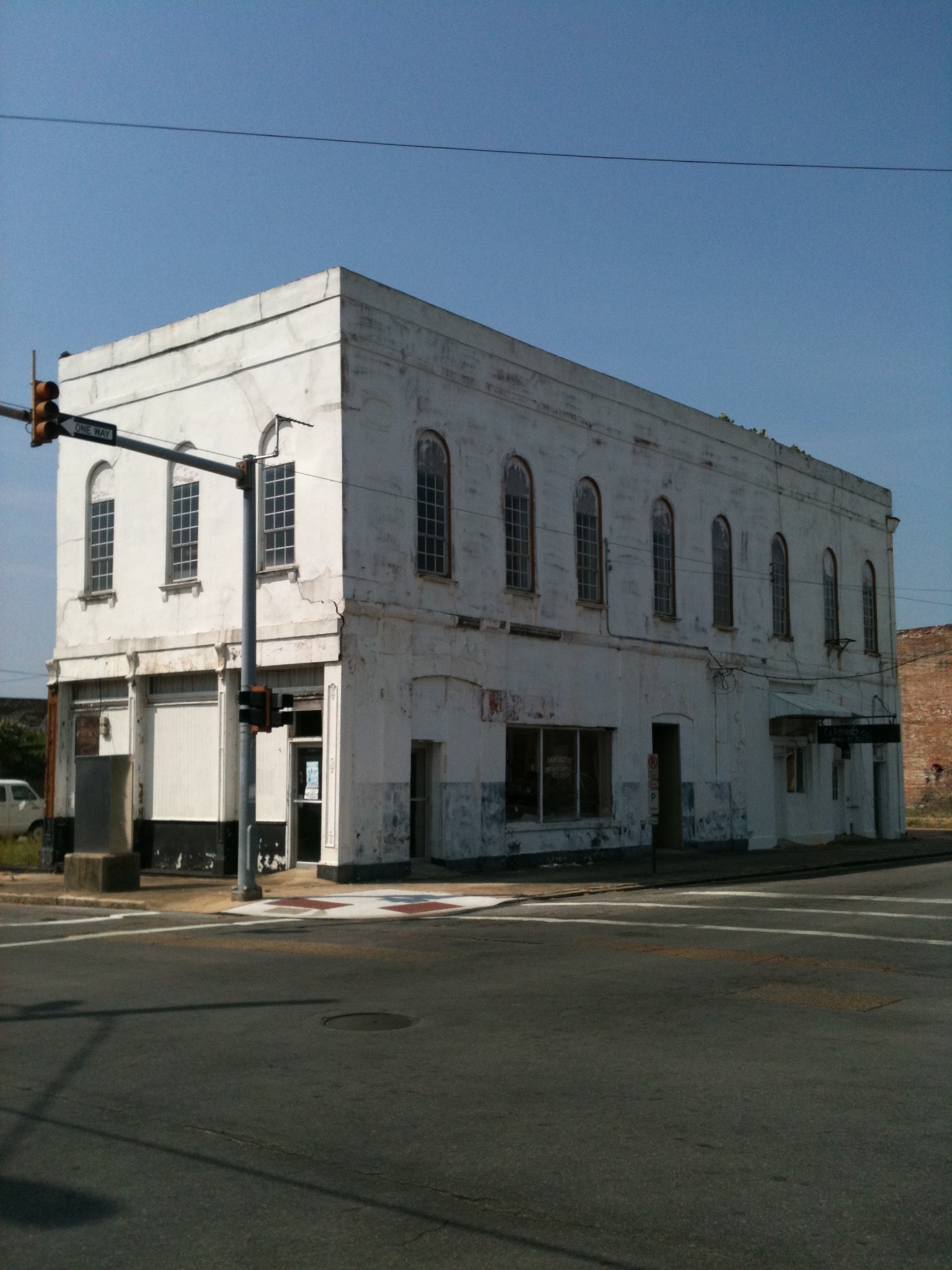
View across 25th Ave. from in front of the E.F. Young Hotel
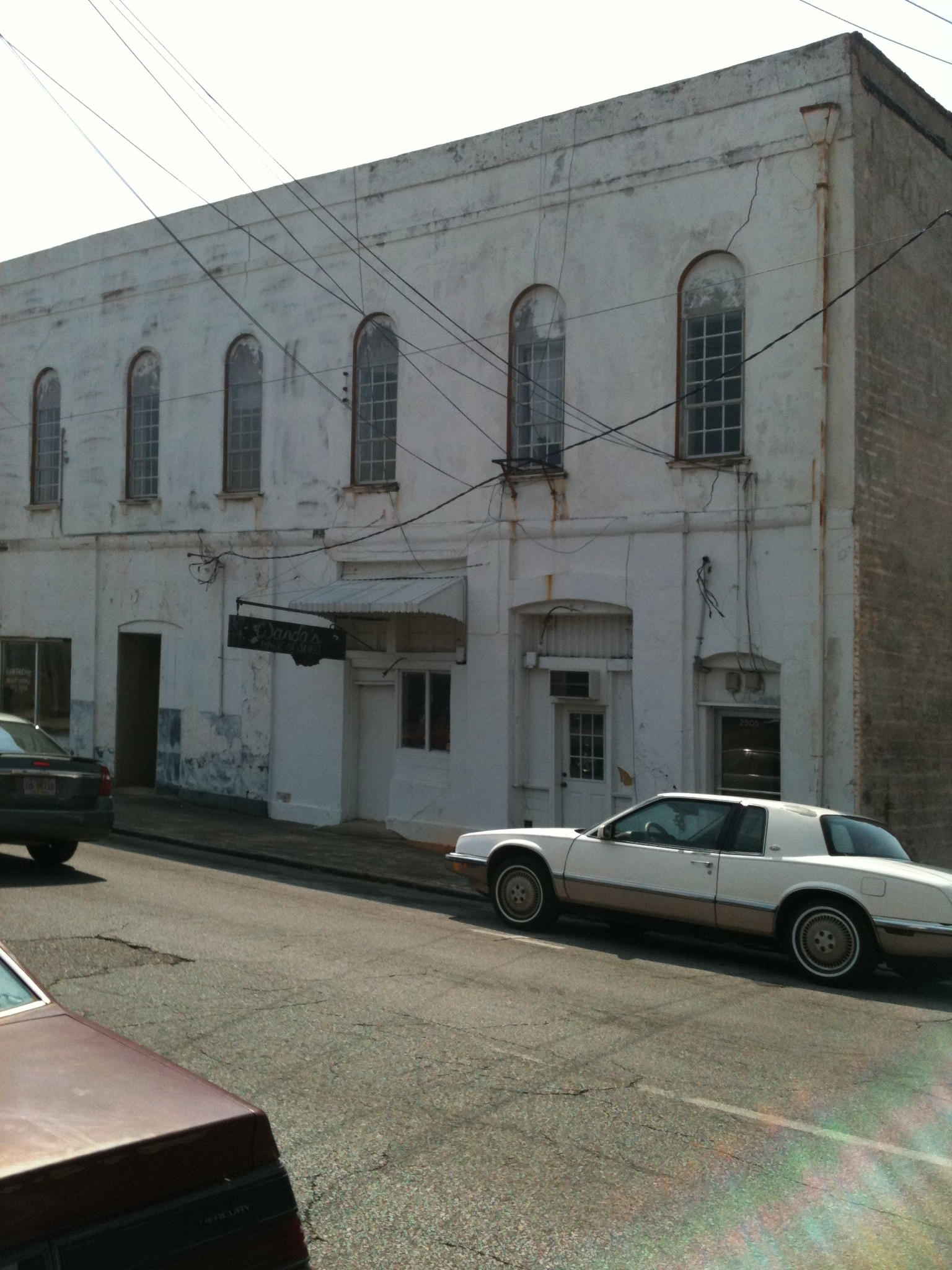
From across 5th St. looking southeast. The door on the far right is 2505 1/2
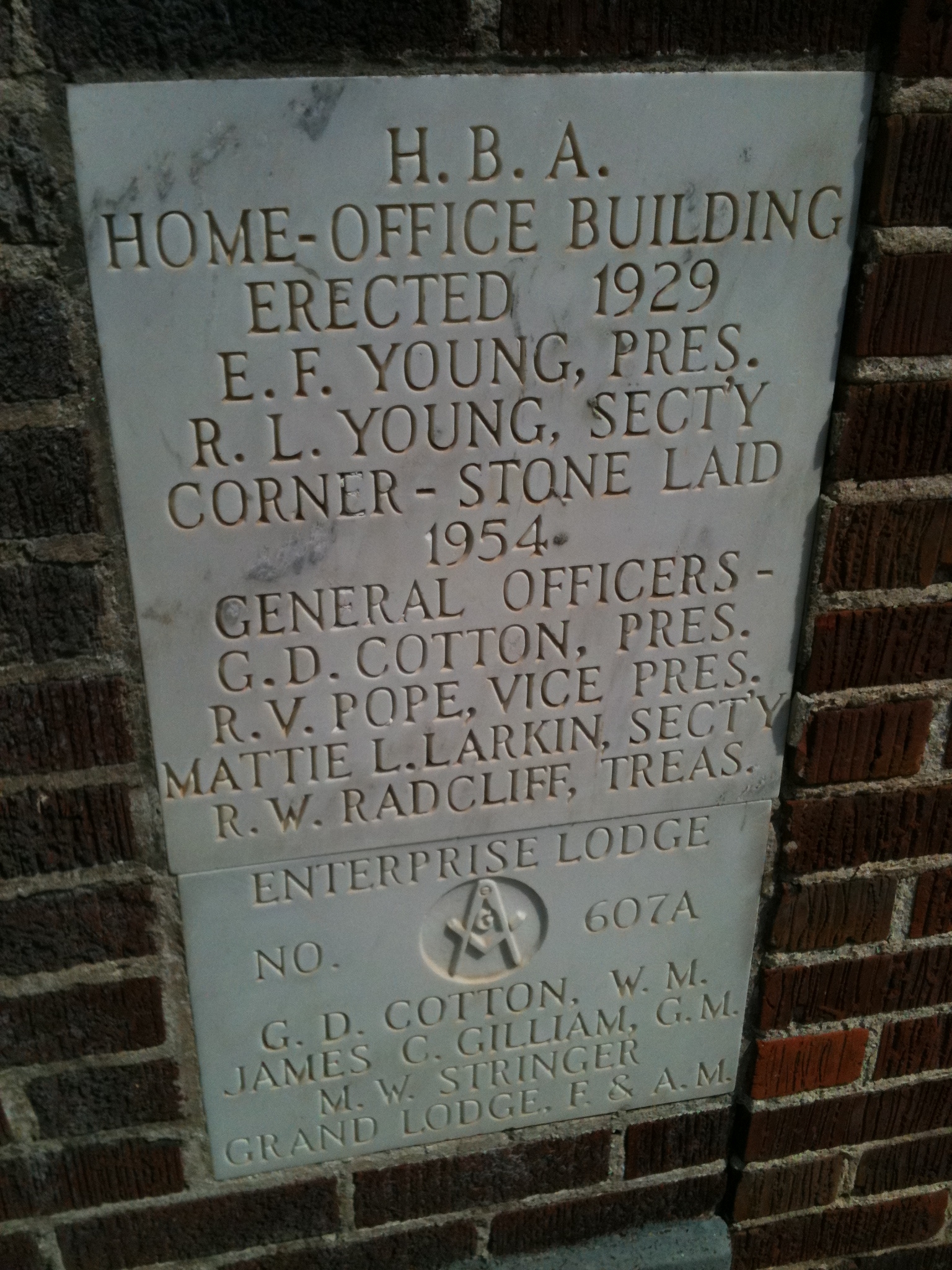
Holbrook Benevolent Association monument on 5th St., typical of sites for an historical trail
MARK LEVY ON THE LEGACY OF FREEDOM SUMMER
May 26, 2011 § 9 Comments
I posted Monday about Freedom Summer in Meridian. One of the courageous COFO workers who spent time in Meridian in that summer of 1964, and whom I mentioned in my post, was Mark Levy, who came with his wife Betty to Meridian from Queens College in New York.
Mark took the time to send me a thoughtful response to my post, and I think it is worth your time to read. He raises some intriguing points about preserving the story of how the civil rights movement touched and changed Meridian, and how it can be passed on. There is food for thought here, and a call to action.
As Mark says, there are the seeds of the beginning of a conversation here. Will you join the discussion?
__________________________________________________
“Ordinary People Doing Extraordinary Things”
Meridian Civil Rights Stories Worth Remembering and Telling
The summer of 1964 touched on people’s lives in Meridian in many different ways. Chancery Judge Primeaux’s narrative is an important and sensitive step in opening up that conversation. I’m glad that my old photos of daily life in the Freedom School are a contribution.
Similarly important was last month’s April 29th recognition by the Mississippi Heritage Trust in Jackson that the Fielder and Brooks Drug Store building and site of the 1964 COFO office at 2505 ½ 5th Street is an endangered but historically significant building in the state, well worth preserving. The Meridian civil rights story needs to be documented and shown. The 2505 ½ 5th Street site would be perfect not only as an interpretive, but also as an educational center and local attraction.
In addition to the pictures I found in my files, I also found the names of about 250 students – ages 8 to 18, at the time – who attended summer classes in the Freedom School. We, the volunteer teachers, learned as much from our students that summer as we were able to teach them. The students were brave and serious young people who took all sorts of risks to come to school. The former students are now in their late 50s and 60s. Where are they today? How did those experiences touch their lives? Who stayed, who left, and who has come back to Meridian? What contributions have those former students made to their respective communities?
The decisions for students to attend — or not attend — Freedom School were family decisions. In 1964, that meant that parents, grandparents, aunts, uncles, etc. all decided to take on some family risk in sending their kids to the Baptist Seminary. Not only should a history of Meridian tell the story of how a famous folk singer like Pete Seeger performed in Meridian, but it should also be noted that the room was packed with people who took a risk in coming to hear him. Another footnote to the Meridian civil rights story is that the Meridian Freedom School at the Baptist Seminary had the honor to play host in August to a state-wide convention of young delegates from Freedom Schools all over Mississippi. The resolutions passed by the students attending reveal a wide range of issues, concerns, and hopes – worth looking at again to see what progress, if any, has been made since those times.
Similarly, in my files, I’ve found the names of about 45 out-of-state volunteers, in addition to Mickey and Rita Schwerner, who participated – at one time or another — in COFO-sponsored community center, voter registration, freedom school, and MFDP work in Meridian during 1964-65. We stayed in the homes of some very brave local people, rented some living and office space, ate in selected establishments, cashed personal checks in some stores, asked cab drivers and others how to get around, attended some church services and used some churches for meetings. In the highly charged atmosphere of the times, those ordinary decisions could have life and death – in addition to job – consequences. We, the volunteers, took risks; but the local families and organizations who invited us to come took far more risks than us.
Several of the pictures I found in my files show a Lauderdale County meeting of the Mississippi Freedom Democratic Party where Meridian and county “precinct” and “beat” representatives elected ordinary people as local delegates to go to the national convention in Atlantic City. The MFDP was formed to show that people prevented from registering in 1964 truly wanted to participate in the electoral system. The civil rights movement in Meridian involved commitment and participation from both young and old. The pressures against taking a stand were powerful and frightening.
Does anyone know where Martin Luther King Jr. came to speak in Mississippi during the summer of 1964? I believe he spoke in just two places – and that included speaking at two churches in Meridian.
The civil rights summer of 1964 should be taken as just one moment in history – with important precedents and ongoing effects. For example: a) In Meridian, an NAACP chapter existed for a number of years prior, sometimes recruiting with quiet, hand-collection of dues. They had a growing youth membership that later became part of the local COFO movement in 1964. That NAACP chapter continues to exist today. b) The Fielder and Brooks pharmacy, itself, was just one example of black professional accomplishment that had been developing for years in Meridian. c) 1965 and the years thereafter, school, college and public facility de-segregation and voter registration brought other challenges and additional sets of heroes and heroines who stepped forward and deserve to be respected and remembered.
What does all of this mean today – especially for younger people? What can research projects in Meridian’s high school, junior college, and senior college contribute to finding, recording, and telling about local people’s hopes, fears, and contributions? What remains to be improved? What stories do old-timers – both black and white – have to tell of those times in Meridian? How would preserving the Fielder/COFO building help in both saving and using that history?
I believe that Judge Primeaux has done a great service in his blog starting a new discussion of those questions.
FREEDOM SUMMER IN MERIDIAN
May 23, 2011 § 17 Comments
This year marks the 50th anniversary of the Freedom Riders’ attempts at integration of transportation and amenities across the south. The arrival of the Freedom Riders in May, 1961 was met with mob violence and police brutality, but it did not end segregation in Mississippi. The Freedom Riders did, however, pique public awareness across the nation of the inequalities in the south and the need to address them.
In 1962, representatives of four civil rights organizations — SNCC (Student Non-violent Coordinating Committee), CORE (Congress of Racial Equality), NAACP and SCLC (Southern Christian Leadership Conference) — met at Clarksdale and formed a new organization designed to coordinate their efforts and resources in Mississippi. They called the organization COFO (Congress of Federated Organizations).
The primary concern was to register black voters in Mississippi. At the time, Mississippi at less than 7% had the lowest percentage of black voter registration in the nation. Blacks seeking to register to vote were subjected to poll taxes, examinations that they had to pass to become enfranchised, and, when that was not enough, violence and even death.
It was decided that COFO would spearhead a massive, concentrated voter registration and desegregation effort in Mississippi in the summer of 1964. Volunteers were enlisted from across the country, primarily from the northeast and midwest, many of whom were college students willing to devote a summer to the cause. The effort came to be known as “Freedom Summer.”
In January, 1964, Michael Schwerner came to Mississippi and opened a COFO office in Meridian at 2505 1/2 Fifth Street. Schwerner was a member of CORE, and was a native of New York. He and his wife, Rita, lived in a Meridian apartment, and engaged in various community organizing activities. The COFO office was the headquarters of the Freedom Summer operation in Lauderdale County.
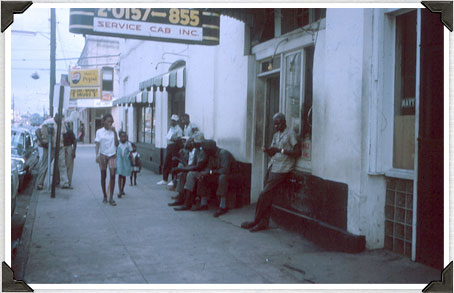
COFO HQ in Meridian
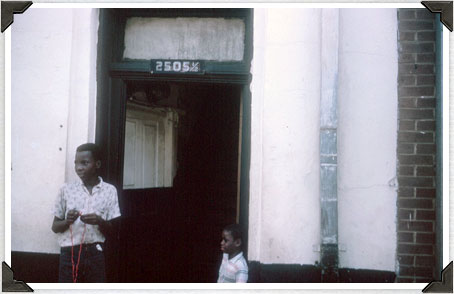
2505-1/2 Fifth Street
The headquarters occupied the second floor of the Fielder & Brooks Drug Store, an established and respected black business.
The Schwerners opened a COFO-sponsored community center where black children could gather and play games, socialize and access a lending library.
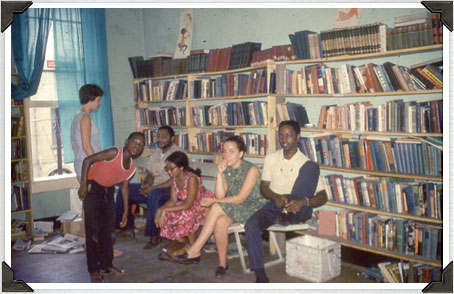
Reading Room
COFO in Meridian also operated one of the several dozen Freedom Schools that were opened across Mississippi that summer. The Freedom Schools taught citizenship, black history, constitutional rights, political processes, and basic academics. More than 3,500 students attended the Freedom Schools. Meridian’s Freedom School was at the old black Baptist Seminary.
Here is the text of a 1964 COFO memo describing the Meridian operation:
Meridian is a city of 50,000, the second largest in the state. It is the seat of Lauderdale county. It is in the eastern part of the state, near the Alabama border, and has a history of moderation on the racial issue. At the present time, the only Republican in the State Legislature is from Meridian. Registration is as easy as anywhere in the state, and there is an informal (and inactive) “biracial committee”, which, if it qualifies, is the only one in the state.
Voter registration work in Meridian began in the summer of 1963 (for COFO staff people, that is), and by autumn, when Aaron Henry ran in the Freedom Vote for Governor campaign, there was a permanent staff of two people in the city. In January, 1964, Mike and Rita Schwerner, a married couple from New York City, started a community center. In Meridian’s mild political climate, the community center there has functioned more smoothly than either of the two community centers which COFO has organized in tougher areas. The center has recreation programs for children and teenagers, a sewing class and citizenship classes. It also has a library of slightly over 10,000 volumes, and ambitious plans for expansion if more staff were available. The COFO staff in Meridian uses Meridian as a base for working six other adjoining counties.
The Freedom School planned for Meridian will have a fairly large facility, in contrast to most places in the state. The Baptist Seminary is a large, 3-story building with classroom capacity for 100 students and sleeping accommodations for staff up to about 20. Besides this, there is a ballpark available for recreation. The school has running water, blackboards and a telephone. The center has a movie projector and screen which it probably would lend. The library lends books to anyone for two-week periods. The question of rent has not been decided for the school. Even if there is no rent, however, we can count on a budget of around $1300, for food for students, utilities, telephone and supplies.
One of the COFO volunteers was Mark Levy, who came to Meridian with his wife, Betty, from Queens College in New York. He chronicled his sojourn in Meridian with his camera, and his impressive collection of photographs is in the Queens College archives, where you can view it online.
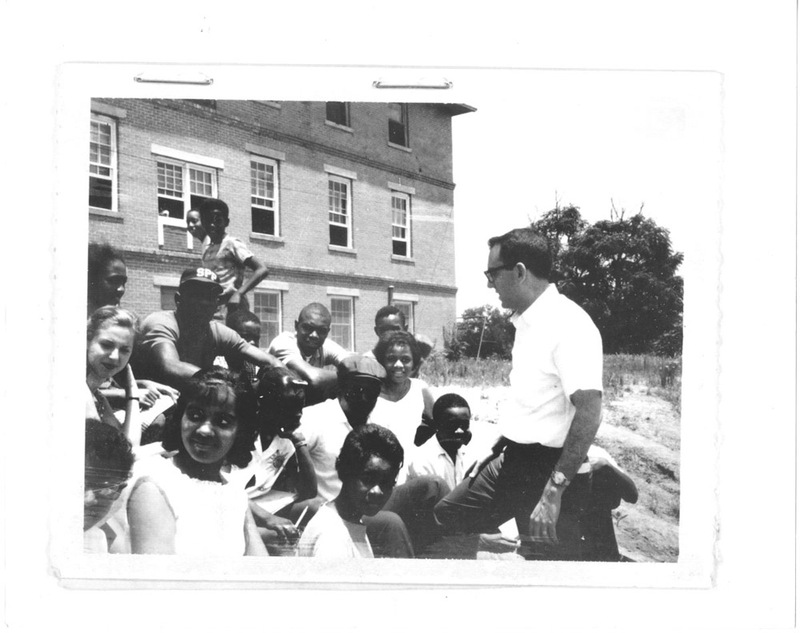
Mark and Betty Levy with students at the Freedom School
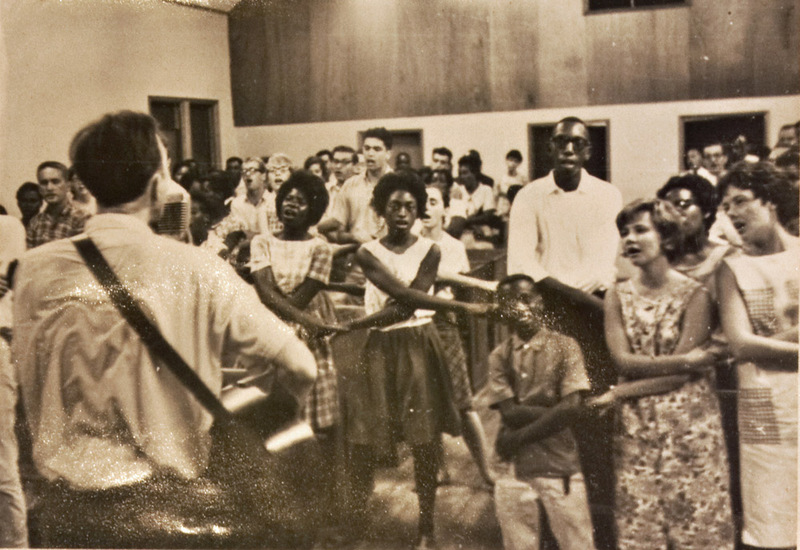
A remarkable fact documented by Levy is that the famed folk/protest singer Pete Seeger visited Meridian and played at the old Mt. Olive Baptist Church during Freedom Summer.
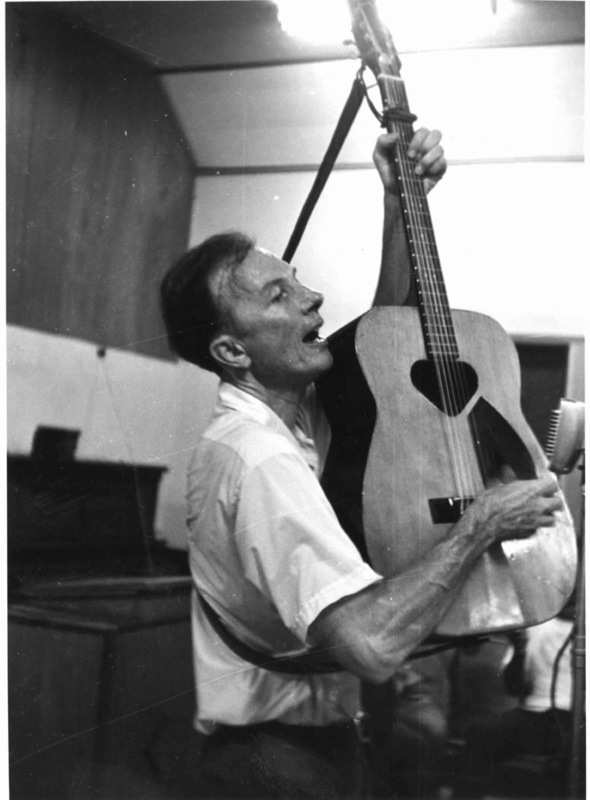
Seeger plays for the COFO workers
He performed for the COFO volunteers. The next photo shows COFO workers and others joining hands to sing along with Seeger. The young woman at the right with the flowered dress is COFO volunteer Patti Miller of Iowa, who pinpoints the date of Seeger’s performance as August 4, 1964.
Shortly after he arrived, Schwerner was joined by an eager young Meridianite volunteer named James Chaney. As the summer drew near, other volunteers began to arrive from other places, among them Andrew Goodman of New York.
Despite its moderate reputation on racial issues, there was a dark underside to Meridian and the surrounding area. The Klan was active, with members in law enforcement and in influential positions. The Klan had its eye on COFO, and on Schwerner in particular. They gave him the derisive nickname “Goatee,” for his beatnik-style beard, and spread rumors that he was having an affair with a black woman.
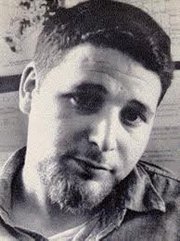
Michael "Goatee" Schwerner
Mississippi’s political leadership provoked the citizenry with accusations that the COFO workers were communists who had trained in Cuba. FBI Director J. Edgar Hoover made the statement that “We will not wet-nurse troublemakers,” insinuating that anyone who took matters into their own hands would not be bothered by the feds.
On June 21, 1964, Schwerner, Goodman and Chaney had returned from a training session in Oxford, Ohio, to learn that the Mt. Zion Methodist Church in Neshoba County had been burned by the Klan and some of its members beaten in retribution for allowing a Freedom School to operate there. The three travelled from Meridian to Neshoba and met with the leaders of the church. As they made their way back to Meridian, the three were stopped by a Neshoba County Deputy Sheriff and taken into custody on the pretext of a speeding charge. After they were released from jail in Philadelphia, they were stopped again on Highway 19 South by the Sheriff, who allowed a group of Klansmen to take them to Rock Cut Road, between House and Bethsaida, where all three were murdered by gunfire. An historical marker is set on the junction of Highway 19 and the road where they were killed.
When the trio did not return to Meridian as scheduled, their disappearance was reported and a manhunt ensued. Hundreds of naval personnel participated. President Johnson ordered Hoover to mobilize the FBI, and the agency began investigating, increasing the number of agents in the state from 15 to more than 150. Posters went up.
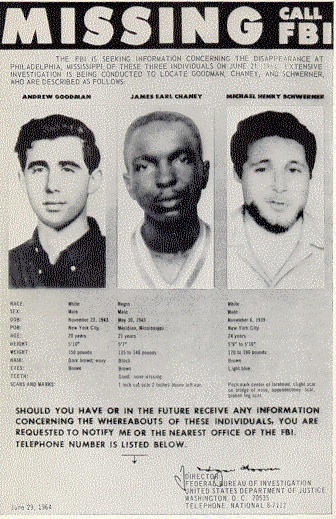
The Mississippi Sovereignty Commission investigated and its reports took the prevailing view that the disappearance was a publicity stunt designed to stir up public opinion. Governor Paul B. Johnson quipped that “Those boys are in Cuba.”
Before long, the searches turned up the CORE station wagon that the men had driven from Meridian. It had been taken to the Pearl River swamps north of Philadelphia east of Stallo off of Highway 21, where it was burned.
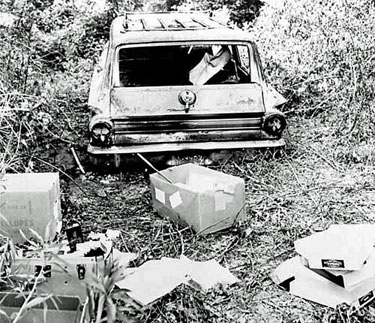
The discovery of the car did not quell the public belief that the disappearance had been staged, but the denial, speculation and ridicule abruptly ended when the three bodies were discovered by the FBI in a dam being built not far from the Neshoba County fairgrounds. It was conclusive proof of the atrocity.

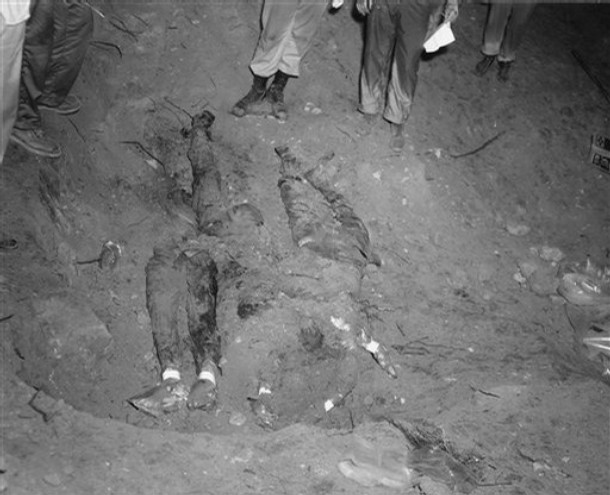
The FBI autopsy revealed that all three young men had died of gunshot wounds. The families were not convinced, however, and they demanded and got a second autopsy which revealed that Schwerner and Goodman had indeed been shot and killed. Chaney, though, had been brutally beaten before being fatally shot. The doctor who performed the autopsy said that he had never seen such extensive, catastrophic injuries, including smashed bones and damaged internal organs, not even in car or plane wreck victims.
Patti Miller remembers that that the bodies were found on August 4, 1964. She remembers that date because it was Seeger himself who announced it that night to the COFO workers during his appearance at Mt Olive.
Nineteen men, many of whom were from Meridian, were arrested and charged with the killings, but state charges were soon dropped. The federal government prosecuted them for violation of Schwerner’s, Goodman’s and Chaney’s civil rights, and seven were sentenced to varying terms up to ten years. It took until 2005 for one of the defendants, Edgar Ray Killen, to be brought to justice in a Mississippi court. He was convicted of manslaughter in Neshoba County Circuit Court.
Long before the legal proceedings, though, the families had to bury the dead as a prologue to getting on with their shattered lives. Schwerner and Goodman were taken back to their homes far away in New York.
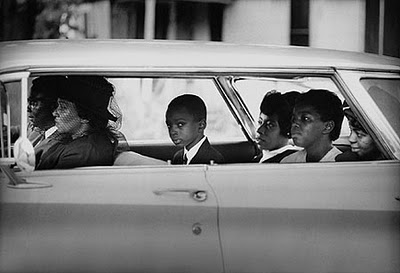
James Chaney's family on the day of the funeral
Chaney’s funeral was held in Meridian. Mourners included his collegues, the COFO workers. The funeral services took place at four different churches, culminating at First Union Baptist Church on 36th Avenue.
As for Freedom Summer, the results were mixed. Some voter registration was accomplished in the face of resistance. People were beaten and killed. Churches were burned. Violence across Mississippi escalated. By any of those measures, it was at least a borderline failure. But the deaths of Schwerner, Goodman and Chaney galvanized public opinion. The 1,000 or so COFO workers returned home from Mississippi with eyewitness testimony about the severity of the situation, many of them with scars to corroborate their stories. The nation realized that the full weight of the law and the federal government would be needed to end the systemic injustice that fostered violence and hatred and shielded murderers. The political pressure became irresistable, and the 1964 Civil Rights Act passed Congress and was promptly signed into law by President Johnson.
Freedom Summer was not the end of apartheid in Mississippi, but it did help deal it a mortal blow.
___________________________________
Thanks to Dr. Bill Scaggs for the info about Pete Seeger, Mark Levy and the Freedom School.
Patti Miller, the COFO volunteer mentioned above, has a Keeping History Alive site where I found several Freedom School photos.
 The Better Chancery Practice Blog
