ID DIVORCES IN DISTRICT 12
October 24, 2012 § Leave a comment
‘Way back in June, 2010, I posted the requirements in this district to present an irreconcilable differences divorce.
As I explained back then …
The chancery judge in an irreconcilable differences (ID) divorce is required by law to make a determination about the sufficiency of the provision for support of the minor children. Different chancellors approach the task in different ways. Some judges require a complete Rule 8.05 financial statement from each party. Some judges take the word of the attorney or litigants.
In District 12, we do not require an 8.05, but we do require that the property settlement agreement (PSA) must include certain information about the income and deductions of the paying parent. Here are our requirements:
- The property settlement agreement must include information showing gross income and deductions for taxes, Medicare and social security for year to date for the paying party, in the form of a pay stub attached to the agreement or a recitation of the actual figures, including monthly and year-to-date figures, in the body of the agreement; or, in the alternative, a statement satisfactory to the court as to why such information is not available. If the pay stub is attached, the agreement itself must include a provision that both parties have seen and are satisfied with the accuracy of the document. If the required information is not included, the agreement will not be approved.
We also have a requirement that the 8.06 disclosures either be in the PSA itself, or that the parties file it with the clerk simultaneously with entry of the divorce judgment. This policy is a recognition of the fact that 99.9% of parties do not file their 8.06 informantion as required in the rules. UCCR 8.06 mandates that the current names, addresses and telephone numbers of both parents must be disclosed and filed in the court file.
We also require at least one of the parties to appear and testify. The witness establishes the jurisdictional facts and answers two questions about the PSA: is it the entire agreement, so that there are no side agreements or unwritten deals; and does it settle all of the marital issues between the parties? If the other party is unrepresented, it would be a good idea to have that party appear also to be available to answer any questions or to make any changes in the PSA that are directed by the court.
TRIAL BY CHECKLIST: UPDATED ALIMONY FACTORS
September 24, 2012 § Leave a comment
The 12 Armstrong factors have long been the decisive authority to be applied by the court in making its determination as to the type, amount, and reasonability of alimony. In the recent COA case of Pecanty v. Pecanty, decided September 18, 2012, however, Judge Fair’s opinion cited (at ¶25) to the 2002 Davis v. Davis case, 832 So.2d 492, 497, where the MSSC laid out 17 factors. Here’s the pertinent language from Davis:
In determining whether to make an award of periodic alimony, the following factors must be considered: (1) the health of the husband and his earning capacity; (2) the health of the wife and her earning capacity; (3) the entire sources of income and expenses of both parties; (4) the reasonable needs of the wife; (5) the reasonable needs of the child; (6) the necessary living expenses of the husband; (7) the estimated amount of income taxes the respective parties must pay on their incomes; (8) the fact that the wife has the free use of the home, furnishings and automobile; (9) the length of the marriage; (10) the presence or absence of minor children in the home; (11) the standard of living of the parties, both during the marriage and at the time of the support determination; (12) fault or misconduct; (13) wasteful dissipation of assets; (14) the obligations and assets of each party; (15) the age of the parties; (16) the tax consequences of the spousal support order; and (17) such other facts and circumstances bearing on the subject that might be shown by the evidence. Hemsley v. Hemsley, 639 So.2d 909, 912 (Miss.1994); Armstrong v. Armstrong, 618 So.2d 1278, 1280 (Miss.1993); Hammonds v. Hammonds, 597 So.2d 653, 655 (Miss.1992); Brabham v. Brabham, 226 Miss. 165, 84 So.2d 147, 153 (1955). In determining the amount of support payable to the wife, a chancellor must consider “not only reasonable needs of wife but also right of husband to lead as normal a life as reasonably possible with a decent standard of living.” Massey v. Massey, 475 So.2d 802, 803 (Miss.1985); Hopton v. Hopton, 342 So.2d 1298, 1300 (Miss.1977) (quoting Nichols v. Nichols, 254 So.2d 726, 727 (Miss.1971)).
The Davis factors expand on the Armstrong factors in several significant ways:
- In addition to “the reasonable needs of the parties,” the court is to consider the reasonable needs of the child. This is significant because it opens the door to evidence about the impact that a child has not only on the expense and availability of child care, as set out in Armstrong, but also to the other needs of the child above and beyond child support, and how those needs impact the alimony recipient’s living expenses.
- In addition to the Armstrong “tax consequences of the spousal support order,” Davis directs the court to consider the amount of income taxes the respective parties must pay on their incomes. Under Davis, the trial court must address not only the tax consequences, such as deductability, but also the availability of refunds, deductions, exemptions and other factors that influence income taxes upward or downward.
- The fact that “the wife” (read “payee”) has free use of the home, furnishings and automobile is included as a factor. Granted, it has long been the law in Mississippi that those items are considered as part of the spousal support package, but the inclusion as a factor to be considered promotes it to a higher level of consideration.
It can be argued that Davis does not really add anything new to Armstrong. That may be so, and most attorneys, in presenting their Armstrong proof cover the same bases (except for income tax proof, which lawyers rarely touch on) for the most part. Still, I think it’s worth adding these to your portfolio of useful checklists. After all, in affirming the chancellor in Pecanty, Judge Fair noted with favor that she ” … addressed the seventeen factors set out in Davis … ” If he (and the rest of the COA) considered them noteworthy, we would be wise to do the same.
FORTY-ONE DON’TS IN A DIVORCE
June 18, 2012 § Leave a comment
I could not possibly say it any better than Clinton attorney Randy Wallace, who lays out “40……make that 41 things NOT to do during your divorce” in his blog.
LIMIT: ONE DIVORCE PER CUSTOMER
March 12, 2012 § Leave a comment
Lane and Cristal Kimbrough appeared before a special chancellor to present their case for divorce. The case was apparently bifurcated, with the court hearing first only the divorce grounds, and the remaining issues to be tried later.
As for divorce grounds, Cristal charged Lane with habitual cruel and inhuman treatment and habitual drunkenness. Lane counterclaimed that Cristal had been guilty of habitual cruel and inhuman treatment and adultery.
At trial, after having heard the proof only on the grounds for divorce, the special chancellor dismissed all of the pled grounds and held that the parties were divorced “one from the other on the grounds of desertion.” The basis for his ruling was that both parties had recognized that the marriage was broken by virtue of having filed for divorce against each other, and they had in essence lived separate and apart within the same residence for more than two years, “abandoning the marital relationship.”
Both parties appealed.
In Kimbrough v. Kimbrough, decided by the COA February 28, 2012, the COA reversed and remanded, saying that “The chancellor’s grant of the divorce to both parties on the equal fault ground of desertion was clear error.” Judge Russell, writing for the majority, stated:
“The Mississippi Supreme Court has held that a chancery court may not grant a divorce based on each party’s fault-based grounds. Hyer v. Hyer, 636 So. 2d 381, 383-84 (Miss. 1994). This Court has stated: “There can be but one divorce granted. Where each party has requested a divorce and offers proof sufficient to establish a basis for divorce, the chancellor must then determine which of the parties will be granted a divorce.” Garriga v. Garriga, 770 So. 2d 978, 983 (¶23) (Miss.App. 2000).
The court reversed and vacated the trial court’s judgment, declining to address any other issues.
Judge Griffis dissented for the reason that the COA should not have accepted and ruled on the appeal at all, since the trial court’s judgment disposed of less than all the issues pending (i.e., custody, child support, equitable distribution, etc.). He agreed that, if the COA should keep the appeal, the chancellor’s grant of a mutual divorce should be reversed, but he would have held that Cristal should have been granted a divorce based on the record.
Quite often lawyers present agreed Irreconcilable Differences divorce judgments granting both parties a divorce. That does not fly in the face of Hyer and Garriga because Irreconcilable Differences is not a fault-based ground.
In fault-based cases, however, the court can grant only one divorce per case. Mutual divorces are forbidden.
CHILDREN IN THE VORTEX, PART TWO
February 2, 2012 § Leave a comment
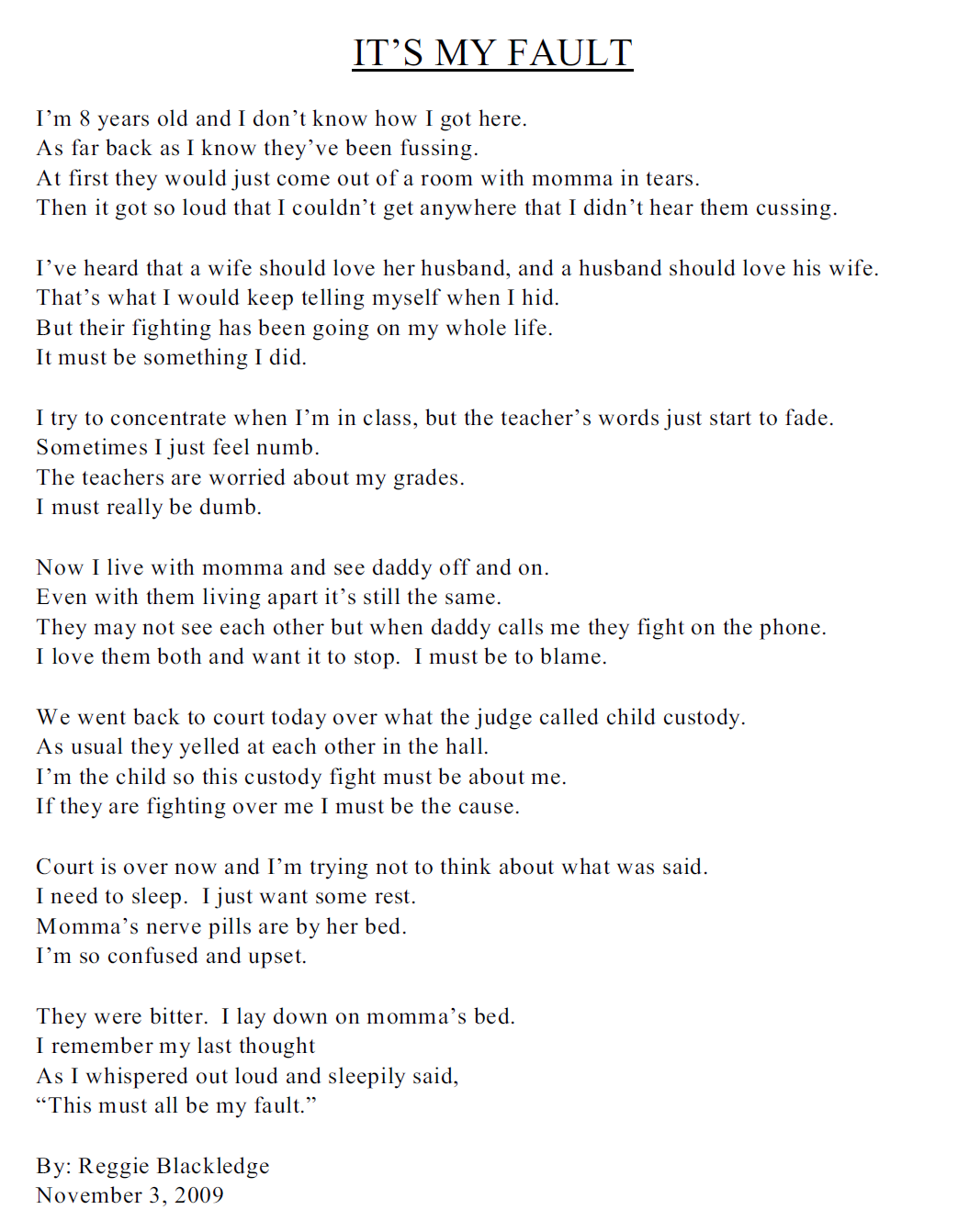
Yesterday I posted about children caught in the middle of divorce conflict. In response, Reggie Blackledge, a lawyer in Collins, MS, sent me this poem he wrote, with permission to share it with you.
CLARIFYING ATTORNEY’S FEES IN CONTEMPT ACTIONS
January 19, 2012 § Leave a comment
I’ve talked here before about some confusion (in my opinion) on the part of the COA as to the criteria to award attorney’s fees in contempt cases as opposed to other cases. The question that gave rise to the confusion was whether proof of the McKee factors and/or inability to pay would be required to support an award of attorney’s fees in a contempt action.
In Williamson v. Williamson, decided January 10, 2012, the COA set the record straight. Judge Carlton’s opinion sets it out at ¶ 28:
Furthermore, we find no merit to Will’s contention that the chancellor erred in awarding attorney’s fees to Mary due to a lack of consideration of the McKee analysis. Will’s argument fails to differentiate the chancellor’s award of attorney’s fees in a divorce action as compared to a contempt action. In Mabus v. Mabus, 910 So. 2d 486, 490 (¶13) (Miss. 2005), the Mississippi Supreme Court explained that, generally, in divorce actions, appropriate attorney’s fees are awarded in an amount to secure a competent attorney. However, in contempt actions, attorney’s fees are awarded “to make the plaintiff whole.” Id.; see also Patterson, 20 So. 3d at 73 (¶26) (stating that an award of attorney’s fees is appropriate when there is a finding of contempt, and “[n]o showing as to the McKee factors is required”); Bounds v. Bounds, 935 So. 2d 407, 412 (¶18) (Miss. Ct. App. 2006). As stated, Mary introduced an itemization of attorney’s fees into evidence at trial. Will failed to provide sufficient evidence showing that the attorney’s fees testified to by Mary were unreasonable. Therefore, we find no abuse of discretion by the chancellor in finding Will in contempt and in awarding Mary the attorney’s fees she incurred in bringing her petition for contempt. See Mabus, 910 So. 2d at 489 (¶8) (“Where a party’s intentional misconduct causes the opposing party to expend time and money needlessly, then attorney[’s] fees and expenses should be awarded to the wronged party.”).
I think that language pretty well clarifies the law on the point. In contempt cases, contrary to other cases such as divorce, proof of the McKee factors is not required, nor is proof of inability of the wronged party to pay; however, you must put on proof to show the fees incurred and the reasonableness so that the trial judge has some objective standard to apply.
There is one often overlooked avenue for establishing the reasonableness of attorney’s fees. It’s set out in MCA 9-1-41, which reads as follows:
In any action in which a court is authorized to award reasonable attorneys’ fees, the court shall not require the party seeking such fees to to put on proof as to the reasonableness of the amount sought, but shall make the award based on the information already before it and the court’s own opinion based on experience and observation; provided, however, a party may, in its discretion, place before the court other evidence as to the reasonableness of the amount of the award, and the court may consider such evidence in making the award.
In my opinion, the statute is something you can use to your advantage in a contempt case, since McKee proof is not required. But be careful in trying to apply it in other kinds of cases. In Doe v. Doe, 644 So.2d 1199, 1209 (Miss. 1994), the supreme court said:
It is true that Miss.Code Ann. § 9-1-41 (1972) allows an award of attorney fees based “on the information already before it and the court’s own opinion.” However, such discretion still requires some guidelines. Guidelines help to insure that the chancellor’s award is based on factual information and is not arbitrary. This Court accordingly holds that chancellors should grant attorney fees under Miss.Code Ann. § 9-1-41 (1972) after considering the factors for attorney fees as stated in McKee v. McKee, 418 So.2d 764, 767 (Miss.1982).
Doe was not a contempt case. It was an action for termination of visitation rights based on allegations of sexual abuse. In non-contempt actions the rule is that you will need to put on the proof required by the case law. In divorce cases, for example, that means proof of the client’s inability to pay as well as McKee proof.
CAN ADULTERY BE HCIT?
December 27, 2011 § 1 Comment
If you prove adultery, can that get your client a divorce on the ground of habitual cruel and inhuman treatment (HCIT)?
In the COA case of Johnson v. Johnson, decided December 13, 2011, Willie Johnson argued that the chancellor improperly granted his wife, Hazel, a divorce on the ground of HCIT because the only proof against him was that he had committed adultery, which had been condoned. He contended that adultery is a separate and distinct ground, and that, since he had proven a complete defense to adultery, it was error for the trial court to grant his wife a divorce on another ground.
It’s an interesting argument, because condonation is an absolute defense against an act of adultery, but it’s much more difficult to apply against HCIT, which involves recurring (habitual) conduct.
Judge Griffis stated the opinion of the court:
¶24. While Willie might be correct that adultery alone cannot support a finding of habitual cruel and inhuman treatment, a pattern of adultery, when combined with other cruel and inhuman conduct, can support such a finding. Id. at 368 (¶¶12-13). In Fisher, the Mississippi Supreme Court held that the husband’s several acts of adultery and few acts of physical violence supported a finding of habitual cruel and inhuman treatment. Id.
¶25. Likewise, in this case, there was substantial evidence that Willie had committed several acts of adultery and that he had, on at least one occasion, committed an act of physical violence. Willie fathered at least two – possibly three – children out of wedlock with two different women during his marriage to Hazel. His affair with Jones spanned almost two decades – beginning in approximately 1991 at Utica Junior College and continuing up until the entry of divorce in 2010. Also, Hazel’s testimony and the hospital records indicate Willie physically assaulted her in their former marital home in May 2004. We find these facts are sufficient to establish that Willie’s conduct was cruel and inhuman.
¶26. We also find Hazel has shown the requisite impact on her physical or mental health. The hospital records indicate that she suffered bruises and lacerations following the incident in May 2004. Also, Willie’s affair with Jones caused significant stress for Hazel. Jones became possessive, jealous, and threatening. She made harassing phone calls to Hazel, damaged property in Hazel’s garage, and scattered Hazel’s wedding photographs on the street in front of Hazel’s house. Hazel testified that as a result of that behavior, she felt terrified and would often barricade herself inside her home.
¶27. Lastly, we do not find Hazel had condoned Willie’s adultery. Hazel did continue in the marriage after she learned about Willie’s affairs, but the evidence indicates she expected him to end the affairs and recommit to the marriage. She forgave him for his past indiscretions, but she did not consent to live in a marriage with a habitually unfaithful husband. This is not a case where isolated acts of adultery were forgiven by the other spouse. Rather, Willie’s adultery was habitual and continuous.
¶28. In Smith v. Smith, 40 So. 2d 156, 157 (Miss. 1949), the supreme court rejected the husband’s argument that his wife had condoned his habitual cruel and inhuman treatment by continuing in the marriage. The court distinguished a “single act” from “courses of conduct,” suggesting that it is more difficult to establish condonation of the latter. Id. The supreme court stated: “The effort to endure unkind treatment as long as possible is commendable and the patient endurance by the wife of her husband’s ill-treatment should not be allowed to weaken her right to a divorce.” Id. Likewise, in Lindsey v. Lindsey, 818 So. 2d 1191, 1195
(¶¶17-18) (Miss. 2002), the supreme court found the doctrine of condonation inapplicable under the facts of the case. The husband had forgiven his wife for her past acts of adultery, but the wife proceeded to commit adultery again. “Condonation can be avoided if . . . the marital offense is repeated.” Id. Based on these authorities, we find Hazel had not condoned Willie’s habitual adultery.
So there you have it. Habitual adultery can amount to HCIT and defeat a defense of condonation if it meets the basic requirements of HCIT.
DIVORCE F*A*I*L
November 14, 2011 § Leave a comment
One of the most valuable service you can render your clients is to convince them that it is indeed difficult to get a divorce in Mississippi without an agreement therefor.
Most clients present facts that would fall generally in the ballpark of habitual cruel and inhuman treatment (HCIT), if anything. And yet, HCIT is not an easy ground upon which to obtain a divorce. The Mississippi Supreme Court’s stringent definition of the ground has really not changed since its pronouncement more than eighty years ago:
“Conduct only as endangers life, limb, or health, or creates a reasonable apprehension of danger thereto, thereby rendering the continuance of the marital relation unsafe for the unoffending spouse, or such unnatural and infamous conduct as would make the marital relation revolting to the unoffending spouse and render it impossible for him or her, as the case may be, to discharge the duties thereof.” Russell v. Russell, 128 So. 270, 272 (Miss. 1930)
In the decades following Russell, Mississippi trial and appellate courts in practice allowed the HCIT divorce where the chancellor was satisfied that the parties “need to be divorced from each other,” even when the offending conduct was less than that defined. In essence, HCIT became an incompatibility ground.
In 1984, however, the MSSC returned to a strict adherence to the Russell standard in Gallaspy v. Gallaspy, 459 So.2d 283, 285 (Miss. 1984). Since then, the appellate decisions reflect the stricter standard, and your case will F*A*I*L if it does not measure up.
To complicate matters, there is the requirement of corroboration.
As for the facts supporting the ground, there is a breathtaking scope of opinions showing what has not passed muster as HCIT. Here is a sampling:
- Wife’s weight ballooned from 165 to 210 because she drank too much beer, but husband bought the beer for her and drank with her, and she was not exactly undernourished at the time when the parties tied the knot. When husband would come home in the evenings a few minutes late, wife would cry and complain that he had been off somewhere with some other woman. Husband said that wife’s treatment had caused him to become nervous and upset, and he had lost 11 pounds, but the court found that he was not at home enough for his health to have been materially affected by any habitual conduct on wife’s part. Husband testified: ‘If I was a few minutes late getting home, she would be waiting and crying under the assumption that I had been out to see another woman, which was untrue;’ and further that she would not have supper prepared for him, and that he would sometimes have to cook his own supper and his own breakfast; and that she was indifferent to her own personal appearance. The court pointed out, on the other hand, that wife had been able to hold a position of employment as cashier at a restaurant for a long period of time. F*A*I*L: Skelton v. Skelton, 111 So.2d 392, 393 (Miss. 1959).
-
Wife complained about the marital residence that ‘the location wasn’t right’; it was ‘too far out of town’; she ‘would not make any choice in the selection of colors’; and ‘she said she was not going to live in that house.’ The parties had many differences, compounded by their son’s congenital hypospadias that required numerous, expensive surgeries that the husband resisted. Wife complained that husband was not employed in a respectable job and was not making enough money; his friends ‘were not much’, and were not welcome in her house; she did not like his work and the hours were too long for what he was making. They would quarrel. He would try to ‘shut up’ at first, and if that would not stop her he would walk out of the house. ‘She would run me off from the house.’ He and his son got along all right on minor corrections, but, if she did not agree, she would attempt to overrule him in the boy’s presence. Husband wanted his son’s condition to be corrected, but thought it could be done in the South nearer home and the doctor told him that it could be done here but she would not hear to this and said that she was going to continue with the doctors in New York. He said that the effect of her attitude and treatment were such that it was on his mind all of the time; he would neglect his work; he would forget things and have to re-do his work; and that this troubled him very much all of the time. ‘There were times when he did not think that he would be able to live any more.’ However, when she was away, there was no domestic trouble on his mind. He did not think that they could live together with reasonable happiness and satisfaction. He was willing to accept the full custody of the boy and contribute to his support within his means. F*A*I*L: Taylor v. Taylor, 108 So.2d 872, 873-874 (Miss. 1959).
-
Husband, an attorney, marries wife for the second time. There are accusations of infidelity, a failed business, overspending, heavy debt, and hostility that ripens like a rotting peach into genuine mutual hatred. F*A*I*L: Wilson v. Wilson, 547 So.2d 803, 804-805 (Miss. 1989).
- Husband and wife have differences in religious views, wife is not as fastidious a housekeeper as husband would like, and wife is not demostrative enough to suit husband, so that husband is seriously unhappy in the marriage. F*A*I*L: Marble v. Marble, 457 So.2d 1342, 1343 (Miss. 1984).
- Husband gave wife the “silent treatment.” He has called her stupid on occasion and sometimes would not listen to her. Wife complained that she suffered from stress. She took the position that husband’s conduct endangered her health and created apprehension of danger, to such an extent, that she felt the relationship was unsafe, even though she did admit, several times in the record, that husband never physically abused her. F*A*I*L: Ayers v. Ayers, 734 So.2d 213, 214 (Miss. App. 1999).
- Wife contended that husband’s conduct created a reasonable apprehension of danger, rendering the relationship unsafe for her, based on: (1) Husband threw her onto a bed to take her pants off; (2) husband punched a hole in the bedroom door and put a gun barrel into his mouth; (3) husband hit her several times during an altercation; and (4) husband hit the car windshield in front of the parties’ son. She also complained of husband’s abusive name-calling and his constant nagging and complaining about her make-up, clothes, and hair style. Wife also argued that husband’s accusing her of being homosexual constituted “conduct so unnatural and infamous as to make the marriage revolting to the nonoffending spouse and render it impossible for that spouse to discharge the duties of marriage.” She cited Hibner v. Hibner,217 Miss. 611, 613, 64 So.2d 756, 757 (1953), for the proposition that false and malicious charges of adultery or immoral conduct which would “naturally tend to cause shame, humiliation or disgrace” would justify a divorce on the grounds of habitual cruel and inhuman treatment. Wife conceded, however, that husband had never actually called her a lesbian, and there was no evidence that David ever accused her of being such to anyone else, other than “insinuating” it to the children by saying “[y]our mother loves another woman more than she loves you.” The supreme court rejected wife’s argument that she was entitled to a divorce under Muhammad v. Muhammad, 622 So.2d 1239, 1250 (Miss.1993), cert. denied, 510 U.S. 1047, 114 S.Ct. 698, 126 L.Ed.2d 665 (1994), which held that a party is entitled to a divorce “if a spouse’s actions which cause deep personal misery that has no foreseeable end is the gravamen of the action for divorce by reason of habitual cruel and inhuman treatment.” That case involved a situation where the husband had moved the family into the community of an oppressive religious cult whose rules and social order were extremely oppressive to women and dictated virtually every facet of life, so that the wife had been “relegated … to a status and set of living conditions that would be unbearable to a great many, if not a majority, of the women living in our modern society.” Id. at 1250. The appellate court found that her situation did not reach that level. The chancellor had said that “[t]here is a great conflict in evidence in this case. And I’m sure that everyone that sat here and heard this case knows. There is almost irreconcilable conflict in many areas of the case … most of the evidence in this case had to do with the parties fussing back and forth with each other with a few physical altercations. It seems to the Court that each party gave about as good as they got when they had these physical altercations. The Court is not impressed by the trips of either party to Magee General Hospital in order to try to bolster their case, which the Court believes was contrived on the part of both parties.” F*A*I*L: Bowen v. Bowen, 688 So.2d 1374-1376-1378 (Miss. 1997).
- Husband charged that wife was disinterested in having sex, and that they had gone six months without a sexual encounter. Wife conceded lack of interest, but said that they had sex more frequently than husband claimed. The parties had frequent, intense arguments over finances and wife’s spending habits. F*A*I*L: Tackett v. Tackett, 967 So. 2d 1264, 1267 (Miss. App. 2007).
- “Boorish, obnoxious and selfish behavior.” Too much to catalog in this space. F*A*I*L: Talbert v. Talbert, 759 So.2d 1105, 1109 (Miss. 1999).
- Controlling behavior by husband, clinical depression of wife, questions about whether wife was a lesbian, husband severly beat wife’s post-separation boyfriend. F*A*I*L: Morris v. Morris, 804 So.2d 1025, 1029 (Miss. 2002).
The number of misfires has dwindled over the years as the “consent” divorce has come to the fore. Every now and then, however, an HCIT case comes through, raising with it the issue whether the ingredients of the Russell recipe are present in the case. Before you launch off into the treacherous waters of the HCIT divorce, consider the shoals, rocks and cross-currents that await your client. You might want to plot an alternate course.
In my opinion,. HCIT requires some creative thinking to make it work. You have to look at the totality of the circumstances and craft your case as strongly as possible to demonstrate the impact of the offending spouse’s behavior on the innocent spouse. Check out Judge Maxwell’s latest on the subject. It’s about as good an exposition on the subject as you will find.
JUDGE MAXWELL’S PRIMER ON HCIT
November 7, 2011 § 8 Comments
Habitual Cruel and Inhuman Treatment (HCIT) as a ground for divorce can be an elusive concept. It’s almost seems to be an “eye of the beholder” phenomenon.
In the case of Smith v. Smith, rendered November 1, 2011, by the COA, Judge Maxwell penned about as concise an exposition on the legal basis of the ground as you will find. Here is an excerpt from the opinion:
In Mississippi, one of the twelve fault-based grounds for divorce is habitual cruel and inhuman treatment. Miss. Code Ann. § 93-5-1 (Supp. 2011). To obtain a divorce on this ground, the plaintiff must show conduct that either:
(1) endangers life, limb, or health, or creates a reasonable apprehension of such danger, rendering the relationship unsafe for the party seeking relief, or (2) is so unnatural and infamous as to make the marriage revolting to the non-offending spouse and render it impossible for that spouse to discharge the duties of marriage, thus destroying the basis for its continuance.
Richard v. Richard, 711 So. 2d 884, 889 (¶22) (Miss. 1998). The plaintiff must prove one of these two prongs by a preponderance of the credible evidence. Shavers v. Shavers, 982 So. 2d 397, 403 (¶35) (Miss. 2008).
¶11. In reviewing a divorce based on cruelty, “[t]here is a dual focus on the conduct of the offending spouse and the impact of that conduct on the offended spouse.” Bodne v. King, 835 So. 2d 52, 59 (¶24) (Miss. 2003). Evaluating the impact on the offended spouse is a subjective inquiry. The focus is on the effect the conduct has on the particular spouse, not its effect on an ordinary, reasonable person. Faries v. Faries, 607 So. 2d 1204, 1209 (Miss. 1992). The plaintiff must show a casual connection between the defendant’s conduct and the impact on the plaintiff. Id. And the defendant’s cruelty must not be too temporally remote from the separation. See Richard, 711 So. 2d at 890 (¶23) (finding a divorce may be granted based on “habitual or continuous behavior over a period of time, close in proximity to the separation, or continuing after a separation occurs[.]”); see also Deborah H. Bell, Bell on Mississippi Family Law § 4.02[8][b]-[c] (2005) (explaining that a strict causal connection between the conduct and the separation is no longer a required element of proof).
¶12. Generally, the party alleging habitual cruelty must corroborate his or her own testimony. Shavers, 982 So. 2d at 403 (¶35). An exception is made in cases where corroboration is not reasonably possible because of the nature of the accusation. Bell § 4.02[8][d]; see also Jones v. Jones, 43 So. 3d 465, 478 (¶30) (Miss. Ct. App. 2009). “‘[C]orroborating evidence need not be sufficient in itself to establish [habitual cruelty],’ but rather ‘need only provide enough supporting facts for a court to conclude that the plaintiff’s testimony is true.’” Jones, 43 So. 3d at 478 (¶30) (quoting Bell § 4.02[8][d]).
¶13. To prove habitual cruelty, the plaintiff must show more than mere unkindness, rudeness, or incompatibility. Robison v. Robison, 722 So. 2d 601, 603 (¶5) (Miss. 1998). Although in cases of violence a single incident may be sufficient for a divorce, generally the plaintiff must show a pattern of conduct. See Curtis v. Curtis, 796 So. 2d 1044, 1047 (¶8) (Miss. Ct. App. 2001). When there is no violent conduct involved, we review the facts on a case-by-case basis, taking into account the frequency and severity of the conduct, as well as the impact on the plaintiff. See Bell § 4.02[9][b]. “There are many kinds of acts such as wilful failure to support, verbal abuse, neglect, and the like which, if taken alone will not constitute cruelty, but when taken together will manifest a course of conduct as a whole which may amount to cruelty.” Jackson v. Jackson, 922 So. 2d 53, 57 (¶8) (Miss. Ct. App. 2006).”
* * *
“Our supreme court has observed “[t]he words ‘unnatural and infamous’ have not been precisely defined by precedent because the plain meanings of those words are sufficient.” To determine the plain meaning of words, we look to their dictionary definition. Gilmer v. State, 955 So. 2d 829, 834 (¶13) (Miss. 2007). The American Heritage Dictionary 1956 (3ded. 1992) defines “unnatural” as “[d]eviating from a behavioral or social norm[.]” “Infamous” means “[c]ausing or deserving infamy; heinous[.]” Id. at 924.
¶16. In McIntosh v. McIntosh, 977 So. 2d 1257, 1267 (¶¶37-38) (Miss. Ct. App. 2008), this court found a wife’s conduct relating to the parties’ finances amounted to habitual cruelty under the “unnatural and infamous” prong. The wife in McIntosh forged her husband’s name to savings bonds, cashed them without notifying him, and pretended to help him look for them afterward. We found: “Such acts certainly qualify as conduct that could have rendered the marriage revolting . . . and could have made it impossible . . . to discharge the duties of marriage.” Id. at 1267 (¶38). In Jones, 43 So. 3d at 471-72 (¶10), 473-74 (¶¶15-16), 477-78 (¶¶26, 29), we found a husband’s substantial gambling losses—when combined with his verbal abuse and sexual demands—rose to the level of habitual cruel and inhuman treatment. Though proof of the gambling losses was limited, the wife testified the losses were $100,000. Id. at 471 (¶10).”
* * *
“¶22. Habitual cruelty may be found from a series of acts, ‘such as wilful failure to support, verbal abuse, neglect, and the like which, if taken alone will not constitute cruelty, but when taken together will manifest a course of conduct as a whole which may amount to cruelty.'” Jackson, 922 So. 2d at 57 (¶8).
ONE TOKE OVER THE LINE
October 24, 2011 § 5 Comments
MCA § 93-5-1 lists the statutory grounds for divorce. Ground “Sixth” is “Habitual and excessive use of opium, morphine or other like drug.”
The somewhat archaic language of the statute has given rise to some obvious questions, including:
- What frequency of drug use is required to be considered habitual?
- When is use of opium, morphine and “other like drugs” excessive (and, for that matter, when is it not excessive?)
- What drugs are included in the definition of “other like drugs?”
Perhaps the leading case to address these questions has been Ladner v. Ladner, 436 So.2d 1366 (Miss. 1983), in which the MSSC held that the husband’s daily use of drugs was so excessive that he had lost the ability to control his use, and the prescription drugs that he used and abused had an effect on him similar to that which would have been produced by opium or morphine, including adverse effects on his cognitive abilities, social and family relationships, and work.
In the case of Carambat v. Carambat, decided by the MSSC on October 20, 2011, the court held that marijuana is a drug included in the definition of “opium, morphine and other like drugs,” and affirmed the grant of a divorce on the ground. The court spelled out that the ground requires that the plaintiff prove the spouse’s drug use was: (a) habitual and frequent; (b) excessive and uncontrollable; and (c) that it involved opium, morphine, or drugs with a similar effect as opium or morphine. Habitual use is proved with evidence that the spouse customarily and frequently used drugs. Excessive use is proven by showing that the offending spouse abused drugs. In determining whether a drug fits the definition of “other like drug,” the trial court should consider the using spouse’s ability or inability to support his wife and family, or to properly attend to business, as well as the guilty spouse’s ability or incapacity to perform other marital duties, or his causing the marital relationship to be repugnant to the innocent spouse.
The court found that evidence in the record did support the chancellor’s findings that the husband’s use of marijuana was habitual and excessive, and that it did have an effect similar to opium and morphine in that it did affect his ability to work and support the family, his family relationships and the family’s financial stability, rendering the marital relationship repugnant to the wife.
At trial, the husband had attempted to argue that the wife knew about his marijuana use before the marriage, and that she condoned his use during the marriage, but the chancelor refused to entertain his objections. On appeal, the MSSC upheld the chancellor, noting that MRCP 8 requires that an affirmative defenses such as condonation must be specifically pled as required, and if not pled is waived. The husband had failed to plead condonation, and the wife timely objected when he attempted to interpose the defense. The MSSC held that the defense was waived.
The husband had also attempted to raise the defense of recrimination on appeal, claiming that the wife had committed adultery. He had not, however, filed a counterclaim or otherwise raised the issue in any pleading, resulting in the same result as that for his failed condonation claim. The court also noted that MCA § 93-5-2 does not mandate denial of a divorce when there is evidence of recrimination.
In a cogent dissent, Justice Carlson takes the position that Mississippi is the first state to hold that marijuana use is a ground for divorce. He also opines that the court’s ruling will open the floodgates to many more divorces. His dissent is worth a read for his argument highlighting the differences between opiates and marijuana, and their statutory treatment in our law. Justices Dickinson and Kitchens joined Carlson’s dissent.
A few points I glean from this case:
- The court has fairly well spelled out the abc’s of what it will take to get a divorce on this ground. If your case fits the recipe, you will likely have some success.
- The key to whether the drug in your case will fit the definition is what effect it has on the life of the using party and its effect on the other spouse and the marriage.
- I agree with Justice Carlson that many cases that formerly were purely habitual cruel and inhuman treatment (HCIT) cases with marijuana use are now candidates for this ground, which could spell an increase in the number of cases. BUT, keep in mind that the burden of proof for ground the Sixth is clear and convincing evidence, which is a considerably heavier burden than the preponderance required for HCIT.
- A side effect of this decision will be to remove any doubt that marijuana use can be included in the discussion of the kind of drugs that can trigger a divorce. Again, the turning point will be the effect on the other spouse and the marriage itself because of the offending spouse’s conduct. What about “synthetic marijuana’ and marijuana substitutes?
- If you expect to raise condonation or recrimination as defense, whether at trial or on appeal, you had better plead them as required in MRCP 8(c).
 The Better Chancery Practice Blog