THE LAST BATTLE OF THE CIVIL WAR
August 28, 2010 § 2 Comments
Through the spring and summer most of my reading has been books dealing with the South in general and Mississippi in particular in the last half of the twentieth century, the era of the struggle for civil rights I still have a few more to read on the topic before I move on to other interests.
One of the seminal events of the civil rights era was the admission of James Meredith as a student at the University of Mississippi in 1962. The confrontation at Ole Miss between the determined Meredith, backed by the power of the federal government, and Mississippi’s segregationist state government culminated in a bloody battle that resulted in two deaths and a shattering blow to the strategies of “massive resistance,” “interposition,” and “states rights” that had been employed to stymie the rights of black citizens in our state.
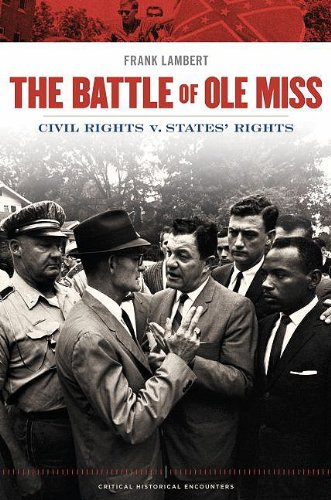 Frank Lambert has authored a gem of a book in THE BATTLE OF OLE MISS: Civil Rights v. States Rights, published this year by the Oxford University Press. If you have any interest in reading about that that troublesome time, you should make this book a starting point.
Lambert, who is a professor of history at Purdue University, not only was a student at Ole Miss in 1962 and an eye-witness to many of the events, he was also a member of the undefeated football team at the time, and his recollection of the chilling address delivered by Governor Ross Barnett at the half-time of the Ole Miss-Kentucky football game on the eve of the battle is a must-read.
This is a small book, only 193 pages including footnotes and index, but it is meticulously researched. As a native Mississippian and eyewitness, Lambert is able not only to relate the historical events, he also is able to describe the context in which they happened.
The book lays out the social milieu that led to the ultimate confrontation. There is a chapter on Growing Up Black in Mississippi, as well as Growing up White in Mississippi. Lambert describes how the black veterans of World War II and the Korean conflict had experienced cultures where they were not repressed because of their race, and they made up their minds that they would challenge American apartheid when they returned home. Meredith was one of those veterans, and he set his sights on attending no less than the state’s flagship university because, as he saw it, a degree from Ole Miss was the key to achievement in the larger society. He also realized that if he could breach the ramparts at Ole Miss, so much more would come tumbling down.
The barriers put up against Meredith because of his race were formidable. He was aware of the case of Clyde Kennard, another black veteran who had tried to enroll at what is now the University of Southern Mississippi, but was framed with trumped-up charges of stolen fertilizer and sentenced to Parchman, eventually dying at age 36. And surely he knew of Clennon King, another black who had managed to enroll at Ole Miss only to be committed to a mental institution for his trouble. Even among civil rights leadrs, Meredith met resistance. He was discouraged by Medgar and Charles Evers, who were designing their own strategy to desegregate Ole Miss, and felt that Meridith did not have the mettle to pull it off. Against all of these obstacles, and in defiance of a society intent on destroying him, Meredith pushed and strove until at last he triumphed.
But his triumph was not without cost. Armed racists from throughout Mississippi, Alabama and other parts of the South streamed to Oxford in response Barnett’s rallying cry for resistance. The governor’s public rabble-rousing was cynically at odds with his private negotiations with President John Kennedy and US Attorney General Bobby Kennedy, with whom he sought to negotiate a face-saving way out. The ensuing battle claimed two lives, injured 160 national guardsmen and US marshals, resulted in great property damage, sullied the reputation of the university, tarred the State of Mississippi in the eyes of the world, led to armed occupation of Lafayette County by more than 10,000 federal troops, and forever doomed segregation. Ironically, the cataclysmic confrontation that Barnett and his ilk intended to be the decisive battle that would turn back the tide of civil rights was instead the catalyst by which Ole Miss became Mississippi’s first integrated state university. It was in essence the final battle of the Civil War, the coup de grace to much of what had motivated that conflict in the first place and had never been finally resolved.
As for Meredith, the personal cost to him was enormous. He was subjected to taunts and derision, as well as daily threats of violence and even death. He found himself isolated on campus, and did not even have a roommate until the year he graduated, when the second black student, Cleveland Donald, was admitted. Meredith described himself in 1963 as “The most segregated Negro in the world.”
The admission of James Meredith to Ole Miss not only opened the doors of Mississippi’s universities to blacks, it also helped begin the process in which Mississippians of both races had to confront and come to terms with each other as the barriers fell one by one. As former mayor Richard Howorth of Oxford recently told a reporter: ” … other Americans have the luxury of a sense of security that Mississippi is so much worse than their community. That gives them a sense of adequacy about their racial views and deprives them of the opportunity we’ve had to confront these issues and genuinely understand our history.”
Meredith’s legacy is perhaps best summed up in the fact that, forty years after his struggle, his own son graduated from the University of Mississippi as the Outstanding Doctoral Student in the School of Business, an event that Meredith said, ” … vindicates my entire life.” His son’s achievement is the culmination of Meredith’s singular sacrifice. What Meredith accomplished for his son has accrued to the benefit of blacks and whites alike in Mississippi, and has helped our state begin to unshackle itself from its slavery to racism.
OLD TIMES HERE ARE NOT FORGOTTEN
August 13, 2010 § 2 Comments
“The past is never dead. It’s not even past.” — William Faulkner in REQUIEM FOR A NUN
“The past is a foreign country; they do things differently there.” — L.P. Hartley in THE GO-BETWEEN
No region of our nation has revered, understood, embraced, been bedevilled by and romanticized its past more than has the South. Much of the South’s history since the Civil War has been the history of evolving race relations in a culture determined to preserve inviolate its notion of its past. Beginning in the 1950’s, however, the irresistable force of change in the form of the civil rights movement collided head-on with the immovable object in the form of “massive resistance,” and the resulting explosion that destroyed the foundation of segregation began the transformation of southern culture that continues to this day.
 Bill May called my attention to DIXIE, by Curtis Wilkie. I had seen this book in various book stores (as I had seen its author, Mr. Wilkie, around Oxford), but had passed it over. On Bill’s recommendation, I got a copy and read it.
On its face, DIXIE is a history of the South’s agonizing journey through the watershed era of the civil rights movement and into the present, a chronicle of the events that shook and shattered our region and sent shock waves across the nation. The events and figures parade across his pages in a comprehensive panorama: The assassination of Martin Luther King, Jr., James Meredith and the riot at Ole Miss, Ross Barnett, Jimmy Carter, Eudora Welty, Brown v. Board of Education, Freedom Summer, Aaron Henry, the Ku Klux Klan, the struggle for control of the Democratic Party in Mississippi, White Citizens Councils, sit-ins, John Bell Williams, William Winter, Willie Morris, Charles Evers, Byron de la Beckwith and Sam Bowers, Trent Lott and Thad Cochran, William Waller, the riots at the Democratic Convention in Chicago in 1968, and more. As a history of the time and how the South tore itself out of the crippling grip of the past, the book is a success.
The great charm and charisma of this book, however, is in the way that Wilkie weaves his own, personal history through the larger events, revealing for the reader how it was to be a southerner in those days, both as an average bystander and as an active participant.
The author grew up in Mississippi, hopscotching around the state until his mother lighted in the town of Summit. His recollection of life in the late 40’s and 50’s in small-town Mississippi echoes the experiences of many of us who were children in those years, and will enlighten those who came along much later.
Wilkie was a freshman at Ole Miss when James Meredith enrolled there in 1962, sparking the riot that ironically spurred passage of the 1964 Civil Rights Act. On graduation Wilkie took a job with the Clarksdale newspaper and developed many contacts in Mississippi politics that eventually led him to be a delegate at the 1968 Democratic Convention in Chicago, where he was an eyewitness to the calamitous events there.
Through a succession of jobs, Wilkie wound up a national and middle-eastern corresondent for the BOSTON GLOBE, and even a White House Correspondent during the Carter years. His observations and first-hand accounts of his personal dealings with many of the leading figures of history through the 60’s and 70’s are fascinating.
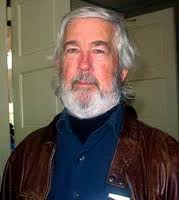
The author
When he had left the South, Wilkie believed he was leaving behind a tortured land where change could never take place, and where he could never feel at home with his anti-racism views and belief in racial reconciliation. He saw himself as a romantic exile, a quasi-tragic figure who could never go home again, but over time he found the northeast lacking, and he found the South tugging at him whenever he returned on assignment.
When his mother became ill, Wilkie persuaded his editor to allow him to return south, and he moved to New Orleans, from where he covered the de la Beckwith and Bowers Klan murder trials and renewed his acquaintanceship with many Mississippi political and cultural figures, including Willie Morris, Eudora Welty and William Winter. He began to discover that the south had undergone a sea change in the years that he was away, and that the murderous, hard edge of racism and bigotry had been banished to the shadowy edges, replaced largely by people of good will trying their best to find a way to live together harmoniously. He found a people no longer dominated by the ghosts of the ante-bellum South.
In the final chapter of the book, Wilkie is called home for the funeral of Willie Morris, and the realization arises that he is where he needs to be — at home in the South. His eloquent end-note answered a question Morris had posed to him some years before: “Curtis, can you tell us why you came home?” Wilkie’s response:
Just as Vernon Dahmer, Jr. had said, I, too believe I came home to be with my people. We are a different people, with our odd customs and manner of speaking and our stubborn, stubborn pride. Perhaps we are no kinder than others, but it seems to me we are … We appreciate our history and recognize our flaws much better than our critics. And like our great river, which overcomes impediments by creating fresh channels, we have been able in the span of Willie’s lifetime and my own to adjust our course. Some think us benighted and accursed, but I like to believe the South is blessed with basic goodness. Even though I was angry with the South and gone for years, I never forsook my heritage. Eventually, I discovered that I had always loved the place. Yes, Willie, I came home to be with my people.
Those of you who lived through the troubled years recounted here will find that Wilkie’s accounts bring back memories that are sometimes painful and sometimes sweet. For readers who are too young to recall that era, this book is an excellent history as well as an eye-opening account of what it was like to grow up in that South.
Wilkie’s new book, THE FALL OF THE HOUSE OF ZEUS, about the Scruggs judicial bribery scandal, is due out in October.
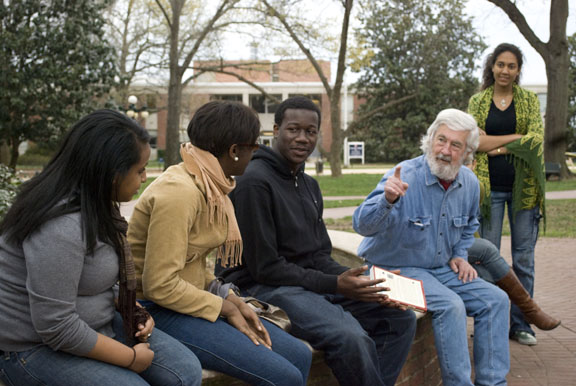
Wilkie and visiting Harvard students in the Circle at Ole Miss at the site of the 1962 riot
 The Better Chancery Practice Blog