NO VOTE TODAY
February 17, 2011 § Leave a comment
The judicial pay raise bill was called for a third time today to keep it alive until the ultimate deadline around mid-March. This is a tactic commonly used when the sense is that there are not enough votes to pass. It gives more time to marshal votes.
My sources suggest that there was plenty of misinformation floated today. There were astronomical figures circulated about how much the bill will cost the counties due to county court, although only 5 counties would be affected. DHS weighed in against it due to the increase in filing fees, despite the fact that the chancellors can and do assess costs against the defaulting child support payors.
I hope this turns out all right, but I’m not optimistic. I look at judges like Mason and Bailey who have served the state faithfully and have done a phenomenal job with only a rare reward of a pay increase, and I wonder what the message is that our legislators are trying to send. The judge is nearly always the lowest paid lawyer in the room, yet they manage to uphold the dignity and authority of the State of Mississippi day in and day out.
I sincerely believe that if the members of the bar will get behind this and push their legislators, it will pass.
One last request: Please talk to your legislator. We need the best government we can afford, not the cheapest we can get by with. I won’t bother you with this any more.
THE PAY RAISE BILL TODAY
February 17, 2011 § Leave a comment
The judicial pay raise bill comes up for a vote before the full House today at 2:00 p.m. If you support the bill, and I hope you do, it’s critical that you contact your legislators and tell them how important it is to you for them to vote for it.
As lawyers, you can appreciate the importance of an independent judiciary. Adequate pay is an important component of independence. Trial judges in Mississippi have not had a pay raise in seven years, and our pay is the lowest in the United States. In that seven year period, other state employees have had significant pay increases, some of which have been quite large. The judges have been told repeatedly to wait. When we had the money to fund judicial raises, the “time is not right” for one reason or another. Now that we do not have the money and we are seeking to fund the raise with an increase in our court fees (which will still be the lowest in the southeast after the increase), there are still objections:
- Some argue that the bill does not fund itself. Justice Waller insists that the numbers do work. The prosecutors hitched themselves to our bill, and those numbers are being crunched, but the hope is that it will work. If the bill will not pay for itself, Governor Barbour will not sign it.
- I am hearing that the board of supervisors association is working against the bill on the basis that it is an unfunded mandate for the five counties whose county court judges are tied to the trial judges salaries. This is an interesting argument since the supervisors made no such objection to the dramatic increases in justice court judge and county prosecutor pay increases. I understand from one source that there were brochures being circulated within an hour or so of the bill coming out of Judicial “A” on this issue.
- DHS has pointed out that the bill will impose additional court costs on its child support filings.
- Members of the conservative caucus are against any increase of anything. If your legislators were among those who voted against any funding of the judiciary at all, it would help if you would give them a call and explain why the judicial branch not only needs to be funded, but why the trial judges need pay increases.
I’ve spelled out these objections so that you can be prepared to meet them when you talk with legislators. It would also help to arm yourself with the facts from Justice Waller’s message below.
The entire judicial branch budget is not even one percent of the entire state budget. We say that we have three equal branches of government that balance each other, but our budget does not bear that out.
This issue is important to your trial judges. If you feel the same as a member of the bar, I ask you please to exercise your influence with your legislators. A simple call or email will do the job. Thanks.
HR VOTE TODAY OR TOMORROW
February 16, 2011 § 1 Comment
Judiciary A Committee of the House of Representatives will take up the judicial pay raise bill today, and it is expected that the bill will be voted out. The full house will get the bill either today or tomorrow. A 3/5 vote is required, since it increases fees.
Please contact your representative and urge support of this measure. Justice Waller’s presentation on the merits is below.
MR. SNOW AND HIS RAILROAD VERDICT
February 11, 2011 § 4 Comments
Ed Snow of Meridian was one of the most formidable defense trial lawyers in Mississippi in the 1950’s and 60’s. He represented the railroad, and it was rare for a jury to return a verdict against his clients.
The railroad had been the lifeline of Meridian since the 1870’s. The rail lines that nurtured the city grew up and proliferated on the south edge of the main business district until by the 1950’s there were more than twenty lines running east and west that had to be crossed headed south from downtown.
Yet in the early 1950’s there was no overpass over the major rail lines running right through the heart of Meridian’s downtown. At the crossing of the city’s busy major artery, the north-south Twenty-Second Avenue, there was a guard shack at both the north and south ends of the crossing. In each shack sat a crossing guard awaiting a telegraph signal that a train was coming. When he got the signal, the crossing guard would stand in the street waving a warning placard in the daylight and a lantern at night.
One dark night, a car cruised southward down Twenty-Second Avenue approaching the crossing. The occupants of the car, I am sure, were noticing the throngs at Weidmann’s and the couples strolling along the sidewalks, and were not giving much thought to the railroad tracks ahead. According to the driver and his wife, who was the passenger, there was no signal at the crossing, and they sped ahead only to slam with considerable force into the side of a freight train that was proceeding east. Both occupants were seriously injured, and they filed suit against the railroad.
Mr. Snow duly prepared for the trial. His case depended on the testimony of the crossing guard, who was a simple, poorly educated man, but who was honest. Mr. Snow went over the man’s story repeatedly, and the man consistently insisted that he did wave his lantern frantically, but the car would not slow or stop. He said that it ran straight past him, into the crossing, almost running him over, and collided fatefully with the train. Mr. Snow was satisfied that the man would answer every question truthfully, and that he would not equivocate.
At trial the plaintiff’s attorney called the crossing guard as a witness. The attorney was a skillful, experienced advocate who tried every wily ploy he knew to catch the crossing guard in an inconsistency or to get him to change his story. He grilled the guard thoroughly, attacking his memory and the plausibility of his testimony. He made the guard demonstrate for the jury how he had held the lantern, the position at which he stood in relation to oncoming traffic, and the angle at which he had waved the lantern to and fro over his head. He quizzed the witness to the point of exhaustion about the exact time when the signal came for the approaching train, how long it took him to respond to the signal and get into the street, and the time that elapsed before the train entered the crossing. The plaintiffs’ lawyer’s cross examination was brutal, but to no avail. The unsophisticated crossing guard held his ground, unwavering in his insistence that he had waved the lantern and had to jump aside to keep from being run over as the plaintiffs’ car zipped by.
The jury returned a verdict for the railroad, and Mr. Snow and his crossing guard left the courthouse. As they walked down the steps leaving the building, Mr. Snow congratulated the witness.
Mr. Snow: You did a good job. I appreciate the way you stood up to that lawyer.
Guard: Thank you, Mr. Snow.
Mr. Snow: It’s not easy for a lay person to avoid all the traps lawyers use in their questions.
Guard: Oh, Mr. Snow, I was afraid he was going to ask me one more question.
Mr. Snow: One more question? What question?
Guard: “Was the lantern lit?”
Post-script One:
Mr. Snow continued to practice law until shortly before his death around 1980. He lived on busy 23rd Avenue in the house that is now the dental office of David McGrew. Every weekday morning Mr. Snow would back out of the driveway in his enormous black Chrysler Imperial. If you saw him at the wheel, you would see a smallish, balding white-haired head in the driver’s seat, eye-level at about the top of the steering wheel. He never looked to see whether any cars were coming; he simply backed straight into the avenue heedless of the traffic, and oncoming cars had to yield or else. He would then proceed south toward his office on the second floor of the First National Bank (now Trustmark) building, never exceeding more than ten miles an hour. Stop lights and stop signs were irrelevant to him, as was the middle line of the street. He glided along straddling the middle of the street, oblivious to other cars, through red lights and stop signs, letting the traffic snarl and back up in every direction as he made his way downtownward at less than a snail’s pace, a long train of cars following him like a doleful funeral procession.
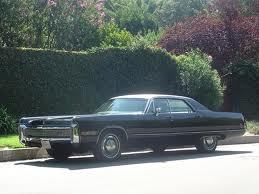
1973 Chrysler Imperial
Post Script Two:
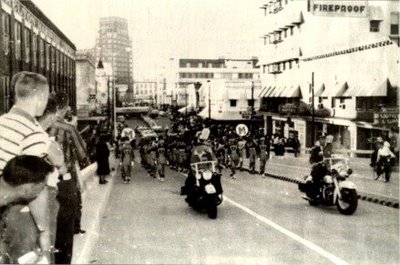
Around 1956, Mayor W. S. Smylie succeeded in completing the defining project of his administration: the Twenty-Second Avenue overpass. Its dedication was marked with a parade through downtown. Here’s a photograph of the occasion taken south of the overpass looking north with the Threefoot Building in the background.
I WISH WE COULD ESCAPE TO PARIS
February 4, 2011 § Leave a comment
But since we can’t, you can go there yourself with this slideshow from my last trip in 2005. You may have to enable popups to view it on YouTube.
There are many postcard sights you won’t see in this collection, but you will find some favorites as well as some out-of the way places. See if you recognize Notre Dame, Place St. Michel, Tuilleries, St. Germain, the Marais, Orsay, the Louvre, Père LaChaise, Montmartre and Sacré Coeur, Hotel de Ville, Moulin de la Galette, Place des Abbesses, Les Invalides and the tomb of Napoleon, the Conciergerie, St. Germain l’Auxerrois, Musée Cluny, Rue Rivoli, Jardin du Luxembourg, Place République, Brasserie Jenny, Pompidou, La Coupole, Sainte Chapelle, Versailles, the quais of the Seine, Galléries Lafayette, many shop windows, and street scenes, among others. it’s a stroll through the city and Versailles from early morning until early evening on a day that turned snowy and chilly, not too different from the weather today.
Better yet, take your own trip and make your own slide show. You owe it to yourself.
The music is Herbie Hancock’s version of Gershwin’s Lullaby.
I hope you enjoy.
LSAT: CATCH YA ‘ROUND THE GRILL*?
January 20, 2011 § Leave a comment
The WSJ Law blog reports that the ABA is seriously considering doing away with the requirement that candidates for admission to law school pass the LSAT. The thinking is that law schools should decide their own entrance requirements, and that the ABA, in its accrediting role, should concern itself instead with whether or not graduates are qualified to practice law. Will the LSAT go the way of the dinosaur? Stay tuned.
In the paleolithic era when I decided to attend law school, there was no debate about the LSAT. One took it to complete the admission requirements, or one did not attend law school.
And so I showed up at Lamar Hall (later renamed Farley), which was then the Ole Miss law school building and now houses the School of Journalism, to undergo my LSAT on Saturday, October 17, 1970. The exact date is easy to pinpoint, as you will see.
We were collected in the large lecture room on the west end of the building on the main floor, around 40 of us. Among the crowd I recognized fellow students with whom I had shared undergraduate classes, and I picked my way to the back of the room where eventually four or five former Ole Miss football players were esconced nearby. I remember the room being quiet and subdued.
Notwithstanding the quiet atmosphere inside the lecture hall, things were popping outside. It was a campus football weekend, and no doubt most of us would have preferred being outside with the fans. The classroom windows were opened slightly to admit the crisp, fresh fall air, and we could hear some of the hubbub from outdoors. In those days tailgating at Ole Miss was markedly different from its current form. Vehicles back then were driven directly into the Grove for tailgating. There were no such things as SUV’s or even minivans. People pulled their cars, pickups and stationwagons (i.e., primitive SUV’s) into the Grove, opened the trunk or tailgate, and laid out their spread. On this Saturday the happy football fans, expectant of glorious victory over our accustomed whipping-boy to the south, were gathering, grilling, visiting, imbibing and back-slapping directly across the street from our lecture hall.
Professor Bill Champion, our proctor, entered the room and distributed the LSAT tests. He wrote the starting time on the blackboard and stayed for awhile before slipping out of the room. In the meantime we set at laboring over the exam.
Everything verbal on the LSAT was a snap for me. The reading comprehension was like English 101. The logic questions took a little thought, but I was doing fine. I began to get that exhiliration that comes from being on the upside of the challenge.
Outside, we could hear the cheering crowds as the afternoon crept past us. It was a heady day for football on campus. The Rebels had finished the previous season ranked 8th in the nation, and now we were ranked in the top 5, having won our first four in a row, crushing Memphis State, Alabama and Georgia, and managing to get by Kentucky. Archie Manning led the powerful Rebel squad. Our opponents this fine Saturday were the Southerners of Southern Miss, a team we had thrashed 69-7 the year before and to whom we had never lost. Confidence wafted through the air like barbecue smoke. The sports page of the Clarion-Ledger on Friday before the game carried a photo of Archie seated in front of his locker putting on his cleats, with the headline: “Does He Really Need to Dress Out for This One?” If the LSAT caused one to miss any football game this promising season, this minor skirmish with the hapless Hattiesburgers would be a good candidate.
And as if on cue, from beyond the Grove we could hear the roar of the crowd in the stadium as the game kicked off.
Meanwhile, I was zipping through the verbal and logic parts of the test and it was seeming like high school stuff.
Now, these were the days before computers, cable tv and cordless phones. There were no smartphones or FaceBook. There was no ESPN. No text messages. No wireless internet because there was no internet. None of the LSAT participants in that room would have expected a play-by-play report for the day’s events, but we had our updates regardless.
Professor Champion re-entered the room and wrote on the blackboard: “1st Quarter Score …” and it looked good for the home team. We were ahead by a touchdown, and with Archie at the wheel, one could assume that victory was assured.
The LSAT, however, had taken a nasty turn. I had departed the relative comfort of verbal and logic questions and found myself in the quagmire of some general knowledge questions that were part of the test back in those days. There were a few questions that posed geometrical problems, some algebra, and even chemistry. All of that might as well have been Greek to me, but I strove valiantly against it. Guesswork became my primary stratagem. The snap had become somewhat of a struggle.
I was not the only one struggling a little with the test. I noticed some of those football players in my vicinity showing some signs of distress. The test was too much for them. This one ran his hand over his forehead and then through his hair in exasperation. That one sighed mightily, put down his number two pencil and cracked his knuckles. Another slumped at his desk and rubbed his neck. The test was taking its toll.
But in the background we could hear roars from the stadium.
Champion entered again a while later and there was a grumble of consternation as he posted the half-time score with USM ahead. Still, no reason at this point for concern with Archie in command. Besides, we had this blankety-blank exam to complete.
As we kept at the test over time the roars from the stadium became noticeably fewer. Champion’s next update showed Southern with a decisive lead, and I noticed that the football boys were decidedly uncomfortable. Heck, I was decidedly uncomfortale.
When Champion chalked up the final score there was a unanimous gasp: USM 30 and Ole Miss 14.
Even with all that hoorah, most of us managed to limp to the end of the LSAT and turn in our score sheets. We were relieved to have come through the LSAT ordeal, but the relief did not outweigh the shock of losing to Southern.
We emerged from our LSAT cloister to learn that Southern had outrushed Ole Miss 205 yards to only 85, behind the electrifying Willie Heidelberg. Phenomenal USM punter Ray Guy had kept Archie Manning bottled up all day with booming punts that averaged 49 yards a pop. Archie had completed two TD passes in the first quarter to take a 14-7 lead, but Southern was too much in the next three quarters, including a 60-yard punt return for a TD that was the back-breaker.
It was the first time ever that Southern beat Ole Miss in football. Southern Miss coach P.W. “Bear” Underwood understated after the game: “We whipped their butt.” Indeed. The next week legendary Ole Miss coach John Vaught suffered the heart attack that ended his career except for an interim return later.
Despite all the distractions, I apparently did well enough on the LSAT to get admitted to law school. Thanks to USM, what would have been another unremarkable day in the grind of my academic career was transmuted into an unforgettable, if not happy, one.
* “Catch Ya ‘Round the Grill” was a ubiquitous saying among Ole Miss students in the 60’s and early 70’s until the new student union was built. The Grill was the students’ nickname for the then student union, which is now Weir Hall. Loosely translated the saying meant: “See ya later.” Some cynics morphed it into: “I hope I don’t see you again anytime soon.” Whichever, my opinion as far as the LSAT is concerned: “Catch ya ’round the grill.”
FREEDOM FOR ALL … OF US
January 16, 2011 § Leave a comment
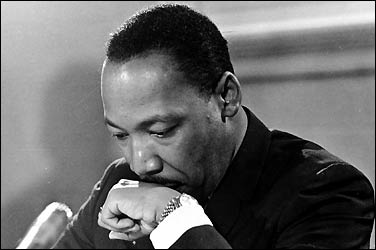 Martin Luther King, Jr.
January 15, 1929 – April 4, 1968
He fought to set us free from the bondage of racism.
Read his Letter from the Birmingham City Jail, annotated, here.
“COURT HOUSE CLOSED”
January 10, 2011 § Leave a comment
That’s the sign on the door as I walked up this morning. Winter weather is to blame, although I zipped right into downtown with nary an icy patch to deter me.
The only advance notice we had of the closure was that “Only essential personnel should report to work.” Naturally, my ego would not let me admit to the possibility of non-essentiality. If only essential personnel did report, that’s scary because there are only three of us in the building. The entirety of Lauderdale County is a heavy load of responsibility for three people.
Oh, well, I guess I can find something to do here as well as I could at home.
For all the rest of you … enjoy your icy day.
STUNG TO DEATH BY SINGLE BEES
January 7, 2011 § Leave a comment
He got into a restless habit of strolling about when the cause was on, or expected, talking to the little shopkeepers, and telling ’em to keep out of Chancery, whatever they did. ‘For,’ says he, ‘it’s being ground to bits in a slow mill; it’s being roasted at a slow fire; it’s being stung to death by single bees; it’s being drowned by drops; it’s going mad by grains.’
— from Bleak House, by Charles Dickens
 The Better Chancery Practice Blog