
RIP CHAMP GIPSON
October 22, 2011 § Leave a comment
RIP Meridian attorney Champ Gipson. September 23, 1921 – October 20, 2011.
ALL COMMENTS ARE NOT CREATED EQUAL
October 5, 2011 § Leave a comment
Comments are most welcome on this blog. I encourage you to question, react or add your opinion. The law is an art, not a science, so ideas and interpretations can vary.
Having said that, though, I have to say that all comments are not on a level playing field. There are some subspecies of comments that are, well, different.
For one, there are the so-called “spam comments,” which apparently are generated either by machines or by humans with the linguistic skills and intelligence no greater than that of machines. Here are three recent examples:
Im a blog crazed person and i appreciate to read cool blog like yours.
Wow! This can be 1 particular of probably the most valuable blogs Weve ever arrive across on this topic. Basically Good. I am also a specialist in this subject so I can understand your effort.
Seriously been searching all around you with information regarding that. Truly thank you a large amount.
And how about this whopper:
Certainly, your post is unquestionably by far the most fantastic during this beneficial issue. Certainly with the results and can thirstily watch out for your own foreseeable future improvements. Announcing cheers won’t just do, for any increadible clearness in the document. I most certainly will easily snap up a person’s rss to remain seated privy for any messages. Great do the job and a lot accomplishment in your business dealings. Could god thanks a lot, [Yes, it ends with a comma, but in all fairness the punctuation is only a small part of the problem.]
The foregoing specimens were trapped in my spam filter, which claims to have snagged 4,608 of them over the life of my blog, which is now 16 months old. That’s an average of 288 spam comments a month, or 9.6 per day.
The above are exemplars of the English-language variety spam. Spam comments also arrive in Russian (in Cyrillic, no less), French, Italian, Bulgarian and Romanian (I know the latter two only from the suffix on the name of the web site, since those languages are beyond my ken). These comments may actually have been intelligent commentary on something I posted, for all I know. For lack of knowing, I send them the way of spam.
Spam comments are intended by the sender to plant a link on your blog that will either generate traffic for the sender or allow the sender to inundate your blog with ads and other unpleasantries. I delete all spam comments and send them to spam hell, wherever that is.
Another genre of comments is the disgruntled litigant. I have had several proposed comments from litigants critical of their judge (in one instance me as judge), the legal system, their attorney, and the appellate courts. Most come from outside Mississippi. A major reason I moderate comments is to screen those out.
There are also commentors who ask for legal advice. Sorry, judicial ethics preclude me from doing that. Besides, that’s not the purpose of this blog.
Then there are the commentors who ask for a slot on my blogroll. One proposed commentor asked me to add a link to his blog, but I politely declined because it was a blog promoting dissolution of the legal system, abolition of the legal profession, and encouraging self-representation until the courts can be done away with. Anybody who has read this blog for any length of time will recognize that those topics are somewhat inconsistent with what I am doing here. He was very polite, though; I’ll grant him that.
So, all of you “blog crazed persons” out there, keep your comments coming. For all your comments, I “Truly thank you a large amount.”

NAME GAME
August 19, 2011 § Leave a comment
“What’s in a name? That which we call a rose
By any other name would smell as sweet.”
— Romeo and Juliet (II, ii, 1-2)
Mississippi chancery courts have jurisdiction pursuant to MCA § 93-17-1 ” … upon the petition of any person to alter the name of such person … ”
As you can probably imagine, most name changes are prosaic affairs involving restoration of a maiden name, or conforming a child’s surname to that of a parental figure, or even correcting spelling.
Some are not so mundane, though. I was presented with a name change that also sought to change the petitioner’s ethnicity. I did change the name, but drew the line at the ethnicity-change until the petitioner could present me with authority allowing me to do so. I’m still waiting.
A post in Futility Closet informs that in 1944, a San Francisco judge refused to let Tharnmidsbe L. Praghustspondgifcem change his name.
He’d asked to change it to Miswaldpornghuestficset Balstemdrigneshofwintpluasjof Wrandvaistplondqeskycrufemgeish.
The man, whose given name was Edward L. Hayes, had requested the first change in order “to do better in my business and economic affairs.” Evidently he felt he hadn’t gone far enough.
But the judge did.
I haven’t been presented with anything that outré — yet — but every day is a new day with new and unexpected challenges and exhilarations. Who knows what Monday will bring.
Have an interesting weekend.
“PAY NO ATTENTION TO THE MAN BEHIND THE CURTAIN”
August 5, 2011 § Leave a comment
“Decision-making is a Gestalt phenomenon, a three-dimensional agitated blob of factual, impressionistic, inferential, prejudicial miscellany from which a decision spins forth, trailing behind it sufficient selective supportive material to assuage the conscience and justify its genesis as a product of the rational mind.”
Thanks to attorney Jak Smith
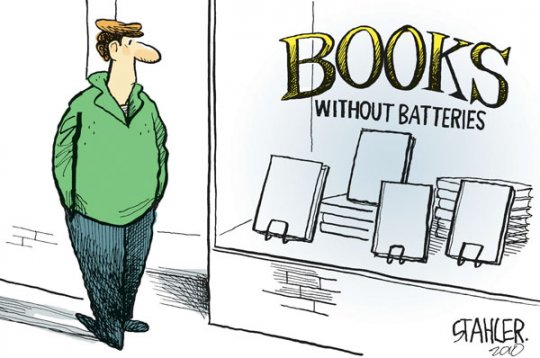
BOOKS WITHOUT BATTERIES
July 29, 2011 § 5 Comments
To Kindle or not to Kindle. That is the question.
On the one hand, books have played a significant role in my life. I love them. I love their heft, their solid feel, the way the pages riffle as you fan them. I love the aroma of a good book, the enticing allure of the dust jacket, the texture of the pages, the quality of the binding. I love to see the words in print, to savor the typography, to marvel at never-before-seen illustrations. I love to find a nugget of the author’s personal story on the inside sleeve. I could never opt for an electronic book reader if it meant the extinction of books with real paper pages and bindings.
 On the other hand, I have hundreds of books, and an electronic book would help reduce the numbers I have to deal with. Too, with an e-reader, you can literally carry an entire library onto a plane or across town. It’s like having a Bookmobile in your hand.
But what is the effect of e-readers on the availability of book stores? I would be lost without access to a good book seller who is local, knows what I want, and offers a stock of tomes that appeal to my sensibilities. Book shops are one of the great pleasures in my life. I remember spending youthful hours in the Sans Souci Bookstore in Lafayette, LA., a modest shop with books filling every space in abundance, something a small-town boy could barely imagine. Over the years I have spent countless hours browsing in book shops. I have gone out of my way to find book sellers in Paris, London, Munich, Rome, New York, Boston, San Francisco and God knows how many other locales. Each local shop offers a different stock in trade to please the palate of its local clientelle. What a pleasure to see the parcels of books ordered awaiting pickup, and to hear the familiarity between seller and reader inquiring about a title or just exchanging pleasantries.
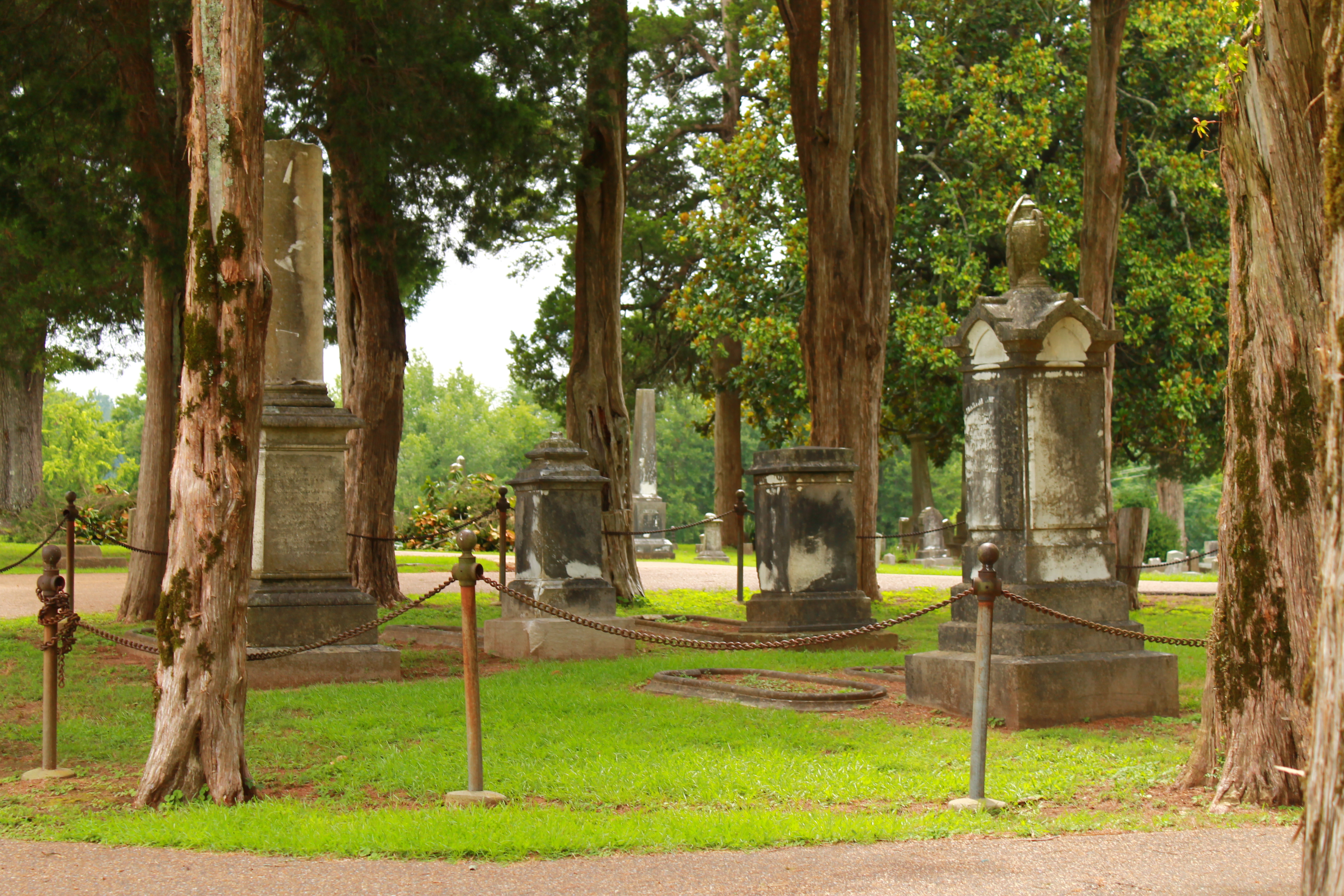
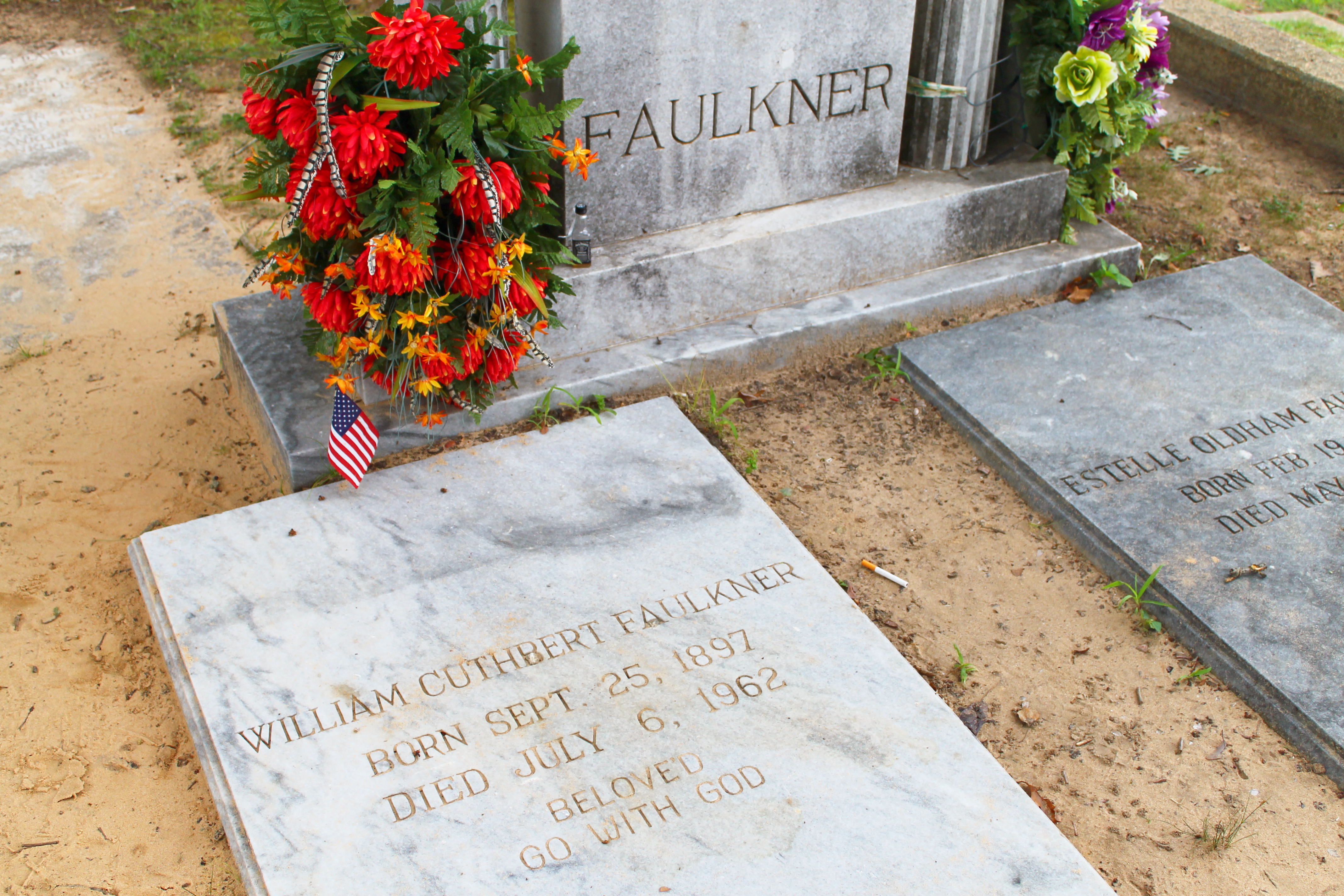
Over the years the book-selling trade has been taken over increasingly by chains and e-tailers like Barnes & Noble, Amazon, Books-A-Million and (now almost extinct) Borders. They were preceded by the Walden Books and Brentano’s chains, who now are past. Chains are giant corporations that make deals with publishers to hype certain books, for which the chains make millions, pushing many deserving authors to the back shelves or out of the store entirely. Of course, any bookseller in a way dictates the readers’ choices by what is in stock, but the big chains go for the big bucks. Regional writers get lost in the shuffle. I wonder whether you would find Eudora Welty, Larry Brown, Ernest Hemingway or Will Faulkner on the bookshelves of the big chains today if those magnificent authors were unknown and just starting out.
Right here in Mississippi we have three phenomenal independent booksellers: Square Books in Oxford; Lemuria in Jackson; and Turnrow in Greenwood. These three stores are as good as any independent shops you will find anywhere. They offer books that the local owners know will interest their readers. Your book choices are not dictated out of corporate headquarters in a skyscraper in a big city up north. The shelves are not stocked by a corporate drone with eye fixed solely on the bottom line. The owners stock titles they know will enrich their patrons and the community as a whole. The local bookseller looks you in the eye and says, “Here is an author that will interest you” or “Have you read this?” They listen to what interests you and respond. The local readers and local sellers become an organic unit.
So that is my dilemma. I am not adverse to supplementing my love of books with an e-reader if … (1) it does not make books any less available … and … (2) it does not adversely impact the availability of independent booksellers.
In the midst of my dithering over this dilemma, I received the Square Books Dear Reader Newsletter that included the following:
KINDLE = Amazon only. ALL OTHER DEVICES = Square Books. Want Choice? Don’t get left to their devices. Google e-books are available at coompetitive prices from www.squarebooks.com and are compatible with any device (smartphones, laptops, tablets and e-reading devices including the Nook and the Sony Reader), except the Kindle. Those who surrender to Amazon’s monopoly reduce local economics, diminish their consumer power, and imperil freedom of choice!
Voila. An answer to my quandary. I can buy a Kindle and work against my interests, or I can acquire another e-reader that uses Google e-books and protect my interests.
I am not particularly fond of the idea of battery-powered books, but I recognize the advantages. I just might pick up one of those new-fangled gadgets after all, but there’s no way that it will take the place of my need for books without batteries.



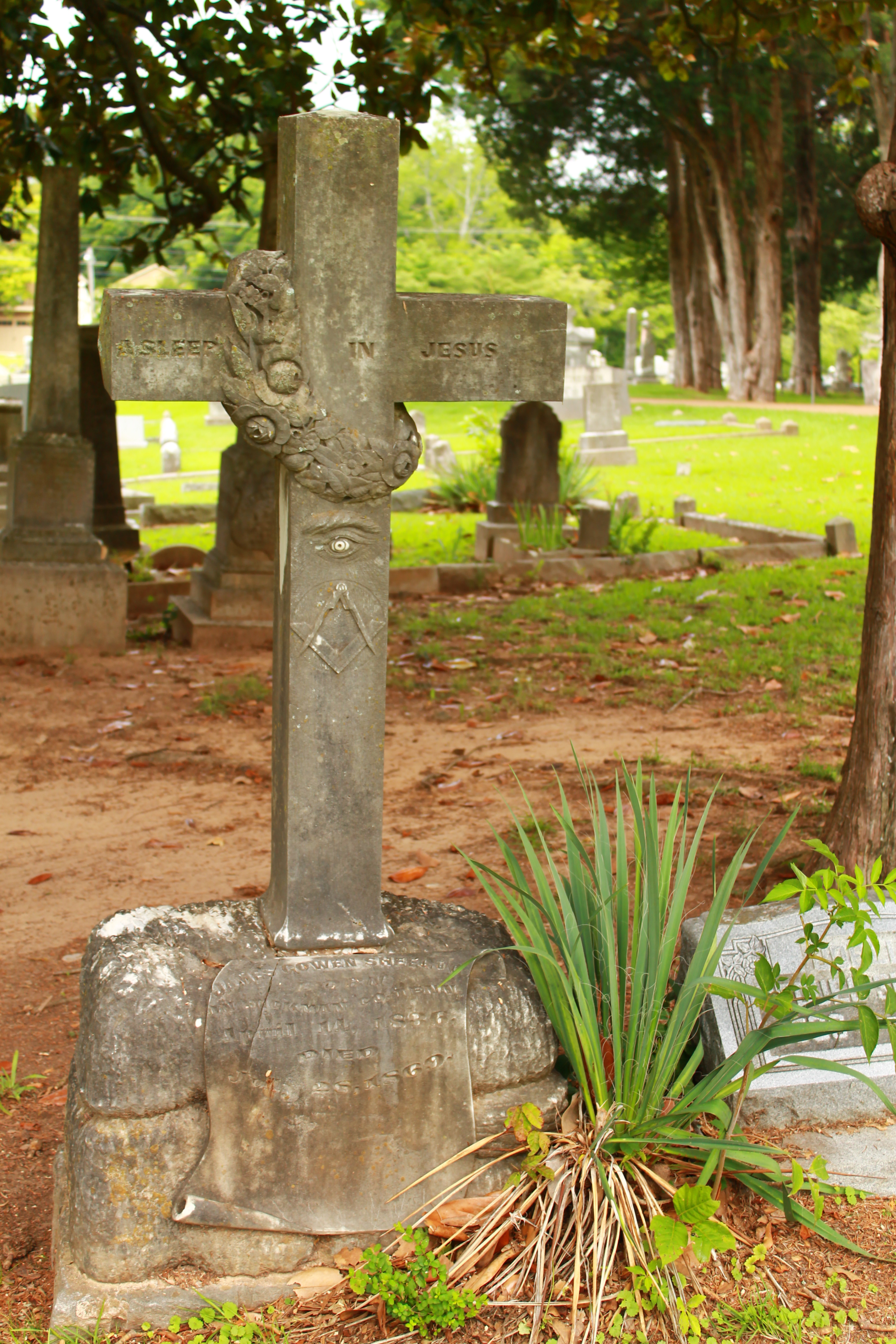

WHY NOT MISSISSIPPI?
July 14, 2011 § 7 Comments
As I write this, around 500 Mississippi lawyers and judges, many with their families, are in Destin, Florida, for this year’s bar association meeting. That is around 1,000 Mississippians who are spending Mississippi dollars in Florida hotels, on Florida golf courses, in Florida restaurants and bars, in Florida shops, on Florida souvenirs, on Florida fishing charters and equipment, and at Florida gas stations and convenience stores.
Why is Mississippi not worthy of this largesse?
Admittedly, when the Mississippi Bar made its move away from Mississippi back in the 80’s, the coast was a tired place in serious need of updating, but that was before the casinos. Now, even after Katrina, the coast is well able to accommodate the brigade of lawyers and their retinue. There are hotels, casinos, restaurants and shops, there are fishing charters, excursions and every conceivable amenity.
Money spent by the bar members here in Mississippi would pay Mississippi jobs, put money in the pockets of Mississippi vendors, and directly benefit the coast … and any other area with a fitting venue, like, for instance, Desoto County, Jackson, Vicksburg or Natchez. Even if the bar were to meet in Mississippi every other year, that would be a positive.
And it would be a plus in the eyes of Mississippians for a profession that continues to be cynically judged from the Scruggs fallout.
Why not Mississippi?
WE HOLD THESE TRUTHS …
July 3, 2011 § Leave a comment
Please allow me to tell you about an experience I had that comes to mind every July 4, an experience that made literally true for me the phrase, “We hold these truths …”
Several years ago my daughter Aimée was living in Boston and working at the Massachusetts Historical Society. On one of our visits, she invited Lisa and me to visit her place of work, around the corner from hallowed Fenway Park, which has its own impressive history. Our son Mark, who was in school in Boston, joined us.
In the Society building, we saw the expected reading rooms where scholars pored over obscure texts. There were artifacts and oil portraits, many invaluable and irreplaceable. There were rooms of antique books and maps. Four or five floors of scholarship steeped in history.
We were introduced to Peter Drummey, Librarian of the Society. Peter is acknowledged by David McCullough in his book, 1776, as ” … the incomparably knowledgeable Librarian of the Massachusetts Historical Society …” for his help in reviewing the manuscript and suggesting revisions. Peter graciously took us in tow and shared his encyclopedic knowledge of early American history and the priceless collections stored in the building.
As we wound upward in the building, we moved from one mind-bendingly impressive item to another. Here in the cradle of the American Revolution, we were standing in the presence of some of its most cherished sacramentals.
On the uppermost floor, we came to a locked door, and Peter pulled out a ring of keys. We entered the room and passed among rows of library stacks until we arrived at a locked gate in an iron-grate, fence-like wall behind which we could see many books, manuscripts and other items.
Peter explained that this gated area protected the most rare and valuable works in the entire collection. Here he showed us some remarkable items. There was the entire, original, handwritten journal of the acerbic John Quincy Adams, documenting every day of his life from youth to his death. There were breathtaking, hand-colored sketches by American plains Indians depicting buffalo hunts, Indians in full regalia riding horseback, and Indian warriors in combat with Anglo soldiers. There was Thomas Jefferson’s day book, which included entries about selling slaves and buying various provisions; On July 4, 1776, the entry related the purchase of some gloves. On another day, the supreme rationalist’s entry noted only that on that day his mother had died.
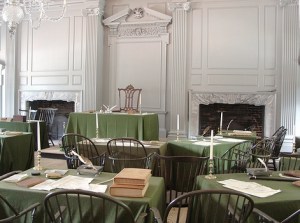
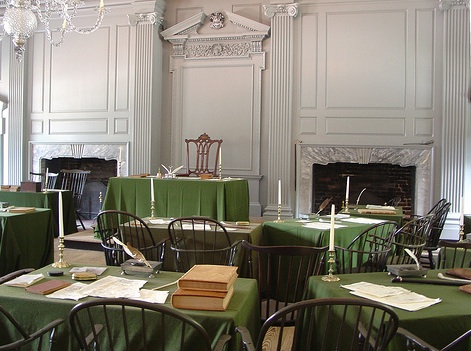
- Independence Hall, Philadelphia
Peter reached up and took down two manuscript boxes, opening one. He reached in, pulled out a piece of a parchment-like paper and offered it to me. Noting my reluctance, he encouraged me to take it in hand, assuring me that it was chemically treated so that handling it would not harm it in any way. I took the document and examined it. It was about 7″ x 5″, and was covered in almost microscopic writing. There were interlineations and lined-through words and phrases. The first line grabbed my eye: “When in the course of human events …” I looked questioningly at Peter and before I could ask he said, “You are holding Thomas Jefferson’s original handwritten notes of the negotiations leading to the drafting of the Declaration of Independence.” He explained that each of the five committee members charged with creating the document kept his own set of notes so as to keep track as ideas developed and to record his own ideas for further discussion. I could scarcely believe that I was looking at, much less handling, a document created by Thomas Jefferson himself. As I peered at it, Peter reached in the other manuscript box and pulled out a slightly smaller document, about 5″x 6″. It had the same kind of cramped handwriting and corrections. Peter handed it to me, and I noted that it bore the same phrase as Jefferson’s “When in the course …” Peter answered my unasked question: “John Adams’ handwritten notes.”
I can not catalogue all the emotions I felt as I held in my own hands these two ordinary-looking pages of notes that were anything but ordinary. They played a not-so-minor role in an event that changed the world and continues to reverberate through history even more than 230 years after the fact. I was awe-struck, of course, but mostly I felt a sense of how unfathomably remarkable and extraordinary were these two men who took care to get it right, knowing as they must have that the pronouncement they were fashioning must say exactly what needs to be said because it would live for many years thereafter. These were the self-recorded thoughts of two of the eyewitnesses to and participants in the creation of the republic.
I passed the two pages on to Lisa, Aimée and Mark, and they were as moved as I had been. We held in our hands these sacred papers that recorded profound truths.
This is what comes to my mind every July 4, the day we commemorate the signing of the Declaration of Independence. It’s the kind of experience that stays with you. It’s the kind of experience that gives fresh meaning to the words, “We hold these truths …”

 The Better Chancery Practice Blog