WHEN IT COMES TIME TO BAIL OUT
July 28, 2011 § 5 Comments
Sometimes it happens that you find it necessary to withdraw from representing a client. Maybe an ethical dilemma has reared its head. Or perhaps you and your client have developed irreconcilable differences. Or it could be that your client has not met the terms of the employment contract as to cooperation or payment or in some other way.
Once you have entered an appearance in a case, you are in it until the court lets you out. You may not avoid responsibility simply by not participating further. So when the need arises, how can you make an effective exit?
Uniform Chancery Court Rule (UCCR) 1.08 provides: “When an attorney makes an appearance for any party in an action, the attorney will not be allowed to withdraw as counsel for the party except upon written motion and after reasonable notice to the client and opposing counsel.”
In other words, it’s not good enough to get an agreed order signed by counsel opposite and present it to the judge. Nor is it adequate to get your client to sign off on an order.
Here is what you have to do, step by step:
- File a motion to withdraw. Set out a general statement of your reason without compromising the interest of your client in the litigation.
- File the motion and send a copy of it with certificate of service to opposing counsel and the client.
- Notice the motion for hearing.
- If your client and opposing counsel will sign an agreed order allowing you to withdraw, present it to the court for entry.
- If either your client or opposing counsel, or both, object, hold a hearing and ask the court to rule on your motion.
Several caveats:
- If the case is set for trial, most chancellors will allow you to withdraw only in the most urgent and exigent circumstances.
- No chancellor will allow you to withdraw if to do so will seriously prejudice your client.
- You may not withdraw in any probate matter unless there is an attorney who will substitute for you. UCCR 6.01 requires that the fiduciary retain an attorney, unless the fiduciary is a licensed attorney.
- Be general in stating a reason. Okay: “The undersigned attorney and the plaintiff have differences of opinion about handling this case that can not be resolved.” Not okay: “My client has filed three bar complaints against me and has retained counsel to sue me for malpractice, and I have reason to believe he is concealing assets from the court.”
- Don’t include any language in your order that absolves you of any responsibility for anything you did in the case, or approves everything you did; that’s overreaching. You may state that you are relieved of all further responsibility from and after the date of the order allowing withdrawal.
- Many chancellors will not permit you to withdraw if the only basis is non-payment of fees. Their rationale is that you took on a professional duty to represent the client when you entered an appearance, and that duty is higher than your desire to be paid.
THE LAWYER’S MISSION IN LIFE
July 13, 2011 § Leave a comment
The Mississippi Bar Association annual meeting commences today in faraway, sunny Florida. I thought this would be a propitious time to look back more than a hundred years at the proceedings of the association in its earliest days.
On May 5-7, 1908, the Mississipi State Bar Association held its third annual meeting in Meridian.
Various papers were presented, among them “Railroads and the People,” Suggestions of Error, Legal and Otherwise,” “Reminiscences of a Few Mississippi Lawyers,” and “The Power of the Courts.”
The convention even adopted a resolution that, because their presence would “lend grace and dignity to its annual meeting and wisdom of its deliberations,” members in future were “invited to attend sessions accompanied by their wives, daughters, sisters and sweethearts as the condition may then exist.” That language of that resolution sounds patronizing to us more than a century later, but we need to keep in mind that lawyers in those days were, if not exclusively male, almost exclusively male, and their language reflected not only that reality but also the more patriarchal usages of the day, which used the masculine gender to denote the general, as the text below shows.
Another of the papers delivered at that meeting was by Meridian’s own S. A. Witherspoon, who spoke on “The Lawyer’s Mission in Life.” The language is perhaps too flowery for todays tastes, but the message is no less relevant and thoughtful now than it was 102 years ago. It is too long to reproduce in its entirety, but here are some excerpts:
- ” … if the exigencies of [the lawyer’s] professional duties do not lead him into the investigation of the truth and require the exercises of his powers in maintaining the cause of justice, and demand the aid of his influence in establishing the great law of love between man and man, then the lawyer’s life work is at war with his better nature, and deterioration instead of development must be his certain doom.”
- “… in the solution of all political, social and religious problems that affect the happiness of humanity [lawyers] have been found in the front ranks, and the cause of freedom, justice and morality has found in them its most devoted and ablest advocates.”
- “The strife, contention and never ending warfare of the lawyer’s life may conceal from the casual observer its logical relation and productive tendency toward the peace, goodwill and love among men, but it should be remembered that the legal battle which he constantly wages merely takes the place of violence and bloodshed of the barbarian, and that the lawyer in civilized life simply confines the fighting, which seems to be a necessity of humanity, within the ranks of his own profession, and this relieves his fellow men of the evils of human warfare.”
- “But the prominent feature of the lawyer’s work is the problem of truth, and his greatest difficulty is measured by its laborious discovery.”
- “And the light of his truth, streaming through all the walks of human life, as distinctly marks the lawyer’s mission as does the warmth and light that gives life and beauty to the flowers and defines the mission of the sunbeam.”
- “The mission of the lawyer is not confined to the court room and does not end when the decree or judgment of the court is placed on the minutes, but it extends into all the affairs of men, and finds its last boundary at that point where his service is not needed for the betterment of humanity.”
- “The professional duties of the lawyer develop in him a capacity for the ascertainment of truth, a power to explain and expound it to others, and the art and ability to advocate the cause of justice, and to win the triumph of right; and the possession of any power involves the duty of exercising it for the good of others. He has no right to bury his talent, or to hide his candle under a bushel. Whatever advantage and superiority he may enjoy over his fellow men is the result of his relation to society and the special privileges which it has granted him. And, therefore, I say that in all the religious, moral, social, and industrial controversies that divide the people, the lawyer is obliged to take part, and to give them the benefit of whatever wisdom and virtue he may possess.”
Excerpted from “The Mississippi Bar’s Centennial: A Legacy of Service,” 2006 by the Mississippi Bar.
“A PERILOUS MISTAKE” IN HANDLING FIDUCIARY MATTERS
July 11, 2011 § 8 Comments
Lawyers in my district are aware that I have begun cracking down on the handling of estates, guardianships and conservatorships. Delinquent and inadequate accountings, lack of inventories, absence of vouchers and other deficiencies are no longer tolerated.
My motivation in part has been the fact that there are lawsuits pending against local lawyers claiming mishandling of fiduciary matters. On the coast only last year, it was discovered that a lawyer serving as county administrator until his death may have misappropriated funds in excess of a million dollars.
If you’re going to handle probate matters, understand that as the lawyer you have a grave responsibility for which you may be held liable by judgment for the proper handling of the estate by the fiduciary. Let me repeat that you may be held liable by judgment.
My responsibility as chancellor is not only to ensure that the assets and rights of the ward or estate are protected, but also to see that the attorney does not err.
To get an idea of the gravity, you need to read and take to heart the Mississippi Supreme Court’s decision in Matthews v. Williams, 633 So.2d 1038 (Miss. 1994). In that case, the conservator failed to file an inventory and, when he finally did, omitted financial assets. He failed to file accountings, and when he finally did reported expenditures made without any prior approval of the court. He made investments without approval of the court, and was unable to account properly for them. The chancellor approved his actions, but when that chancellor left office, the next chancellor granted a petition to remove the conservator. Here are some key excerpts from the court’s opinion (beginning at page 1039):
Every guardian shall, within three months after his appointment, return to the court, under oath, a true and perfect inventory of the estate, real and personal, and of all money or other things which he may have received as the property of his ward; and he shall return additional inventories of whatever he may subsequently receive. And he shall annually return an inventory, under oath, of the increase of the estate, if there be any. A guardian who shall fail to return inventories may be removed and his bond put in suit, unless he can show cause for the default. (Emphasis added)
The first inventory was not filed until February 23, 1988, a year and two months following Dan’s appointment. It did not mention bonds owned by the estate. The third inventory filed May 13, 1990, purporting to show the inventory of the estate as of December 31, 1989, lists “Series E. Bonds $2,063.22.”
The bonds were first identified by serial number and date of purchase in the fourth inventory showing assets as of December 18, 1990, and filed January 7, 1991, which states: “Series E Bonds (all $25.00/7 year Bonds),” and then lists twenty-seven bonds by serial number and showing dates of purchase from July 1966 through July 1969. Subsequent inventories were not timely filed, and no reason was given therefor. There is no explanation for failure to include the bonds.
II. ANNUAL ACCOUNTS
It shall be the duty of the guardian … to improve the estate committed to his charge, and to apply so much of the income, profit or body thereof as may be necessary for the comfortable maintenance and support of the ward and of his family, if he have any, after obtaining an order of the court fixing the amount…. The guardian is empowered to collect and sue for and recover all debts due his said ward … (Emphasis added)
This statute requires that a court order fixing the amount to be spent for the care and maintenance of the ward be obtained prior to making such expenditures. Dan simply made the expenditures as he saw fit. When this Court addressed such action in Welch v. Childers, 195 Miss. 415, 420, 15 So.2d 690, 691 (1943), we held:
A minor under guardianship is a ward of the Chancery Court. All receipts and disbursements of his estate are required to be under the authority and direction of the Chancery Court or the Chancellor in vacation. The expenses for the maintenance and support of the ward cannot be proved in any other way. The object of the law is to guard against dishonesty and mismanagement of the estate by the guardian…. The law does not leave the amount of the expenditures by the guardian for the maintenance, support and education to (the guardian’s) discretion. The sum must be fixed by the court. If the guardian contracts therefor without the sanction of the Chancery Court or Chancellor, the liability therefor is personal to him, and he cannot be allowed for it in his accounts for the ward. The guardian has no power to bind the estate of his ward without the sanction of the Chancery Court or the Chancellor.
That prior court approval is absolutely required by statute before a conservator makes expenditures seems never to have occurred to counsel representing Dan or the chancellor who then examined and approved them. Expenditures for the care and maintenance of Mrs. Mathews and her property were made by Dan as though he had some blanket power of attorney to spend as he thought best, and only then report it to a chancellor. No explanation was offered to the chancellor for all these expenditures having been made without court approval, nor did the chancellor require one. This is of profound concern to this Court. We again remind attorneys for estates of wards and decedents and the chancellors who examine accounts and inventories that they, too, have special and far-reaching fiduciary duties. It was the obligation of the attorney to advise the conservator as to his statutory duties, responsibilities, and limitations on expenditures. As for chancellors, a chancellor who must approve accounts and inventories has a duty beyond deciding lawsuits. He is under an obligation first to see that accounts and inventories filed comply with the statutes before he approves them. He is also the “superior guardian” of the ward. This Court long ago in Union Chevrolet Co. v. Arrington, 162 Miss. 816, 826, 827, 138 So. 593, 595 (1932), held:
Infants and persons of unsound mind are disabled under the law to act for themselves. Long ago it became the established rule for the court of chancery to act as the superior guardian for all persons under such disability. This inherent and traditional power and protective duty is made complete and irrefragable by the provisions of our present state constitution. It is not competent for the Legislature to abate the said powers and duties or for the said court to omit or neglect them. It is the inescapable duty of the said court and or the chancellor to act with constant care and solicitude towards the preservation and protection of the rights of infants and persons non compos mentis. The court will take nothing as confessed against them; will make for them every valuable election; will rescue them from faithless guardians, designing strangers, and even from unnatural parents, and in general will and must take all necessary steps to conserve and protect the best interest of these wards of the court. The court will not and cannot permit the rights of an infant to be prejudiced by an waiver, or omission or neglect or design of a guardian, or of any other person, so far as within the power of the court to prevent or correct. Grif.Chan.Prac. §§ 45, 360, 530, 533. All persons who deal with guardians or with courts in respect to the rights of infants are charged with the knowledge of the above principles, and act to the contrary thereof at their peril. (Emphasis added) Also, Mississippi State Bar Association v. Moyo, 525 So.2d 1289, 1293 (Miss.1988).
Solicitors for guardians and conservators and chancellors who must approve their accounts and inventories who ignore these fiduciary responsibilities make a perilous mistake. [Note from the opinion: We are not comforted by the May 18, 1990, decree approving the third annual account in which the chancellor first authorized the conservator to “pay all future medical, personal, and other expenses for the creature comforts of Frances Mathews.” With no representation from Dan as to why any of these expenses might be, the chancellor gave him blanket authorization to expend his estate’s funds.
IV. INVESTMENTS WITHOUT COURT APPROVAL
Whenever the guardian shall have money of his ward not needed for current expenditures, or directed to be invested for the ward, he shall apply to the court, or chancellor in vacation, for direction as to the disposition he shall make of it. The court or chancellor shall determine whether he shall lend it at interest, and upon what security, or how he shall dispose of it. If the court or chancellor designate the person to whom the loan shall be made, or the security on which it shall be made, and the loan to be so made, responsibility shall not attach thereafter to the guardian; but if the court or chancellor shall entrust him with discretion in the matter, he shall be bound for the exercise of sound judgment…. Any guardian who fails to report to the court the fact that he has money of his ward not needed or allowed to be used for current expenditures, and to ask the order of the court as to the disposition of such money, may be chargeable with interest on the same at the rate of eight per centum (8%) per annum during the time of failure. (Emphasis added)
Moreover, we have been unable to trace the certificates of deposit from one accounting period to the next because the numbers identifying them differed. Interest proceeds appear to have been treated inconsistently, some deposited in the ward’s checking account, other reinvested. Interest deposited in the checking account identified by certificate of deposit numbers differed from the numbers identifying the certificates in the inventory for that period.
On January 23, 1987, Dan petitioned and on January 26, 1987, received court approval to commence legal action to recover money fraudulently obtained from her. No report was ever made to the court of the outcome of this action.
V. QUESTIONABLE EXPENDITURES
We do not have before us and do not address the justification for any expenditures made by Dan as conservator, or their reasonableness or necessity. These may be proper inquiries upon remand. Neville v. Kelso, 247 So.2d 828, 834-835 (Miss.1971).
The chancellor should also upon remand see that inventories reflect and accurately trace the investment of all funds.
Our sole inquiry on this appeal is whether the chancellor abused his discretion in removing Dan as conservator, and for the reasons set forth she clearly did not. Harris v. King, 480 So.2d 1131, 1132 (Miss.1985); Conner v. Polk, 161 Miss. 24, 29, 133 So. 604, 605 (1931).
I don’t know how it could be any clearer. You deal lackadaisically with probate matters at your peril. Your law license, your reputation as an attorney, your malpractice coverage, and even your own assets are on the line. I am not being melodramatic when I say this; I am being completely truthful and trying to wave a huge caution flag. Matthews v. Williams makes it abundantly clear that the approval of the chancellor will not shield you or your fiduciary.
PARING DOWN YOUR LEGAL PROSE
June 23, 2011 § 2 Comments

The importance of being Ernest
Nobel Prize-winning author Ernest Hemingway worked as a reporter for the Kansas City Star newspaper in 1917. The sparse, compact language of journalism proved to be ideally suited to his writing skills, and he adopted it as his style. The minimalist prose that resulted became his trademark.
Here are excerpts from the paper’s style sheet:
- Use short sentences. Use short first paragraphs. Use vigorous English. Be positive, not negative.
- Eliminate every superfluous word, as “Funeral services will be at 2 o’clock Tuesday,” not “The funeral services will be held at the hour of 2 o’clock on Tuesday.” “He said” is better than “He said in the course of conversation.”
- Avoid the use of adjectives, especially such extravagant ones as “splendid,” “gorgeous,” “grand,” “magnificent,” etc.
- Be careful of the word “also.” It usually modifies the word it follows closest. “He, also, went” means “He, too, went.” “He went also” means he went in addition to taking some other action.
- Be careful of the word “only.” “He only had $10″ means he alone was the possessor of such wealth; “He had only $10″ means the ten was all the cash he possessed.
- A long quotation without introducing the speaker makes a poor lead especially and is bad at any time. Break into the quotation as soon as you can, thus: “‘I should prefer,’ the speaker said, ‘to let the reader know who I am as soon as possible.’”
“Those were the best rules I ever learned for the business of writing,” Hemingway told a reporter in 1940. “I’ve never forgotten them. No man with any talent, who feels and writes truly about the thing he is trying to say, can fail to write well if he abides with them.”
There’s something for lawyers to chew on here. Is your writing clear, concise and direct? Does it make your point in the first sentence, or in the first few words, or do you make the reader meander through prolix piles of prose? Does it read like nineteenth-century legal jargon, or does it state your client’s position in easily comprehensible language?
Take a few minutes to read your pleadings. Take a few minutes to review your motions and briefs. Does your writing do the job for your client, or does it get in the way?
When a judge reads your pleadings, motions or briefs, can he or she get right to the point, or does it take laborious digging to get there? And when the judge finally gets to the point, is it clear exactly what the point is?
Do you have a reliable style book you can pull out and check from time to time? I like Strunk and White’s Elements of Style. It’s timeless without being stuffy, and at a mere 85 pages, it’s packed with easy-to-find gems. The chapters include rules of usage, principles of composition, commonly misused expressions, matters of form, and an approach to style. There’s a lot here that is easily digestible and quite useful.
Give your writing a little thought. It’s one of your most potent tools to advance your client’s interest. And consider that muddled writing is symptomatic of muddled thought; if you can’t find a way to express it in writing, you may not be able to say it at all.
Thanks to Futility Closet for the Hemingway material.
THE US CONSTITUTION AT LONG LAST ARRIVES FOR THE LEGAL PROFESSION IN MISSISSIPPI
May 17, 2011 § 3 Comments
Every lawyer sworn in on and after July 1, 2011, will have to swear to support not only the Constitution of the State of Mississippi, but also the Constitution of the United States. Which means that only 193 years and 7 months after Mississippi was admitted to statehood, the lawyers thereof will now be getting around to swearing (or affirming) to support the national constitution.
Here is the oath prescribed in MCA § 73-3-35 as it is pre-July 1:
“I do solemnly swear (or affirm) that I will demean myself, as an attorney and counselor of this court, according to the best of my learning and ability, and with all good fidelity as well to the court as to the client; that I will use no falsehood nor delay any person’s cause for lucre or malice, and that I will support the Constitution of the State of Mississippi so long as I continue a citizen thereof. So help me God.”
The code shows the first appearance of the oath among our statues in the 1848 Hutchinson’s Code. It’s impossible to tell from the currnt code whether the US Constitution ever appeared in the oath, or whether it was deleted. Legislative history is not included in the judges’ Westlaw subscription — at least mine — so I can’t follow that up.
I am not aware of any requirement that the pre-July 1 lawyers will have to take a new vow vis a vis the US Constitution. So does this set up the likelihood of warring factions among attorneys with loyalties divided between competing sources of organic law? Are we to conclude that all pre-July 1 lawyers are exempt from supporting the US Constitution? No, that would be erroneous, my dear friends. MCA § 73-7-37 lists among the seven statutory duties of attorneys the duty “To support the Constitution and laws of this state and of the United States,” thus allaying fears of a bar civil war.
In 1945, the president of the Mississippi State Bar, Bidwell Adam, said with respect to the US Constitution, “It is my firm belief and honest conviction that no progress can be made in the direction of undermining this great Constitution … so long as the lawyers of this state and Republic continue to contribute their time, talents, energy, training and experience as its defenders. Without the lawyers of this state and country, our Constitution would be lost to humanity and decadence would follow.” Even 66 years ago, the need for lawyers to support the US Constitution was apparent, at least to the bar association.
But why was that particular requirement omitted from the oath and yet enshrined in statute?
The judicial oath of office set out in Article 6, § 159 of the Mississippi Constitution does include both the state and the US Constitution:
“I, ____________, solemnly swear (or affirm) that I will administer justice without respect to persons, and do equal right to the poor and to the rich, and that I will faithfully and impartially discharge and perform all duties incumbent upon me as ____________ according to the best of my ability and understanding, agreeably as to the Constitution of the United States and the Constitution and laws of the State of Mississippi. So help me God.”
I am sure there is some history behind all of this. If anybody knows why the US Constitution was left out of the attorney’s oath, I wish you would enlighten us.
APPEARANCES CAN BE DECEIVING
April 7, 2011 § 5 Comments
When do your actions constitute an appearance in court on behalf of your client? It’s an important question, because your actions or non-actions can result in professional liability for you.
Take for example this scenario:
Joey, an old client, and his daughter meet with you one morning. Joey is upset because his wife, Betty, has filed a divorce complaint against him. He wants you to represent him, but he can’t afford your retainer, and you know from past experience that he probably won’t pay your bill. In an effort to mollify Joey, you call the lawyer on the other side and tell him that Joey is willing to agree to a divorce, and if Betty will provide a list of property she wants, the case can be settled. You hang up the phone, Joey and daughter leave thinking all is taken care of, and you promptly put it out of your mind, turning your attention to paying clients.
Fast forward a few months. Joey returns to your office quite upset. He hands you a judgment granting Betty a divorce and giving her most of the marital assets. Oops.
What happens next? In the case of Simmons v. Simmons, with facts almost identical to those above, Joey’s lawyer filed a motion to set aside the divorce on the basis that the phone call constituted an appearance. The opposing attorney took the position that he had a vague recollection of a phone call from someone, but could not even remember who called him, and he went forward with the divorce when his client insisted he finalize the case. The chancellor overruled Joey’s motion, and Joey appealed. The COA held that the chancellor’s finding that the phone call did not amount to an appearance was one of fact, and would not be disturbed on appeal.
So how do you protect yourself in these situations? A few suggestions:
-
Don’t do it. Don’t make that call. Explain to Joey that you can not just call the other lawyer without being retained. If you call, Joey will likely believe that you now represent him, retainer or none, and you may well have a professional responsibility to him.
-
Okay, if you simply can not resist, then don’t make the phone call without a representation agreement. If the client can’t pay the full freight tab, consider a limited scope representation agreement at a lesser rate, and reduce your services accordingly.
-
Document, document, document. Write a letter and follow up. Fax the letter; that fax transmission notation and receipt may be just the proof you need if the lawyer on the other side claims he never received the letter.
You’ve probably thought of a few other measures you could take. Good. Protect yourself.
Just last week I continued a divorce trial (for two weeks) because a lawyer had gotten into a similar swivet. To make matters worse, the lawyer has a letter from the defendant, who is in Rankin County Correctional Facility, thanking him for his efforts in representing her, although all he did was make a couple of phone calls to counsel opposite. He has two weeks to get straight with his client/non-client.
Another post on this subject is here.
THE VALUE OF THINKING LIKE A LAWYER
March 30, 2011 § 1 Comment
In law school we were taught not so much the law as how to think like lawyers. That is, we were taught to think analytically, to break complex issues into comprehensible components, and to bring creative solutions to bear using the framework of the law.
Michelle Harner of the University of Maryland School of Law has written a remarkable paper entitled, The Value of “Thinking Like a Lawyer,” which you can download here as a .pdf file. The abstract of the paper summarizes it succinctly:
The legal profession was hit particularly hard by the recent recession. Law firms laid off lawyers in record numbers, and law school graduates found few if any employment opportunities. Clients also started rethinking the terms of the lawyer-client relationship, at least in the larger law firm context. Some commentators suggest that these changes are indicative of things to come; that the legal profession is undergoing a long-overdue paradigm shift that will permanently change the nature of the legal profession. This Essay examines these developments through the lens of Larry Ribstein’s The Death of Big Law and Richard Susskind’s The End of Lawyers?: Rethinking the Nature of Legal Services. It compares and contrasts Ribstein’s and Susskind’s analyses of the profession and assesses potential lessons for lawyers, clients, and legal educators. This Essay concludes by encouraging professionals to remain open to changes that improve efficiency and client service. It also stresses the value of preserving and promoting the hallmark of being a lawyer – that is, thinking like a lawyer.
Professor Harner begins by accepting some of the premises offered by Ribstein and Susskind: that forces are at work changing the legal profession; that the legal profession is becoming commoditized and generic; and that survival as a lawyer, and indeed, survival of the legal profession, will demand evolution in the way lawyers offer and market services.
Where she ends up is with the idea that legal thinking has a marketable value, and that lawyers should evaluate the services they offer in terms of the value that their legal thinking can add, as opposed to simply doing all the traditional tasks that lawyers have assumed and which do not require legal thinking, many of which nowadays are being taken over by non-lawyers.
Her challenge is for lawyers and the legal profession to re-examine our ways of looking at the ethical framework in which we operate to determine whether it really does promote the best interest of clients and the profession.
I encourage you to read professor Harner’s paper, and to begin to think about the future of your profession.
WHAT IS YOUR DUTY TO THE COURT WHEN YOU HAVE CONTACT FROM THE OTHER SIDE?
February 14, 2011 § 1 Comment
You have filed a Complaint for Divorce for your client, and thirty days have elapsed with no answer being filed by defendant. Your client wants you to get this over with, and has been calling and asking when you plan to present his case to the court. Only problem is you received a letter from another attorney the day after the defendant was served with process. The letter says that she wants to settle, and if no settlement can be reached, she intends to defend. Since that letter, though, you haven’t heard anything further.
What do you do? Can you present the case as an uncontested divorce? Do you have a duty to tell the court about the letter?
The facts above are close to those in Holmes v. Holmes, 628 So.2d 1361, (Miss. 1993), in which the Mississippi Supreme Court reversed a chancellor’s refusal to set aside an uncontested judgment of divorce in those circumstances. The supreme court stated:
“In the case at bar, Mrs. Holmes promptly contacted an attorney. Her attorney wrote her husband’s attorney and informed him that Mrs. Holmes was represented by counsel and that she wished to settle the case if possible; however, he made clear Mrs. Holmes’ intent to defend the suit should no settlement be reached. With knowledge of this letter, Mr. Holmes’ attorney nevertheless proceeded to secure a divorce by default against Mrs. Holmes. In this regard, his conduct suggests gamesmanship. In the Comment to M.R.C.P. 1, it is stated that “properly utilized, the rules will tend to discourage battles over mere form and to sweep away needless procedural controversies that either delay a trial on the merits or deny a party his day in court because of technical deficiencies.” Conversely, improper utilization of the rules invariably results in the type of gamesmanship and ambush techniques, employed in the case at bar, that the rules were designed to abolish. We refuse to condone such behavior and therefore reverse the judgment of the chancellor and remand for proceedings consistent with the opinion rendered in this cause.”
So what is your duty to the court? At your first opportunity, tell the judge with all candor what contact you have had from another attorney. The judge will decide whether the contact is sufficient to constitute an appearance. You should offer the court any correspondence for the judge to examine. If your only contact was in the form of a conversation, relate accurately what the conversation was. Sometimes that contact was with the other party. Tell the court and let the judge decide whether it was enough to be treated as a contest. The judge may rule that the other side is entitled to a notice of hearing before you may proceed.
If you fail to disclose contact from another attorney or the other party, you run the risk that the other side may file a motion to set aside that judgment, and the judge may just file away a mental note about you that you are one of those lawyers who doesn’t tell the court all it needs to know to make a fair decision.
Read the entire Holmes decision and keep in mind the supreme court’s use of the distasteful terms “gamesmanship and ambush techniques.” Judges don’t appreciate those kinds of tactics that bring both the courts and the legal profession into disrepute.
LIMITED SCOPE REPRESENTATION NOW A FACT IN MISSISSIPPI
February 2, 2011 § 1 Comment
I’ve talked here before about “unbundling” of legal services, also called “limited scope representation,” as a way of opening legal services to people who otherwise can not afford a lawyer for matters that they consider routine or uncomplicated.
On January 27, 2011, the Mississippi Supreme Court adopted amendments to the professional rules that allow limited scope representation. You can read the press release, which includes a link to the amended rules, here.
On the whole, I think this is a positive development in that it will help open up access to lawyers and courts. I do have a couple of practical concerns:
- What does the lawyer do when the client insists that you limit the scope of your representation, but you know it is definitely not in the client’s best interest, and may even be to the client’s detriment, not to address other matters?
- How do you draft a limited scope representation agreement that protects the lawyer from action by the client claiming inadequate representation?
Other states have trod this path before us, so there are possibly bar opinions and case law that can provide some guidance to practitioners.
From the court’s perspective, I can tell you that there is a serious need for low-level involvement of attorneys in those so-called simple and uncomplicated matters. I could go on and on about experiences with pro se litigants going forth boldly where no lawyer has set foot before, using pleadings and guidance material from the internet or from so-called legal software, or from kits purchased at office supply stores. These cases are a judge’s nightmare because the judge should never be put in the position of assisting any party with correcting and putting pleadings and other papers right, and the judge certainly can not do so when there is an opposing party. It can be painful and demoralizing to watch a pro se party inflict serious legal damage on herself, usually without a clue as to the extent of the injury. Even minimal involvement of an attorney in those cases would be a major benefit.
Another aspect of pro se proceedings often overlooked is that the pro se litigant has no professional or ethical duty to the court or to the opposing party. The possibility for fraud and misrepresentation is significant. There is no attorney, with his or her license and professional responsibility on the line to reassure the court. Likewise, these companies that sell the kits, software and advice owe their customers no duty at all. The insurance that a client obtains by hiring a lawyer is non-existent.
Finally, lawyers need to be aware that the DIY legal industry stands to keep chipping away at the edges of the practice of law until there will be real competition for clients. Your license and substantial investment in legal education, as well as your dedication to legal ethics and duty to the courts are all going to be in competition with nameless and faceless paper mills and internet sites that have no professional standing, no investment in education, and no ethical responsibilities.
I hope limited scope representation helps reduce the trend toward more DIY litigation. I encourage lawyers to look into limited scope representation and discover how it can enhance their practice as well as aid laypersons who feel that they can not afford legal services.
TOOLS OF THE TRADE
December 29, 2010 § 4 Comments
If you were a carpenter, you’d want to have the finest power tools you could afford. If you were a doctor, you’d try to invest in the best diagnostic instruments available. If you were a farmer, you’d want to have a really good tractor with all the implements. If you were a — well, you get the idea. If you’re going to do a job, you need to be sure you have the right tools AND use them.
Lawyers are no different. If you’re going to practice in Chancery Court, you need to have ready access to the information you need AND use it.
Every lawyer’s most important tool is that perfect case on all fours with the one you are presenting to the court. It is a satisfying coup, indeed, to hand the judge that gem of a case with a confident smile while your opponent stands by twiddling his thumbs. The Court of Appeals hands down decisions every Tuesday, and the Supreme Court hands down decisions every Thursday (holidays and vacation days excepted). You can read the decisions as soon as they are published online at the Mississippi Judiciary website. And all of the court rules and directories are there, too.
Finding that perfect case used to be a matter of digging through the digests and key numbers, then finding the volume with your case in it and making a photocopy. Nowadays, you can find what you’re looking for on the Mississippi Bar’s website at Casemaker, which is a free online legal research engine paid for through your bar dues. If you prefer, WestLaw and Lexis have subscription services.
 Of course, the MISSISSIPPI CODE is indispensable. If you can’t afford your own copy, you can browse and copy it online through CaseMaker or one of the subscription services, but many of us find it more productive to be able to flip through the pages of a book. The annotations in the code are a gold mine of authority and starting points for further research for any lawyer. If you do any probate work, you will experience a lot of frustration and failed efforts if you do not read the code. The answers to 99% of all questions that lawyers ask me about probate matters are right there in the statutes, in black and white.
MISSISSIPPI RULES OF COURT. Every lawyer who comes to trial should have a copy of the rules with her or him. You will need to flip to that specific hearsay exception so you can convince the court to let in that crucial evidence, or you will need to know what rule to cite to get around that objection to the timeliness of your motion. It’s all in the rules. But before you ever get to court, you need to be familiar with what’s there and where you can find it. It’s never very convincing to say, “Judge, I know it’s in there somewhere; I remember hearing aboout it back in law school.” If you only had one book in your library (and I hope you have more than just one!), it should be your rule book.
Any lawyer who will do much family law should have one or both of these books in his or her library …
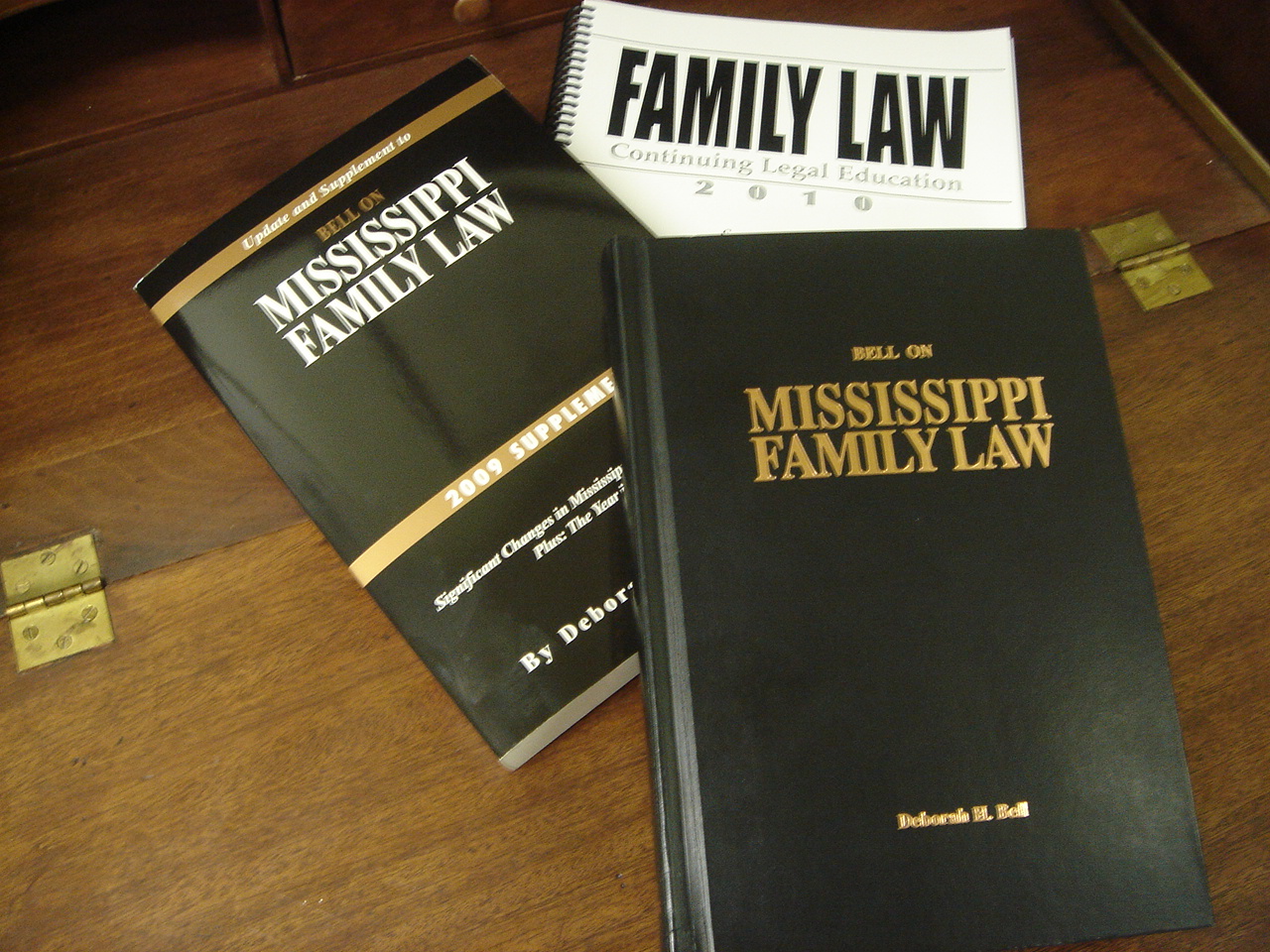 BELL ON MISSISSIPPI FAMILY LAW. Professor Deborah Bell of the Ole Miss Law School has published what many consider the definitive reference work on divorce, custody, child support, and all things family law in Mississippi. Her text, along with its annual supplement, are well organized, thorough and concise statements of the law upon which you can rely in advising your client, preparing your case, presenting your case, and even briefing an appeal. Professor Bell’s work has been cited as authority by the appellate courts and is considered authoritative in trial courts as well. If you have a significant family law practice, you should arrange to take in a Professor Bell seminar. They are held every May, one in Oxford, one in Jackson, and one on the coast, and you will not find a more complete annual overview of developments.
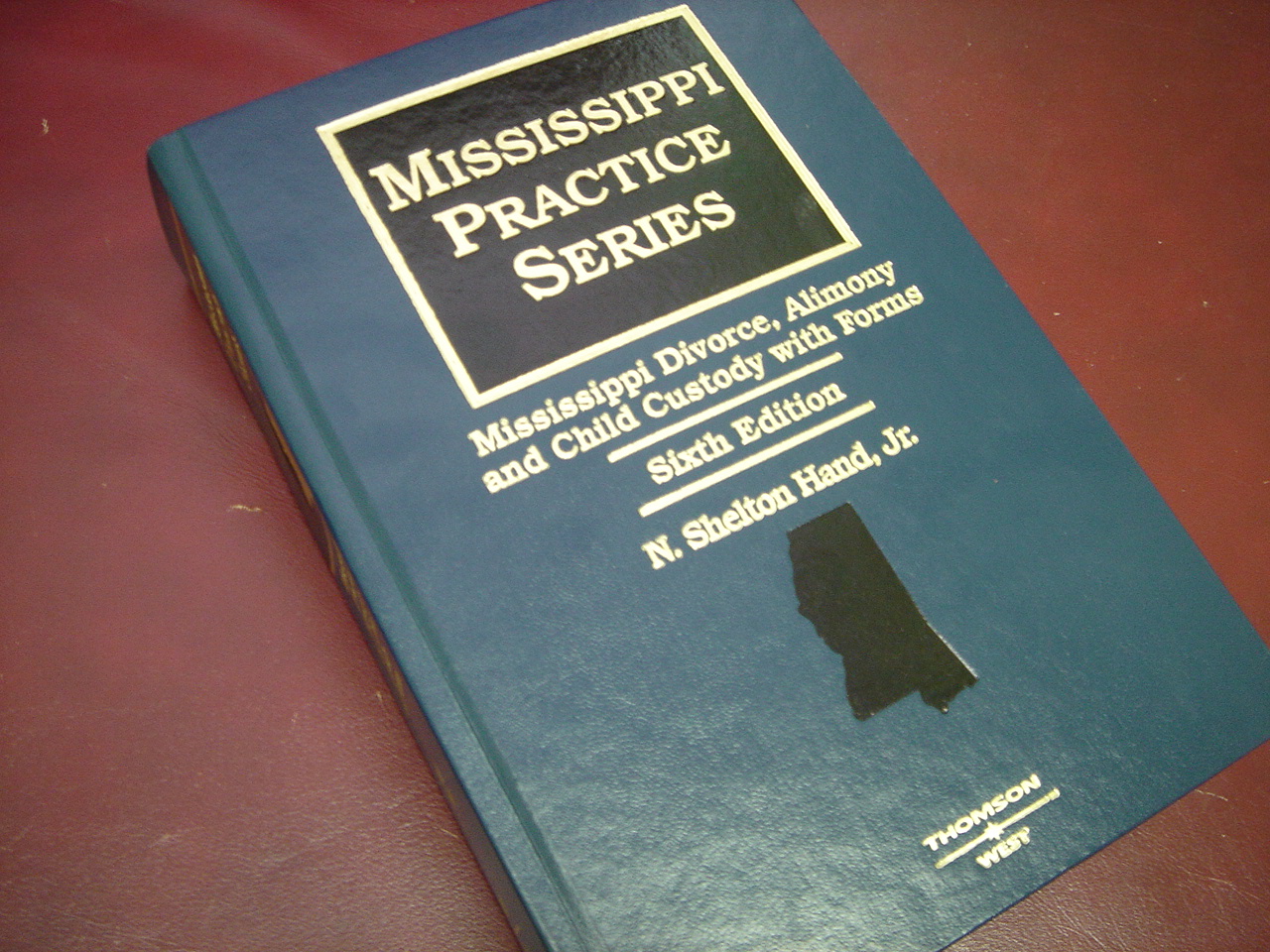 MISSISSIPPI DIVORCE, ALIMONY AND CHILD CUSTODY. Professor Shelton Hand’s treatise has been a go-to authority in Mississippi for many years, and includes suggested forms as a bonus. Another feature of Hand’s work is his discussion of pleadings and procedural matters, which, coupled with the forms, may be a benefit to young practitioners more concerned with filing a viable pleading, having it served, and setting the case for hearing.
If you do any probate work, you might find these texts helpful …
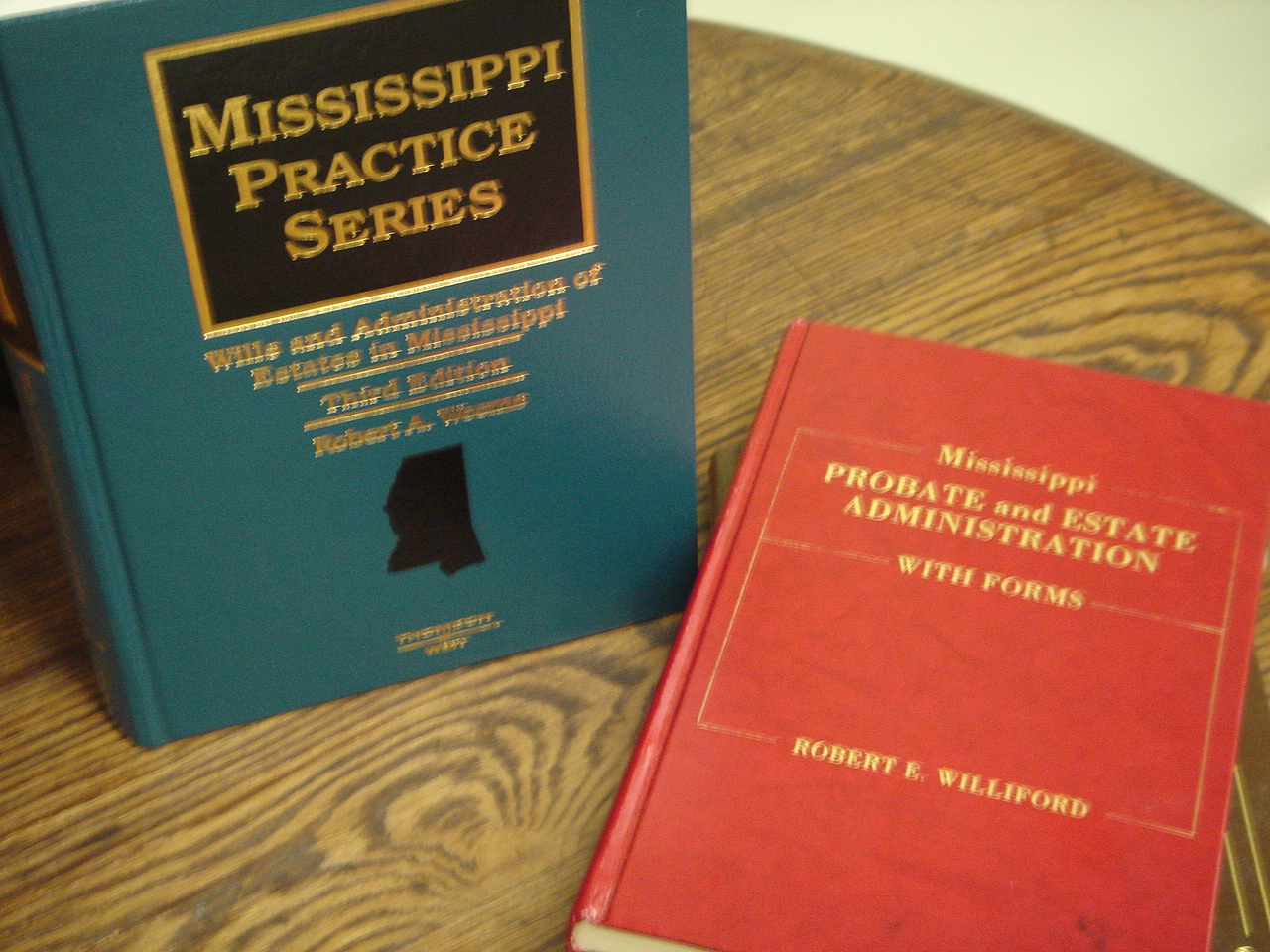 WILLS AND ADMINISTRATION OF ESTATES IN MISSISSIPPI. By Robert A. Weems.
PROBATE AND ESTATE ADMINISTRATION. By Robert E. Williford.
Yes, it’s true that everything you need to know about probate is in the code, but finding the exact answer to your specific question in the multitude of statutes can be a time-intensive task. These two books can help you sort through that haystack of statutes to find the right answer to your question. Complete with case citations and text by the authors.
Some helpful guides to chancery practice …
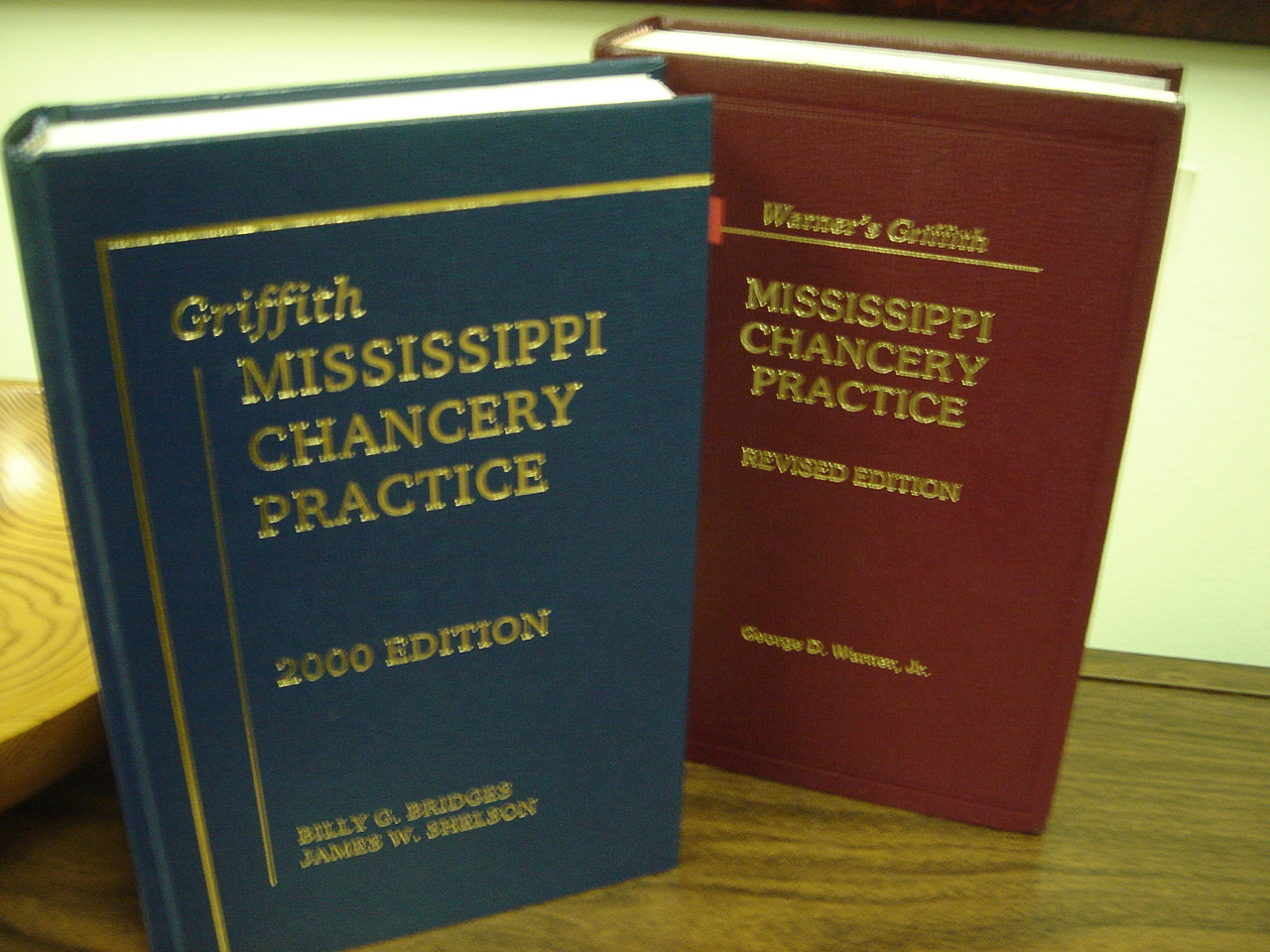 GRIFFITH MISSISSIPPI CHANCERY PRACTICE. By Billy Bridges and James Shelson. Updated Warner’s version of Griffith in 2000. Judge Bridges and Mr. Shelson again updated Griffith through the beginning of the new century.
WARNER’S GRIFFITH MISSISSIPPI CHANCERY PRACTICE. By George D. Warner, 1991. The first update to Judge Griffith’s cornerstone work in more than 40 years. Judge Warner took Griffith’s text and incorporated the Mississippi Rules of Civil Procedure, as well as important developments in the law in the intervening time.
And two old gems that were black letter authority for years …
GRIFFITH’S MISSISSIPPI CHANCERY PRACTICE. 1950 Edition. Originally published in 1925, Griffith is the seminal authority on Chancery Court in Mississippi. Almost all of the procedural provisions have been supplanted by the Mississippi Rules of Civil Procedure and the Uniform Chancery Court Rules, but there is no more authoritative text in Mississippi for understanding the philosophy, history and approach of Chancery Courts.
DIVORCE AND SEPARATION IN MISSISSIPPI. 1957. This work by professor Bunkley updated the original by Judge A.B. Amis of Meridian first published in 1934. There have been so many developments in the procedural and substantive law of the family in our state that it is tempting to regard this book as a mere historical curiosity. Some provisions bear looking at, however. The provisions about how to plead non-residency to support publication, for example, are models that modern-day attorneys should consider. The book was written in an era when careful pleading was essential to survival of one’s suit, and more careful pleading would benefit most lawyers and clients today.
And two recent additions …
PROFESSIONAL RESPONSIBILITY FOR MISSISSIPPI LAWYERS by Jeffrey Jackson and Donald Campbell and COMMENTARY ON JUDICIAL ETHICS IN MISSISSIPPI by Donald Campbell and Jeffrey Jackson arrived on the scene in 2010. These two works were published by MLI (Mississippi Law Institute), a function of the Mississippi College Law School. The unique aspect of these books is their focus on Mississippi, and I am not aware of any comparable works on these subjects of vital importance to bench and bar. Both are impressive in their depth of scholarship and thoroughness. The set is pricy for a small firm at $245, and, admittedly, they are not reference works you will turn to every day, but the odds are that they will be worth every cent you pay when you really need them. If you are practicing in the Twelfth District and would like to look over a set, feel free to drop by my office and browse through for yourself. MLI’s description and an order form can be found here.
 The Better Chancery Practice Blog