THE SOUND AND THE FURY OF THE UNVANQUISHED POSTMAN
January 1, 2011 § 1 Comment
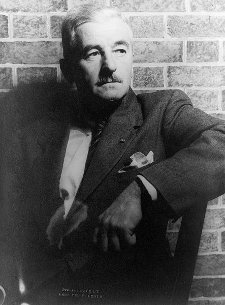 In December 1924, a postal inspector from Corinth, Miss., leveled a series of charges against the postmaster at the University of Mississippi. “You mistreat mail of all classes,” he wrote, “including registered mail; … you have thrown mail with return postage guaranteed and all other classes into the garbage can by the side entrance,” and “some patrons have gone to this garbage can to get their magazines.”
The slothful postmaster was William Faulkner. He had accepted the position in 1921 while trying to establish himself as a writer, but he spent most of his time in the back of the office, as far as possible from the service windows, in what he called the “reading room.” When he wasn’t reading or writing there he was playing bridge with friends; he would rise grumpily only when a patron rapped on the glass with a coin.
It was a brief career. Shortly after the inspector’s complaint, Faulkner wrote to the postmaster general: “As long as I live under the capitalistic system, I expect to have my life influenced by the demands of moneyed people. But I will be damned if I propose to be at the beck and call of every itinerant scoundrel who has two cents to invest in a postage stamp. This, sir, is my resignation.”
Thanks to Futility Closet.
TRIBUTE TO JUDGE LACKEY
November 21, 2010 § Leave a comment
It was Judge Henry Lackey of Calhoun City whose refusal to be corrupted and courageous cooperation with law enforcement brought to justice some of the most powerful trial lawyers in this country.
This tribute from the Calhoun County Journal:
Judge Lackey is truly one-of-a-kind
“There are two things you need to be a judge,” Judge Henry Lackey said. “A lot of gray hair to look distinguished and hemorrhoids to look concerned.”
Judge Lackey was speaking to a large gathering at the Oxford Convention Center that turned out to honor him upon his upcoming retirement after 17 years as circuit court judge and even longer as public servant.
Judge Lackey is less than two months away from entering retirement, but one look at this week’s Journal and you would see he’s busier than ever.
He was “roasted and toasted” at the Oxford Convention Center last week shortly after being honored by the Mississippi Supreme Court for his years of service on the bench.
Another reception is planned for Dec. 10 at First Baptist Church in Calhoun City.
This Thursday, Judge Lackey will once again be auctioning off Christmas items at the City Sidewalks Celebration at the Methodist Corner on the Calhoun City Square. Saturday night he is the featured entertainment at the Vardaman Sweet Potato Festival Banquet.
In between all of this he is still managing his day job as Circuit Court Judge for District Three. He’s spent all of this week holding court in Holly Springs.
The honors for 75-year-old Judge Lackey continue to pour in due in part to his role in one of the biggest legal crackdowns in recent history – the downfall of famed trial lawyer Dickie Scruggs and several of his colleagues.
“I’ve received praise and accolades that I don’t deserve,” Judge Lackey told me a few months back. “It’s like praising the sheriff for not stealing. It’s your job.”
Judge Lackey’s “integrity and intrepidness” in the case are well documented in Curtis Wilkie’s new book “The Fall of the House of Zeus” – a must-read according to my wife Lisa.
But as all the attention still pours in, and rightfully so, Judge Lackey still thinks of himself as the simple, “country lawyer” who still lives “within 300 yards of where he discovered America,” and that’s why he is so treasured here in Calhoun County.
A visit with him and you hear no mention of Dickie Scruggs. He talks of his “wonderful upbringing” in Calhoun City, working at his family’s business – the Ben Franklin 5 and 10 Cent store on the Calhoun City Square – and the endless list of fascinating people he grew up with such as Clarence “Dummy” Martin, Ray “Funnyman” Tolley, John Pittman, Mr. Mac, Monk and Big Dog.
I’ll never forget sitting in his office and him telling me of his experience when Robert Wardlaw, the world’s tallest man at 8’9″, visited Calhoun City.
One of the best story tellers I’ve every known, Judge Lackey is always worth the price of admission at any event he’s attending. I certainly wouldn’t let an opportunity to enjoy his tales or company pass me by.
The homespun Judge Lackey deserves our accolades. As it is with Judge Lackey, I hope it will be said of all of us at the end of our careers that we adhered to the highest ethical principles and upheld the honor and dignity of the law.
Thanks to Tom Freeland for the link to this tribute.
ELVIS IN MERIDIAN: THE PINK CADILLAC
November 5, 2010 § 1 Comment
I posted about Elvis Presley’s appearance in Meridian in 1955 here.
Several people who saw the Meridian parade with Elvis in person told me they remembered that the car was pink. Turns out their memories were on target.
According to this Elvis fan’s website, Elvis had purchased the car, a 1954 pink and white model, in March, 1955, only 2 months before the Meridian parade photos that I posted. He used it to transport himself and his back-up musicians, Scotty Moore, D. J. Fontana and Bill Black, who were billed as the Blue Moon Boys, to various gigs around the south. Elvis had made it known to all of his friends and fellow performers that it was his dream to own a pink Cadillac. The one he rode in Meridian was his first.
On June 5, 1955, Elvis and his band had completed a show at Hope, Arkansas. The next show was in Texarkana, and Elvis invited a local girl to ride with him in the Cadillac, while Moore, Black and Fontana rode in another car with some friends. Near Fulton, Arkansas, about half-way to Texarkana, a brake lining on the Cadillac caught fire, and the car burned up.
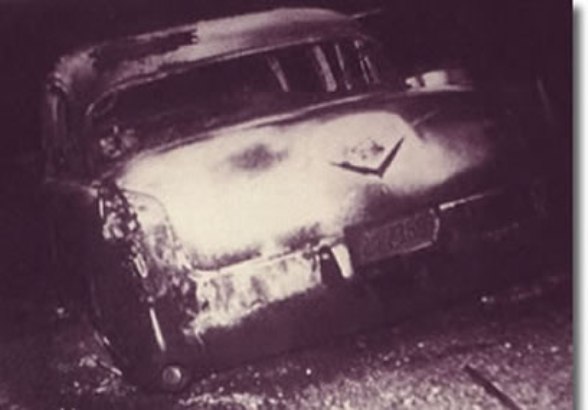
Elvis's dream car goes up in smoke
Neither Elvis nor his passenger were hurt, but Elvis was probably sad to see his dream car, the one he rode on in the Meridian parade, in flames.
On July 7, 1955, Elvis bought his second pink Cadillac. Actually, it was a blue 1955 Fleetwood Series 60 with a black top. He had a neighbor formulate a pink color for it that the neighbor named “Elvis Rose,” and the neighbor painted the car for him. This second Cadillac is the famous Pink Cadillac that Elvis gifted to his mother and became her proudest possession. It is still on display in the auto museum at Graceland.

Gladys Presley's "Elvis Rose" Cadillac in the driveway at Graceland
MYSTERY SOLVED: THE BUILDING WITH THE THREE ARCHES
October 30, 2010 § 1 Comment
In the post below about Elvis in Meridian I posed the question about the building with the three arches. Turns out it was the YMCA located on the corner of 23rd Avenue and Ninth Street, which is now the location of WTOK-TV. The television station renovated the building and removed the arches and porch roofs. Tom Williams, the President of Meridian Regional Airport, sent me an aerial photo of the building in its pre-WTOK state. Here is the pic that Tom sent …
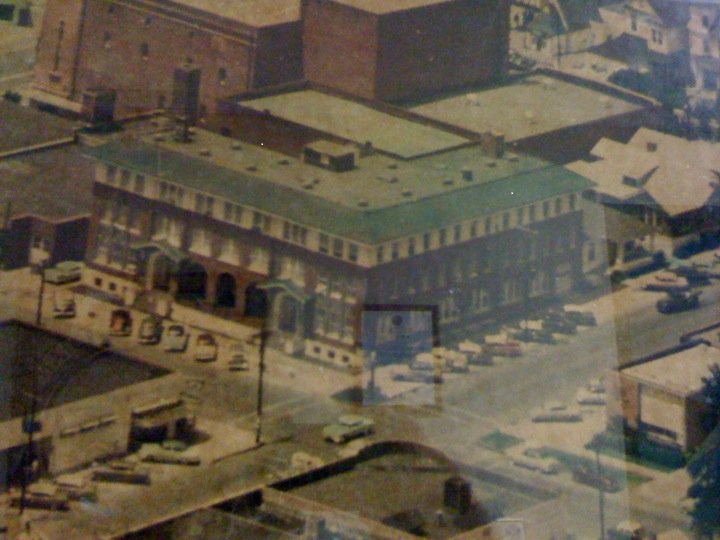
Recognize the three arches and the porch roof from the Elvis parade photo? That’s the Temple Theater directly behind the YMCA Building.
Tom pointed out that he had an interest in the building because his father, Marvin Williams, Esq., at one time had an office in the building.
Thanks to Tom for unlocking this mystery for us. That building would most certainly have been on any downtown parade route.
THE KING OF SOWASHEE
October 30, 2010 § 2 Comments
I have to confess to my second tour this weekend of that mystical shrine of tackiness, Graceland in Memphis, home of Elvis Presley and spiritual Mecca for his adherents. We took some Louisiana relatives who had never been there.
It got me thinking about what I had heard for years — that Elvis had performed in Meridian.
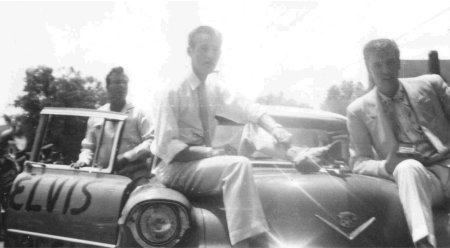
What I had been told was that the King had been in Meridian years ago to perform at the fair and calf scramble before he became famous. I even heard that there were photos. So I dug around on the internet, and actually found a couple of photos. The photos are both dated May 26, 1955, which would predate Elvis’s 1956 appearances on the Milton Berle and Ed Sullivan shows, the gigs that propelled him into national attention. The pictures show him in his more princely days, before he was anointed king.
The photo below shows Elvis and Jimmy Snow riding on a Cadillac in the parade for the 1955 Fair in Meridian. Anybody recognize that building? It’s interesting to me that the crowd appears more interested in whomever is coming up behind Presley and Snow; of course, Elvis back then was merely a musical act from Memphis who was mostly known for his performances on the Louisiana Hayride. Those folks on the parade route had no clue then that they were seeing a future international superstar. Jimmy Snow, incidentally, was the son of country music legend Hank Snow, and deveoped his own career eventually performing on the Grand Ole Opry before becoming a minister in Tennessee.
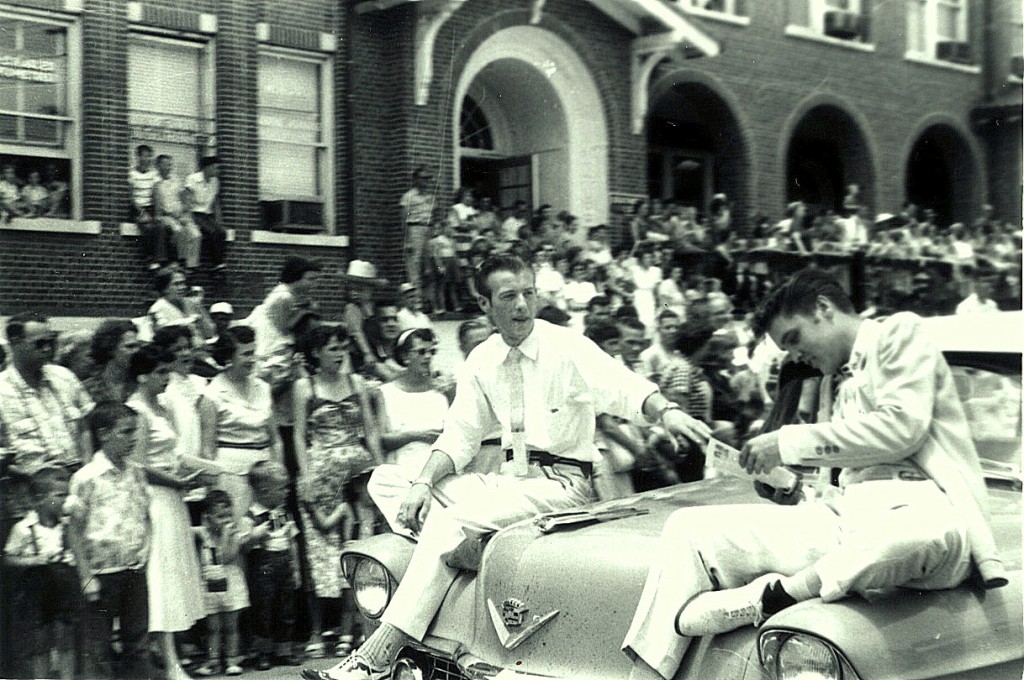
The other photo, below, shows Elvis with Bill Black and Jimmy Snow on the same Cadillac.
Nobody I know in Meridian has developed any oral history about this or any clearcut description of the event.
Here’s an interesting wrinkle: a Wikipedia article on Elvis gives a different time frame …
“The audience response at Presley’s live shows became increasingly fevered. Moore recalled, “He’d start out, ‘You ain’t nothin’ but a Hound Dog,’ and they’d just go to pieces. They’d always react the same way. There’d be a riot every time.” At the two concerts he performed in September at the Mississippi-Alabama Fair and Dairy Show, 50 National Guardsmen were added to the police security to prevent crowd trouble.”
According to the article, this was in 1956, after Presley had appeared on both Milton Berle’s and Ed Sullivan’s tv shows and created a national sensation. Of course, the reference to the Mississippi-Alabama State Fair and Dairy Show is Meridian’s own and was back then. Not enough info for me to resolve the discrepancy in dates beyond doubt. My best guess is that the source for the Wikipedia info, who was part of Elvis’s entourage back then, may be a little confused as to the timing. I would go with the dates of the photos for two reasons: first, that the dates of the pictures are part of their provenance; and second, after the national tv appearances, the crowd in the parade picture would have been far more focused on Elvis.
Steve Labiche did a little more research and found that the Cadillac had been purchased by Presley in Florida, and he had the dealer paint “ELVIS” on the door.
NOTE: the mystery of the building above with the three arches is solved here.
It’s an interesting little tidbit of Meridian history.
JUDGE LACKEY RETIRES
October 5, 2010 § Leave a comment
This from Tom Freeland’s NMissCommentor Blog …
Judge Lackey Retirement Dinner, & request for donations
A retirement party for Hon. Henry Lackey, Circuit Judge of the Third Circuit Court District is being held by the Third Circuit Bar in Oxford on November 4th at the Oxford Conference Center. I’m one of the lawyers collecting contributions toward this dinner, which will also include a retirement gift to Judge Lackey.
Please send any contributions you are willing to make with the check made out to:
Judge Lackey Retirement Party Fund
Send them to me at:
Box 269
Oxford, MS 38655If you send a check, it would be useful to my effort to keep track of donations if you sent me an email telling me you did and how much it was. Send the email to tom (at) freelandlawfirm.com
Invitations to this event will be sent out later this month to members of the Third Circuit Bar and to judges all over the state; if you wish to attend the event and aren’t in the counties of the Third Circuit, send me an email to the address just mentioned and I will see that the information gets to the appropriate person.
Thanks!
[Tom Freeland]
I don’t know how many Twelfth District lawyers have had the privilege to know or practice before Judge Lackey. If you do know him or tried cases in his court, you may want to try to make the event or send a contribution.
I met Judge Lackey back in the 1980’s at a CLE program in New Orleans during Mardi Gras. I had recently finished trying a case before Chancellor Woodrow Brand, sitting as Special Chancellor in Meridian in a trial involving lots of money and a world-renowned manufacturer. At the conclusion of the trial Judge Brand complimented the attorneys on a job well done and took the case under advisement. When he heard that, Judge Lackey raised his bushy eyebrows and remarked with humor and some irony that that sort of compliment was something that lawyers in Judge Brand’s district were simply not accustomed to. We laughed together and swapped tales about practice in our different parts of the state. He knew some Meridian lawyers and judges and asked about them. He was kind, soft-spoken, attentive and humorous, and I enjoyed the little time I spent with him — so much so that I remembered it down through the years.
I ran into Judge Lackey last year at a Judges’ meeting in Tunica, and he remembered the New Orleans seminar and was kind enough to say that he did remember sitting next to me and visiting. He reminded me that there had been an ice storm that Sunday that closed the bridges out of the city so that he and his wife were stranded there an extra day. I had forgotten that. My wife and I had made it out of the city an hour before the bridges were closed.
If Judge Lackey’s long service as a lawyer and as a Circuit Judge were all he accomplished in his career, he would be remembered as a successful public servant. His role in the Scruggs scandal, however, in which he hewed strictly to judicial and legal ethics, and would not deviate an inch from the proper path, elevates him to a higher level of esteem. Not because he did what professional standards required of him, but because of his courage in facing down the beast and bringing it to destruction.
Judge Lackey is a beacon of right shining through the ashy pall that Scruggs and his minions cast over the legal profession and the judiciary. For that let us ever remember him and esteem his memory.
God bless you in your retirement, Judge Lackey.
THE BALDUCCI FILES
October 4, 2010 § 1 Comment
If you’re familiar with the story of Dickie Scruggs’ downfall, you know that the final, climactic act in his Greek tragedy began in the Calhoun City offices of Circuit Judge Henry Lackey, who met with Scruggs operative Tim Balducci and recorded Balducci’s offer to bribe him.
Patsy Brumfield of the Tupelo Daily Journal, has obtained copies of the FBI recordings and has posted them online here. There are four video and three audio recordings. Six are in Lackey’s office, and one is in Scruggs’ office after Balducci has been arrested and has agreed to cooperate with he FBI.
What is most remarkable about them is the prosaic, almost ho-hum nature of the conversations. The tone is business as usual, which is chilling, considering how far-flung were Scruggs’ conflicts with other lawyers similar to the one that led to the Lackey bribe attempt.
Another compelling feature of the recordings is how they show the banal nature of evil. It seldom manifests itself with the dramatic flair we see on tv and in the cinema. It is a handshake, a wink and a nod, an exchange of consideration.
Thanks to Tom Freeland at NMissCommentor for posting about this.
Tom also has a great post today about whether Curtis Wilkie’s upcoming book, FALL OF THE HOUSE OF ZEUS answers some questions about the handling of the Scruggs trial.
EVER IS A LITTLE OVER A DOZEN YEARS
September 12, 2010 § Leave a comment
 W. Ralph Eubanks is publishing editor at the Library of Congress and a native of Covington County, Mississippi. His book, EVER IS A LONG TIME, is a thought-provoking exploration of Mississippi in the 1960’s, 70’s, and the present, from the perspective of a black child who grew up in segregation and experienced integration, and that of a young black man who earned a degree from Ole Miss, left Mississippi vowing never to return, achieved in his profession, established a family, and eventually found a way to reconcile himself to the land of his birth.
It was his children’s inquiries about their father’s childhood that led Eubanks to begin to explore the history of the dark era of his childhood. In his quest for a way to help them understand the complex contradictions of that era, he came across the files of the Mississippi Sovereignty Commission and found his parents’ names among those who had been investigated, and he became intrigued to learn more about the state that had spied on its own citizens.
Eubanks’ search led him to Jackson, where he viewed the actual files and their contents and explored the scope of the commission’s activities. He had decided to write a book on the subject, and his research would require trips to Mississippi. It was on these trips that he renewed his acquaintance with the idyllic rural setting of his childhood and the small town of Mount Olive, where, in the middle of his eighth-grade school year, integration came to his school.
There are three remarkable encounters in the book. The author’s meetings with a surviving member of the Sovereignty Commission, a former klansman, and with Ed King, a white Methodist minister who was active in the civil rights movement, are fascinating reading.
The satisfying dénouement of the book is Eubanks’ journey to Mississippi with his two young sons in which he finds reconciliation with his home state and its hostile past.
If there is a flaw in this book, it is a lack of focus and detail. The focus shifts dizzyingly from the Sovereignty Commission, to his relationship with his parents, to his rural boyhood, to life in segregation, to his own children, to his problematic and ultimately healed relatiosnhip with Mississippi. Any one or two of these themes would have been meat enough for one work. As for detail, the reader is left wishing there were more. Eubanks points out that his own experience of segregation was muted because he lived a sheltered country existence, and his memories of integrated schooling are a blur. For such a gifted writer whose pen commands the reader’s attention, it is hard to understand why he did not take a less personal approach and expand the recollections of that era perhaps to include those of his sisters, or other African-Americans contemporaries, or even the white friends he had.
This is an entertaining and thought-provoking book, even with its drawbacks. I would recommend it for anyone who is exploring Mississippi’s metamorphosis from apartheid to open society.
The title of this book has its own interesting history. In June of 1957, Mississippi Governor J. P. Coleman appeared on MEET THE PRESS. He was asked if the public schools in Mississippi would ever be integrated. “Well, ever is a long time,” he replied, ” [but] I would say that a baby born in Mississippi today will never live long enough to see an integrated school.”
In January of 1970, only twelve-and-a-half years after the “ever is a long time” statement, Mississippi public schools were finally integrated by order of the Fifth Circuit Court of Appeals, a member of which, ironically, was Justice J. P. Coleman, former governor of Mississippi.

Eubanks
FIVE YEARS AFTER
August 29, 2010 § Leave a comment
It was five years ago today — August 29, 2005 — that Hurricane Katrina brought death and devastation to New Orleans, the Mississippi Gulf Coast and south-central Mississippi.
The news this weekend cast the familiar images of flooded homes in the Lower Ninth Ward, Bay St. Louis reduced to piles of debris, the Superdome, victims clamoring for help, and on and on.
The storm was still powerful when it crossed east Mississippi near Newton, bringing 85-mile-per-hour winds with gusts to 105 here in Meridian. More than one thousand homes in Meridian suffered serious damage. It took nearly two weeks to restore electric service throughout the city and county, and the damage to structures took years to repair. The devastation was astonishing considering that Meridian is nearly 200 miles inland.
In the years since Katrina the Mississippi Gulf Coast has rebounded well. Rebuilding is a continuing process, and there are ongoing battles between property owners and insurers, but the resilience of the Coast makes all Mississippians proud.
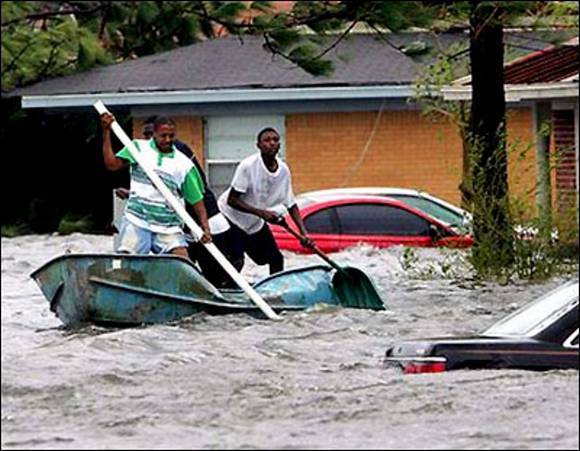 New Orleans, on the other hand, has struggled. The dysfunctional near-anarchy of the Big Easy that has always been one of its most endearing features as an entertainment center has not served it well in its efforts to recover. The city’s population is significantly reduced (the poverty-plagued Lower Ninth Ward had 18,000 residents before the storm and now has around 1,800), and many damaged neighborhoods, particularly in the east, remain mostly boarded up and abandoned. There are still 50,000 abandoned homes in the city. Convention business and tourism, the lifeblood of the city, are greatly diminished. New Orleans is down, for sure, but not out. New Orleans is now the fastest-growing city in the US. The New York Times has an interesting article, with video, showing evolution of two streets near the Industrial Canal in the Lower Ninth both before and since Katrina [Thanks to nmisscommentor for letting us know about it]. There is a University of Southern California study of damage in the area, with video, here.
Today, three tropical cylones are churning across the Atlantic, with yet another tropical wave trailing them out of Africa. Is our next Katrina among them? We pray not.
THE LAST BATTLE OF THE CIVIL WAR
August 28, 2010 § 2 Comments
Through the spring and summer most of my reading has been books dealing with the South in general and Mississippi in particular in the last half of the twentieth century, the era of the struggle for civil rights I still have a few more to read on the topic before I move on to other interests.
One of the seminal events of the civil rights era was the admission of James Meredith as a student at the University of Mississippi in 1962. The confrontation at Ole Miss between the determined Meredith, backed by the power of the federal government, and Mississippi’s segregationist state government culminated in a bloody battle that resulted in two deaths and a shattering blow to the strategies of “massive resistance,” “interposition,” and “states rights” that had been employed to stymie the rights of black citizens in our state.
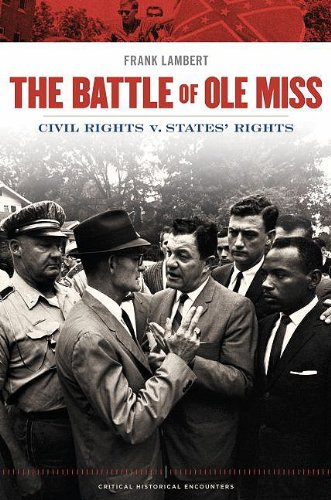 Frank Lambert has authored a gem of a book in THE BATTLE OF OLE MISS: Civil Rights v. States Rights, published this year by the Oxford University Press. If you have any interest in reading about that that troublesome time, you should make this book a starting point.
Lambert, who is a professor of history at Purdue University, not only was a student at Ole Miss in 1962 and an eye-witness to many of the events, he was also a member of the undefeated football team at the time, and his recollection of the chilling address delivered by Governor Ross Barnett at the half-time of the Ole Miss-Kentucky football game on the eve of the battle is a must-read.
This is a small book, only 193 pages including footnotes and index, but it is meticulously researched. As a native Mississippian and eyewitness, Lambert is able not only to relate the historical events, he also is able to describe the context in which they happened.
The book lays out the social milieu that led to the ultimate confrontation. There is a chapter on Growing Up Black in Mississippi, as well as Growing up White in Mississippi. Lambert describes how the black veterans of World War II and the Korean conflict had experienced cultures where they were not repressed because of their race, and they made up their minds that they would challenge American apartheid when they returned home. Meredith was one of those veterans, and he set his sights on attending no less than the state’s flagship university because, as he saw it, a degree from Ole Miss was the key to achievement in the larger society. He also realized that if he could breach the ramparts at Ole Miss, so much more would come tumbling down.
The barriers put up against Meredith because of his race were formidable. He was aware of the case of Clyde Kennard, another black veteran who had tried to enroll at what is now the University of Southern Mississippi, but was framed with trumped-up charges of stolen fertilizer and sentenced to Parchman, eventually dying at age 36. And surely he knew of Clennon King, another black who had managed to enroll at Ole Miss only to be committed to a mental institution for his trouble. Even among civil rights leadrs, Meredith met resistance. He was discouraged by Medgar and Charles Evers, who were designing their own strategy to desegregate Ole Miss, and felt that Meridith did not have the mettle to pull it off. Against all of these obstacles, and in defiance of a society intent on destroying him, Meredith pushed and strove until at last he triumphed.
But his triumph was not without cost. Armed racists from throughout Mississippi, Alabama and other parts of the South streamed to Oxford in response Barnett’s rallying cry for resistance. The governor’s public rabble-rousing was cynically at odds with his private negotiations with President John Kennedy and US Attorney General Bobby Kennedy, with whom he sought to negotiate a face-saving way out. The ensuing battle claimed two lives, injured 160 national guardsmen and US marshals, resulted in great property damage, sullied the reputation of the university, tarred the State of Mississippi in the eyes of the world, led to armed occupation of Lafayette County by more than 10,000 federal troops, and forever doomed segregation. Ironically, the cataclysmic confrontation that Barnett and his ilk intended to be the decisive battle that would turn back the tide of civil rights was instead the catalyst by which Ole Miss became Mississippi’s first integrated state university. It was in essence the final battle of the Civil War, the coup de grace to much of what had motivated that conflict in the first place and had never been finally resolved.
As for Meredith, the personal cost to him was enormous. He was subjected to taunts and derision, as well as daily threats of violence and even death. He found himself isolated on campus, and did not even have a roommate until the year he graduated, when the second black student, Cleveland Donald, was admitted. Meredith described himself in 1963 as “The most segregated Negro in the world.”
The admission of James Meredith to Ole Miss not only opened the doors of Mississippi’s universities to blacks, it also helped begin the process in which Mississippians of both races had to confront and come to terms with each other as the barriers fell one by one. As former mayor Richard Howorth of Oxford recently told a reporter: ” … other Americans have the luxury of a sense of security that Mississippi is so much worse than their community. That gives them a sense of adequacy about their racial views and deprives them of the opportunity we’ve had to confront these issues and genuinely understand our history.”
Meredith’s legacy is perhaps best summed up in the fact that, forty years after his struggle, his own son graduated from the University of Mississippi as the Outstanding Doctoral Student in the School of Business, an event that Meredith said, ” … vindicates my entire life.” His son’s achievement is the culmination of Meredith’s singular sacrifice. What Meredith accomplished for his son has accrued to the benefit of blacks and whites alike in Mississippi, and has helped our state begin to unshackle itself from its slavery to racism.
 The Better Chancery Practice Blog