LAWYER, KNOW THYSELF
January 4, 2012 § 9 Comments
Understanding what makes you tick is a key to understanding how you can be more effective as a lawyer, spouse or parent, and in every other role you undertake. A major element of what makes you tick is your personality. The way in which your personality operates defines you as a unique individual.
Carl Jung posited that personality consists of a combination of three components formed from three dichotomies: extraversion or introversion; sensing or intuition; and thinking or feeling. He saw extraversion or introversion as an attitude, and sensing, intuition, thinking and feeling as ways of functioning. According to Jung, every personality is a combination of one of each dichotomy. For example, an extraverted, sensing, feeling person has one type of personality and an introverted, intuitive, thinking person has an entirely different one. Katherine Cook Briggs and her daughter, Isabel Briggs-Meyers, added a fourth dichotomy based on lifestyle: judging and perceiving (judging = organized and on schedule; perceiving = disorganized and not punctual). Under their methodology, the personality consists of a combination of one each of the four dichotomies, resulting in 16 different personality types.
Briggs and Meyers came up with a personality inventory that sorts you into one of the 16 personality types. You can read more about the Meyers-Briggs Type Inventory (MBTI) here. For convenience, the dichotomies are assigned letters: E for extraversion; I for introversion; S for sensing; N for intuition; T for thinking; F for feeling; J for judging; and P for perceiving. The 16 personality types, then, are: INTP, INTJ, INFJ, INFP, ISTP, ISTJ, ISFJ, ISFP, ESTP, ESTJ, ESFJ, ESFP, ENTP, ENTJ, ENFJ, ENFP. Each has its own unique characteristics and ways of functioning.
Each of the 16 types represents the synthesis of preferences that the personality operates under, or the default settings if you will. Each of us can “turn off” those settings or reset them as the need arises. A strongly feeling person, for instance, can tune down the feeling function in order to operate more rationally in the court room. A more introverted person has to set aside that preference in order to get the full benefit of the Kiwanis Club membership. A judging person has to put away the schedules, personal planner apps, internet and cell phone while on vacation.
So which are you? You can take a brief questionnaire based on the Jungian/Meyers-Briggs typology here. The site will score it for you and give you a synopsis of the characteristics of your personality type, and you can read there more about your and other types. The questionnaire is similar to the MBTI and, in my experience, will produce similar results. For that matter, you can Google Meyers-Briggs and come up with plenty of other sites with much more info and other questionnaires. Some even offer in-depth analyses by “qualified” professionals — for a fee, of course.
A great book that explains personality typology in greater detail is Please Understand Me: Character and Temperament Types, by David Keirsey and Marilyn Bates. It includes the MBTI, which you can take and score yourself, as well as explanations of the various types and how they operate in various settings.
Is the MBTI accurate? Some professionals accept it, others question it, and some pan it. I like it because it’s a gateway to getting you to consider just how you function in this world. Realizing how you learn and process information, how you make decisions, how you work effectively and what is ineffective for you, can help you in almost every area of your life.
Most judges are strongly ST. All I’ll tell you about me is that I am not, so I process information and make decisions differently than some others. The rest you’ll have to puzzle out for yourself.
DOING SOMETHING
December 7, 2011 § Leave a comment
Joe Kieronski and Leonard Cobb, both of whom are Meridian lawyers, are in Haiti this week with a work group from First Baptist Church. Their job is to do what they can while they are there to make life even a wee bit better for the people of that island who have been shattered by earthquake, hurricanes, cholera, corrupt government, and crushing poverty.
I’m proud that members of the bar are in the number of those who would make this sacrifice. They are taking time away from busy and lucrative law practices to subject themselves to primitive living conditions (they are living in tents), as well as the risk of malaria and cholera, amidst unreliable police protection and almost non-existent government. That they would do so is in the most noble spirit of our profession.
The cynics among us might snicker at this paltry effort, and it can not be argued seriously that the work of this little band is more than a mere pittance that will do precious little to overcome the monumental problems of this dysfunctional island. But these volunteers are doing something, and for that they deserve our praise. As Edward Everett Hale said …
I am only one; but still I am one.
I cannot do everything; but still I can do something;
and because I cannot do everything,
I will not refuse to do the something that I can do.
“Well done, good and faithful servants.” Matthew 25:23
WHAT SETS YOU APART?
November 29, 2011 § 3 Comments
Many years ago, when I had been practicing law only a few years, my father-in-law posed this question to me: “What sets you apart from the other lawyers in your town?”
His question was actually “What is it about you that makes people want to hire you instead of any of the other lawyers in your town?”
Now I will confess that I had not really given that sort of thing much thought at the time. With all the demands of a law practice, a family and the myriad other things that make up the life of a young lawyer, I hadn’t taken time to sit down and ponder that sort of thing.
But I have in the many years since. And I learned to become aware of the things that I could do as a lawyer that would add value for my clients. I learned that not all lawyers take time to listen to their clients, to really hear what their concerns are — so I tried to listen better. I learned that most lawyers do not take the time to explain to their clients what is happening and will happen in their cases — so I tried to explain. I learned that many lawyers are impatient with their clients and try to cut them short — so I tried to be patient and give them some attention. I learned that there are lawyers who file sloppy pleadings and discovery — so I tried to make sure that everything I filed looked professional and like it was done with care. I learned that some lawyers do not prepare their clients and key witnesses for trial — so I did, and did a better job than many in litigation.
Sometimes I fell short. But I like to think that most times I succeeded. Simply because I took care to give some thought and attention to what I could do to do a little better job.
My father-in-law also told me that only 10% of people in any profession are superlative, and it takes only a little extra effort and attention to rise above the other 90%. It takes continued attention and effort to stay in that special 10%.
Clients like to think they are getting the best when they spend their hard-earned money to hire a lawyer.
What sets you apart? What is it about the way you practice law that makes people want to hire you instead of the other 90% of lawyers?
THE MORNING AFTER
November 9, 2011 § Leave a comment
As is always the case the morning after an election, I awake to discover that I won some and lost some. I”m sure your experience is pretty much the same.
Overall, though, I’m pleased that we once again came together in this ancient civic ritual of our republic and peaceably renewed our government through the ballot, resolving our differences via democracy.
Cynics will argue that I am wrong, that special interests, plutocrats and autocrats actually govern, and that electoral democracy is a chimera designed to placate the masses. As with all overstatements, there is a kernel of unfortunate truth in that, but even the most hardshell cynic can not deny that we did get to vote, and our votes counted.
Some years ago when I campaigned for the judgeship I now hold, I was astonished at the number of people who told me that they would be happy to vote for me if they were registered to vote, but they weren’t registered because they did not want to bother with jury duty.
Think about it. They are shirking the two core privileges/responsibilities of a citizen in a democracy: the right to vote, and the right to a jury of one’s peers. This is mind-boggling to me. Some of these are the very same people who wave the flag, act like patriots, and criticize politics and politicians with whom they disagree. These are some of the same people who welcome back our troops from conflicts afar and forward partisan emails about supporting our troops.
I don’t know about you, but I don’t think of those people as fellow citizens. They are, I hope, fellow taxpayers, and they are fellow occupants of space on this continent, but citizens? No. They are not supporters of our military. They are parasites sponging off of the blood and sacrifice of all who truly valued our freedom and sacrificed their lives, their fortunes and their sacred honor to preserve it.
Lawyers have traditionally had a special role to play as guardians of our democratic ways. They have been looked to as leaders, policy makers, defenders of those whose rights are threatened, and active in the political arena. That role has been blunted, in my opinion, over the past 25 or so years by one party that has vilified lawyers and cynically attacked their legitimate role in society, as well as by lawyers themselves, who have increasingly become shopkeepers interested more in a safe profile and the bottom line. That’s a pity — if my opinion is accurate. If you disagree, feel free to comment.
So to those of you who exercised the grandest privilege of your liberty yesterday and voted, I tip my hat to you and embrace you as my fellow citizen. We may not have voted the same way, but we made our voices — however small — heard.
And to those of you lawyers who are hunkered down with your bottom line, I urge you to do yourselves and your embattled profession a favor by sticking your head up out of the trenches, look about you at the surrounding landscape, roll up your sleeves, and lead. Critics be damned.
BACK IN THE DAY WHEN LAW SCHOOL WAS REALLY TOUGH
November 3, 2011 § 2 Comments
Law school ground you down, eh? Con Law especially rugged? Took you a while to get back on your feet?
Well, you only thought you had it tough. Take a look at this sad tale of an overzealous law student from the Chicago Tribune’s June 8, 1900, edition.
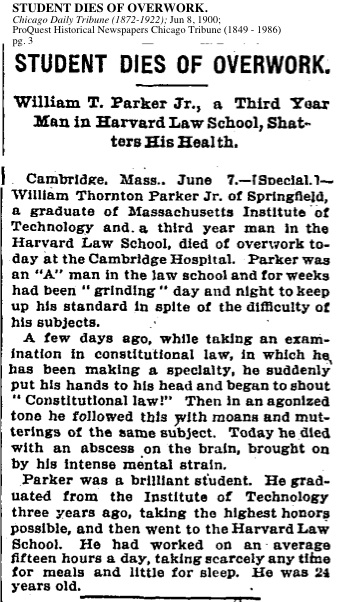
“CONSTITUTIONAL LAW!” he shouted. Indeed. If that had been me, I would have yelled “REAL PROPERTY” and swooned dead away.
___________________________________________________________
Thanks to The Law Life.
ANYWAY
October 27, 2011 § Leave a comment
People are often unreasonable, irrational, and self-centered. Forgive them anyway.
If you are kind, people may accuse you of selfish, ulterior motives. Be kind anyway.
If you are successful, you will win some unfaithful friends and some genuine enemies. Succeed anyway.
If you are honest and sincere people may deceive you. Be honest and sincere anyway.
What you spend years creating, others could destroy overnight. Create anyway.
If you find serenity and happiness, some may be jealous. Be happy anyway.
The good you do today, will often be forgotten. Do good anyway.
Give the best you have, and it will never be enough. Give your best anyway.
In the final analysis, it is between you and God. It was never between you and them anyway.
_______________________________
Credited to various sources, but it doesn’t matter who came up with it; it’s a way to live as a lawyer.
SCRUGGS-PETERS-DELAUGHTER CONNECT-THE-DOTS GAME
October 19, 2011 § 2 Comments
Of all the sad aspects of the Scruggs saga, the one that most troubles me is the chain of events that led to the downfall of Circuit Judge Bobby DeLaughter. Up to now, what we have known of his culpability could be gleaned from his own guilty plea and from reading between the lines of other disclosures. Ed Peters’ involvement, and how he interacted with DeLaughter, has been left mostly to conjecture and street gossip.
Thanks to motions filed by Scruggs in federal court, however, Peters’ grand jury testimony, or a portion of it, has been unsealed, and you can read for yourself the sordid details. Tom Freeland has summarized it, and has another post about it. You can read Peters’ testimony for yourself here and here. Freeland followed up with another couple of posts that you can find on his blog.
Philip Thomas has a post questioning why Peters has never been prosecuted in state court.
Some had considered DeLaughter a sort of wunderkind of the bench. They expected special things of him after he stepped out of the role as prosecutor of Byron De la Beckwith into a circuit judgeship. But he was a long-time associate of Ed Peters, the Hinds County DA, and he allowed himself to be in a position to be influenced by Peters. Peters took advantage of the cozy relationship to demand hefty fees from clients who expected him to influence the circuit judge. Peters’ testimony reveals how they did it.
It still turns my stomach to read this stuff, but it’s important for us to know and understand how this unfolded so that we can take measures to ensure that it will never happen again.
THE UNDISPUTED CHAMP
September 23, 2011 § 1 Comment
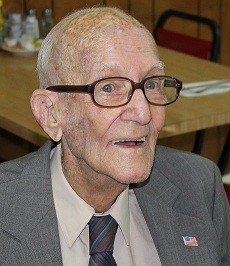 Today marks the 90th birthday of Meridian attorney Champ Gipson. That is Champ on the left.
Champ served in the Army Tank Corps in World War II.
He graduated from Cumberland Law School in Birmingham in 1947, and returned to Meridian to practice with his dad. Champ was in general practice for decades, and now spends his days visiting with his friends in several breakfast and lunch groups, running errands and at home in Tamola with his wife.
TWO PRAYERS FOR LAWYERS
September 16, 2011 § 4 Comments
My Lord God, I have no idea where I am going.
I do not see the road ahead of me.
I cannot know for certain where it will end.
Nor do I really know myself, and the fact that I think I am following your will does not mean that I am actually doing so.
But I believe that the desire to please you does in fact please you.
And I hope I have that desire in all that I am doing.
I hope that I will never do anything apart from that desire.
And I know that if I do this you will lead me by the right road, though I may know nothing about it.
Therefore I will trust you always though I may seem to be lost and in the shadow of death.
I will not fear, for you are ever with me, and you will never leave me to face my perils alone.
This next prayer comes from Alan Lomax’s The Land Where the Blues Began. He recorded it at a black Baptist state convention in Clarksdale in 1942. The sentiment, especially with its reference to a “war coat,” could not be more appropriate for the litigation gladiator.
You know I can’t help from loving You.
Because You loved me myself,
Long before I knew what love is.
And when my time have come
I’ve got the king’s crown in coming glory.
And when I come down to the river,
Help me to pull off my war coat and enter.
I’ll enter in the name of the Lord,
Make my enemies out a liar,
Make us able to bear our burdens.
NEW DISCIPLINARY AND LJA RULES FOR COMMENT
August 30, 2011 § Leave a comment
The MSB is asking for comments on some fairly sweeping proposed changes to the disciplinary rules. You can click on this link to comment.
Unfortunately, you will need to read paragraph by paragraph, comparing your current rules, because there is no redline/italicized version. For that reason, I haven’t had the time to go through the changes and digest them for us here.
The Bar is also asking for your comments on a proposed rule setting up a separate Lawyers and Judges Assistance (LJA) committee. You can click on this link to get to it. This change is part of an ongoing effort to differentiate and separate the LJA function from the disciplinary function. Historically, some lawyers have been reluctant to submit to LJA intervention because it was linked to the disciplinary process, and they were concerned that they were placing their license in jeopardy. The new arrangement focuses on help to resolve self-destructive behaviors.
As always, I encourage you to offer your constructive comments. It’s your profession.
 The Better Chancery Practice Blog