FREEDOM TRAIL
October 5, 2012 § Leave a comment
Last week marked the fiftieth anniversary of James Meredith’s enrollment at Ole Miss. The tumult and combat that surrounded the diminutive Meredith’s entrance to the university has often been characterized as “the last battle of the Civil War.” It’s an event we have talked about here before.
But as much as Meredith did to bring down the oppressive reign of white supremacy, there was much struggle to come after. The bloody summer of 1964 — “Freedom Summer” — was especially noteworthy, because its murders sent a shiver of revulsion through the collective conscience of the nation that directly gave rise to the 1964 federal Civil Rights Act. Gradually, with the weight of the federal government behind it, the civil rights movement demolished barrier after barrier.
And so, as the weeks click by, we will be clicking off fiftieth anniversary after fiftieth anniversary of milestones in the Civil Rights Era.
I saw that one of the events to commemorate Meredith’s feat was the unveiling of a marker on the Mississippi Freedom Trail at Ole Miss. To date, the Freedom Trail has markers at Bryant’s Grocery in Money, Medgar Evers’ home in Jackson, The Greyhound Bus Station in Jackson, Jackson State University, and Mississippi State Penitentiary at Parchman.
A list of the sites planned for the first 30 markers is here.
It’s a bit of a surprise to me that there is no marker slated for Meridian, which: had the biggest COFO operation and Freedom School in the state in 1964; was the base of operations for Schwerner, Goodman and Chaney, who were murdered in nearby Philadelphia; and was the site of the state’s Freedom School Convention in 1964.
There is a group in Meridian that has secured ownership of the old Fielder & Brooks drug store, which housed the COFO headquarters. They plan to restore it and create an educational center there. As always, funding is the main obstacle.
Knowing and understanding our history is vitally important. We have to comprehend the forces that have shaped us, our ethos and the place where we live in order to be able to see clearly where we can and should go from here. The history of racial conflict and gradual reconciliation is so deeply ingrained in our culture that we must know and understand it so that we can know and understand ourselves.
No place on earth is better equipped by experience to show and tell the way out of racial oppression than Mississippi. Others can talk about it, but we are living it, day by day, increment by increment. To bear that witness, however, we must be able to tell our history.
James Meredith bravely blazed a trail to freedom in 1962. Many others, in ways large and small, blazed similar courageous paths. Mississippi’s Freedom Trail will help us remember.
MORE HISTORY OF THE LAUDERDALE COUNTY COURT HOUSE
October 21, 2011 § Leave a comment
I posted here about the evolution of the Lauderdale County Court House, which included various historical photos of the building.
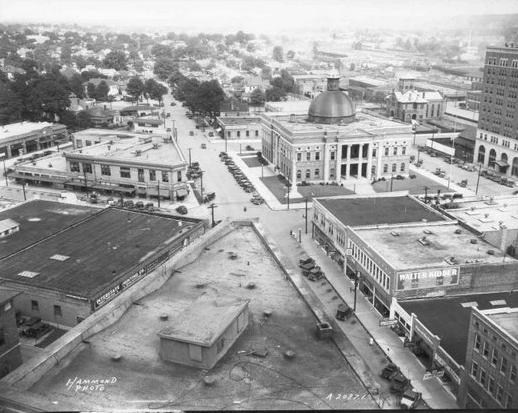
Below is a photo of Meridian looking east-southeast, obviously from a vantage point in the Threefoot Building, Meridian’s 16-story Art Deco icon, which had been built in 1929. The Lauderdale County Court House is the domed, Beaux-Arts-style building in the right center. The photo had to have been taken before 1939, because that is the year when the WPA work removed the dome, replaced it with a squarish jail, and transformed the façade from Beaux Arts to Art Deco. The photo, then, had to have been taken between 1929 and 1939.
If you compare this photo to some in the prior post, you will notice that the statues that originally adorned the court house roof above the west-facing columned entrance are removed. The Confederate memorial has been installed on the northwest corner of the lawn.
In other details of the photo, look to the right of the court house, east of and about a block from the Lamar Hotel building, and you will see the old jail that predated the one installed atop the court house during the WPA renovation.
You will also notice the residential neighborhoods to the east that extend in this photo within a block of the court building. I imagine some of the more everyday lawyers strolled to work from home in those neighborhoods back when this photo was taken. The more prosperous barristers lived in the mansions along Eighth Street, or around Highland Park, or in the ample residences on Twenth-Third and Twenty-Fourth Avenues.
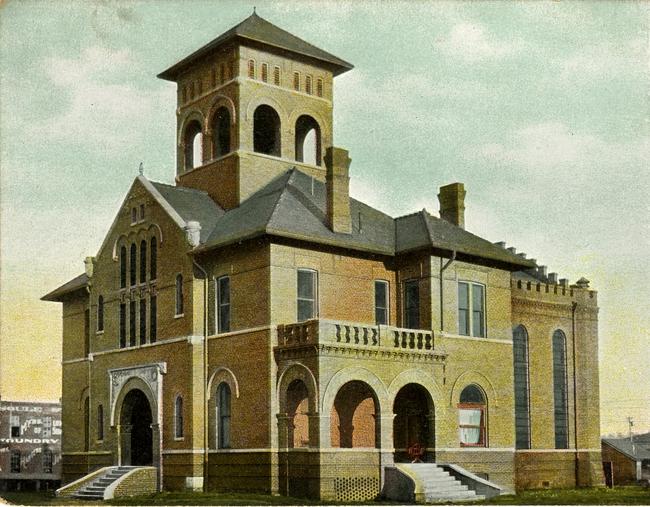
Here is a post-card photo of the jail building. Notice the Soulé foundry building to the left (east) of the jail. Its location will give you a clue as to the site of the old jail.
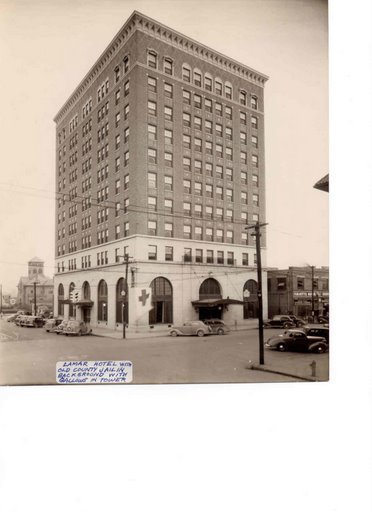
And below is a photo of the Lamar Hotel looking southeast, with the jail to the left, or east. Notice the caption, “Lamar Hotel with old County Jail in background with gallows in tower.” Before the state employed a travelling electric chair, executions for capital offenses were carried out in the various counties by hanging. Meridian, in forward-looking fashion, had a permanent gallows for the purpose, rather than having to go to the expense of constructing an ad-hoc apparatus as the need arose. Even back in those days, Lauderdale County had innovative leadership.
 The Better Chancery Practice Blog