REVENGE OF THE PONY-BIRD
February 15, 2013 § 1 Comment
Don’t you just hate that whooshing sound of a joke sailing right over your head?
Like when the Chinese People’s Daily online reported that the American media had named N. Korean leader Kim-Jung-Un the “Sexiest Man Alive.” >WHOOSH!< It was a joke, man! The American article was published in The Onion. (I hope I don’t need to explain what that means).
I imagine it would be especially distressing to expound in a scholarly fashion on a particular subject only to find out that the authority or data on which that scholarly opinion was a >WHOOSH!< joke.
Like Michael J. Bean and Melanie J. Rowland, who authored a book entitled The Evolution of National Wildlife Law. It’s certainly a worthy subject; I’ll grant that. On page 5, the authors touch on the subject of legal disputes over ownership of new breeds. In footnote 5 on that page, they state:
To illustrate the bizarre results that can sometimes happen when courts consider such questions, see the Canadian case of Regina v. Ojibwa, 8 Criminal Law Quarterly, 137 (1965-66), (Op. Blue, J.), described in United States v. Byrnes, 644 F.2d 107, 112, n. 9 (2d Cir 1981). The Canadian court concluded that a pony saddled with a down pillow was a “bird” within the meaning of a statute defining the term as a “two legged animal covered with feathers.” The court reasoned that the two legs were the statutory minimum, and that the feather covering need not be natural.
Clue: Op. Blue, J. = Opinion by Judge Blue. Or, in Canadian parlance, Blue, J. As in Blue Jay. The bird.
You see, it was a joke. Regina v. Ojibway was a joke, a scholarly one, to be sure, but a joke nonetheless. It was a parody of legal reasoning. I posted about this faux opinion here before, pointing out that ” … scarily, it could easily be mistaken for the real thing.” I guess so. >WHOOSH!<
Thanks to Colette Corr.




YEAR OF THE SNAKE
January 4, 2013 § Leave a comment
According to the Chinese zodiac — and who can argue with that — 2013 is the Year of the Snake.
The idea that this will be the Year of the Snake got me thinking about the law. I guess that’s because, after sharks, snakes are the most likely creatures to be mentioned in the same breath with lawyers, as in “A shark, a snake, and a lawyer walk into a bar …”
If you were born under the Sign of the Snake, the Chinese believe that you possess the snake’s attributes. So what can we learn about lawyers born under this serpentine sign? I did a little research to find out.
From what I read, the snake symbolizes such character traits as intelligence and gracefulness. Good start. Both are certainly desirable traits for any lawyer.
Snakes are also considered by the Chinese to be materialistic. Yes, this is what they maintain, but this seems problematic to me on a couple of counts. First, most materialistic people are considered “grasping,” but how can one grasp when one has no appendage with which to grasp? Second, I am unaware of any hoarding snake species, although I do have to confess that my lack of knowledge is due not only to lack of research on the subject, but also to utter reluctance to do any personal invesitigation. Too, it seems odd to me to think of snakes as materialistic. Magpies, yes. Raccoons, yes. Chimpanzees, yes. Copperheads, not so much. Lawyers? To be honest, I have to admit that the pursuit of materialism that is a motivator for many of us in the legal profession is more shark-like than snake-like.
Not mentioned anywhere in the sources I researched are the facts that snakes are cold-blooded, and have beady eyes, that forked-tongue thing, and fangs. All wincingly stereotypical lawyer traits. Snakes also eat fluffy, cute animals that would be great pets for little children if they were not eaten by the snakes. On the whole probably not so positive an attribute for lawyers, at least in most circles outside of the membership of the bar.
If you were born under this sign, you have no problem making an asp of yourself. Okay, I just made that up to be funny. If you thought it was funny, fangs a lot.
“When it comes to decision-making, Snakes are extremely analytical and as a result, they don’t jump into situations.” I read that on a web site. Now, I don’t know about you, but my encounters with snakes, both the deadly pit vipers, as well as the non-poisonous and merely scary-as-hell kinds, have never given me the impression that they are analytical. In fact, they impress me as being insanely impulsive. And if you’ve ever seen one strike up close, I think you would agree that they do, indeed, “jump into situations.” You would prefer that one not jump into your particular situation.
The authorities say that snakes are effective at getting the things they want. Yes, I think they usually do, considering the consequences of not giving a venomous reptile exactly whatever its cold-blooded heart desires.
According to one piece I read, snakes like calmness, preferring quiet over noise. This may be one reason why none of us has ever heard a snake scream.
Another source said that humans born under this sign want a manageable workload rather than a schedule that’s overly-booked, and they become easily stressed when their lives aren’t peaceful or in order. Next time you encounter a right choleric lawyer who turns out to be a snake, you just might find that she’s too busy and needs some orderly peace and quiet. I am sure you can contrive some ways to turn that to your advantage. But why would someone who craves peace, order and breathing room want to enter the high-pressure legal profession in the first place?
Good question, because although snakes are diligent, creative, hard workers who are excellent problem solvers, my research indicates that good career choices for snakes include: scientist, analyst, investigator, painter, potter, jeweler, astrologer, magician, dietician, and sociologist. No mention of the law.
In their personal relationships, snakes excel at seduction. Interesting. I always thought it was that turbaned flute player who had the cobra in thrall, but the Chinese say it’s vice versa. Snakes can be insecure (who knew?), jealous and possessive (grasping?). The snake is compatible with those born under the sign of the rooster and the ox, and incompatible with pig and monkey. There are all kinds of thoughts I could offer on that, but I will leave you to draw your own conclusions.
Finally, without going into too much detail, different snake years have the added attributes of metal, water, wood, fire, and earth. If you’re a snake, here are yours:
Metal Snake – Years 1941 and 2001
Incredibly goal-oriented, Metal Snakes will stop at nothing to get that which they believe they deserve. Failure is not in their vocabularies. With their money, they’re continually acquiring more and more possessions – for themselves.
Water Snake – Years 1953 and 2013
Influential, motivated, insightful, and highly intellectual are words that best characterize Water Snakes. These Snakes work well with others and enjoy being recognized and rewarded. They’ll reveal feelings to those closest to them, but no one else.
Wood Snake – Years 1905 and 1965
Kind and genuine, these Snakes enjoy building a solid foundation of friends and family whom they love deeply and whose company they enjoy immensely. But even with all this support, Wood Snakes rarely seek the advice of others.
Fire Snake – Years 1917 and 1977
Fire Snakes are more extroverted, forever offering opinions and telling others what’s on their minds. Even so, others enjoy listening to Fire Snakes. They’re very persuasive and are especially good at convincing others that their ways are best.
Earth Snakes – Years 1929 and 1989
Earth Snakes always seem to be calm and content. They’re friendly and approachable and believe that they’ll reap great rewards by working hard and relying on common sense.
I am proud to say that, as an ox myself, I am compatible with snakes. That’s for the best, since I have had many occasions to deal with, handle, and avoid getting bitten by any number of them through the years — professionally and otherwise. I’m with the snakes, too, when it comes to pigs and monkeys. The less I have to deal with those, the better.
GETTING WARNERIZED
November 30, 2012 § 6 Comments
George Warner was chancellor in the 12th District from 1982 through 1994. Every lawyer who ever practiced in his court can tell you dozens of hilarious stories about things that happened during trials and some of his zany opinions. When you got zinged by one of his unexpected rulings, your colleagues would shake their heads and say you were the latest to be “Warnerized.” One example is the case where he denied the parties a divorce and found that they had come to an “exact tie” on the Albright factors, leaving the parties in status quo ante but poorer for their attorney’s fees. Another example is the divorce case where he ordered the sheriff to take possession of the parties’ 26 chickens, and to pluck, gut, clean and freeze them, and then to give each party 13. I never heard whether the sheriff did all that himself or got someone else to do it. Judge Warner also ordered a bailiff in a child-support contempt case to go to a man’s farm and shoot his registered quarter horse to free up the money that the man claimed he was spending on feed. The man relented and the judge granted a reprieve.
Here is one of his gems from a 1990 opinion:
“The problem with going to Court and not telling the truth is many-fold. You run the risk of being charged with perjury which seldom happens, quite frankly. But what is more important, you run the risk of hurting a case rather than helping a case, because there are very few judges that I have ever met who were neither male nor female. They are one or the other, and all of them at one time or another have seen, heard, or been involved in most of life’s problems. Yet, people come to court and assume that judges are stupid, believe anything, or what-have-you. We really don’t. And when we, quite obviously, do not, then we wonder what to do with the facts in a case.
“The defendant runs a one-room motel. I think everybody in town has slept at her house, except her attorney and the manager of the store that fired her for stealing. She didn’t testify that her attorney had spent the night there. I believe everybody else that wandered through this courtroom stayed at her house. Certainly all the male people did. It is a one-bedroom house. It must get crowded over there. It sounded like a dog pound. It is certainly not a place fit and proper to place a child.”
Here is one for the legal scholars from 1987:
“The Statute of Frauds has probably received almost as much attention as perpetuities. Both arose many, many years ago in the days of merry old England. The interpretations of the statute of frauds and the rule against perpetuities vary with who is doing the interpreting. It is almost as bad as Lou Costello’s baseball dialogue of Who is on first and What is on second. This Court admits that I fall into the category of “I don’t know” on third. If I were asked to make a speech tomorrow specifically on the Statute of Frauds, I would suddenly become sick and go fishing.”
And one more from 1991:
“Young man, you come up here. You stand right there. The last person that got up and charged out of my courtroom and slammed the door, I fined him $100 and put him in jail for three days. Now, if you don’t have any more respect for the court than that, I am going to give you something different to do. I find you in willful contempt of this Court. I am going to let you wash every one of the Sheriff’s cars every Saturday for the next four Saturdays. The first day you don’t show up, I will personally carry you to Youth Court and do all I can to encourage the Youth Court Judge to send you to the state reform school. You have no respect for authority whatsoever when you get up and charge out of my courtroom. Do you understand what I am saying? (Answered in the affirmative.) Saturday morning at exactly 8:00 you will report to the Sheriff’s Office. If it is pouring down rain, wear your raincoat. I want them washed in the rain.”
In a notorious case, he slumbered through testimony after lunch only to awaken with a start and exclaim, “Overruled!” The lawyers pointed out that no one had objected, to which the judge replied, “Well, you should have.” [The judge’s version is that he sustained the objection, but the two attorneys present say he overruled it; one of them says that he then asked the judge, “If we should have objected, why did you overrule it?”]
Judge Warner is also known as the judge who entered an order finding himself in contempt for not showing up for a trial, fined himself $100, and went to the clerk’s office and paid it.
The judge still wanders through the courthouse from time to time. One day he came by my office wearing a t-shirt that read “I DO WHATEVER THE VOICES INSIDE MY HEAD TELL ME TO DO.” He dropped by Monday and gave me and several others a copy of his latest book, Through the Eyes of a Judge, which features excerpts from his many opinions. The quotes above are taken from that book.


HAVE A CRISPY FRIED DAY
October 12, 2012 § 2 Comments



YOU CAN TAKE THIS TO THE BANK
August 16, 2012 § 6 Comments
Many more years ago than I care to think about, when I could not have been more than ten years old, my sainted grandfather (paw-paw Walter, we called him) took me in tow and we walked hand in hand out of his appliance store, across South State Street in my little home town of Abbeville, LA, into First National Bank.
First National Bank of Abbeville was a serious place where adults went to perform esoteric rites beyond the ken of youngsters. It was a place of “business” where no childish frivolity was allowed. We entered together. There were the tellers in their crisp, short-sleeved white shirts and clip-on ties (all men), their pomaded hair and balding pates glistening in the fluorescent light. There were the marble-topped tables with brass fixtures and chained pens that patrons used to inscribe bank forms with the runes of commerce. There was an air of solemnity in the little walnut-panelled bank. People conducted their business in a sort of sacramental hush, as if the money and paper passed between them was a kind of commercial communion.
We went into a bank officer’s splendid office and sat in the leather-upholstered chairs facing him across his uncluttered, massive desk. A muted clock tocked out of view. Tasseled drapes hung across the window, obscuring the view of the whitewashed courthouse across the street, but allowing an afternoon splash of light. Some words were exchanged between the adults that I did not understand, but the officer smiled, reached into a drawer and pulled out a page of paper that my grandfather signed. My grandfather handed the man a couple of bills, whereupon the bank officer wrote something on an impossibly tiny book and handed it to me. From what little I understood of cursive writing at the time, I could make out my name on the cover of the book.
Back across the street in his store, my grandfather explained that I now had a savings account with a few dollars in it. The transaction had taken only a few minutes, but it made me feel like I had entered, or at least gotten a glimpse into, the mysterious realm of adulthood. I proudly took my passbook home and put it in as safe a private place as I could, considering the tribe of siblings I grew up with.
Fast forward more than fifty years.
I have had a miniscule savings account at a local bank for several years. The bank required me to open it with only $300 when I opened a home improvement line of credit, now paid off. Why this was required, I don’t know. But the money has languished there, earning pennies every quarter.
Or so I thought. I discovered that the bank has been charging my savings account an “account maintenance fee.” Now, I don’t know about you, but I had thought the deal was that, in return for the safekeeping of my money as long as I left it there, the bank would pay me an almost vaporous amount of interest and have nearly free use of it to earn money for itself.
Nope. They have been charging me a fee to “maintain” something that requires no maintenance as far as I can discern. They also unauthorizedly paid my safe deposit box rent out of the account, depriving me of the documentation I need to include that on my 1040. Then I discovered that they had even charged my account for a payment against the line of credit, which caused the little account to dip below some line of tolerance, costing me a few more farthings. By the way, I was dinged for the extra charge despite the fact that the loan was paid off in full that month and the bank even had to send me an overpayment refund of several hundred dollars. My miserable little account was being nibbled to nothing by the ducks of banking.
I went to the bank and sat down with an 11-year-old “vice president” (okay, I concede he probably was older, but danged near everybody who doesn’t yet have gray hair looks that age to me). I brought with me five checks totalling several thousand dollars, aiming to create an escrow account for a property my wife and I own, and I told the youngster that if we could reach an agreement whereby the bank would let me “save” my money there, instead of pilfering my account whenever the bank needed petty cash, I would deposit those checks into the existing savings account. Alas, to make a long story short, the “vice president” and I could not reach an understanding, and I approached the teller with a “memo advice” from the “vice president” to give me my few remaining dollars. The teller at first told me that there would be a $10 charge to close the account. I told her just to take whatever else the bank felt it needed of my money and give me what few dollars might be left so that I could get out of there before it disappered altogether, or, worse, before they calculated that I owed them money. Her supervisor reversed that closing charge, which made me deliriously happy to be able to escape with an additional $10 of my own money.
I left the bank and went to a credit union down the street. After waiting a tad, I was directed into the offices of the “Member Services” representative, a stern woman who obviously took her duties quite seriously. Her first pleasantries to me were “Driver’s license and Social card,” with her hand out palm up. After which she typed at a computer uninterrupted for several minutes. Our conversation next ventured into home address, mailing address, home phone, work phone, my employer, what the account was for (so she could figure out what kind of account I needed, I guess), and on and on, each question punctuated by a couple dozen computer keystrokes. At some point, I meekly interrupted to inject that I needed my wife to be on the account, which she brushed aside with the statement that “She will need to come here personally to do that.” I pictured my wife taking off work for an hour or so to provide the exact, same information that I was already providing.
Accessibility was the reason that I had wanted an account at the nearby bank or credit union in the first place. I imagined what a convenience it would be to have the money within a block or two of work. At that point, though, as the “Member Services” representatives clacked away on her computer, it dawned on me that the mind-numbing bureaucracy of dealing with these once-neighborly financial organizations cancelled out any perceived advantage of geography. Sitting there while being processed with no greater care than a chicken gone to glory being packaged for a meat rack at Winn-Dixie, it occurred to me that my wife and I already had a joint CMA account at a local brokerage, and I really didn’t need all this. Sure, the CMA account was not conveniently within walking distance, but it was, definitely, a mere phone call away from a transaction. I halted the credit union process, took my DL and SS card, picked up my sheaf of checks, thanked the lady for her trouble, and retreated out of doors into the breathtaking sauna that is Mississippi in August, but that seemed to me to be the fresh air of sanity.
Mulling over my experience, I wondered when and just how we transitioned from the friendly banker who could take a moment out of his busy day to open a tiny savings account for a little boy who might one day grow into a profitable customer, into the grasping, impersonal institutions we have to deal with today. My first impulse was to blame it on the financial meltdown and the resultant spasm of regulation, or maybe it was the nearly irrational fear of terrorism and its possible use of our banking system for all manner of dastardly deeds, or maybe the banks were scrambling for a few bucks in the deflated economy like everone else.
But then I thought back several years ago when I was in practice, and several years before financial collapse. I had had a trust account at Deposit Guaranty since the 70’s, always with impeccably unobtrusive, silent service. DG’s successor at first did fine. Then they were taken over by a financial conglomerate out of Nashville, and started imposing service charges on my trust account. I was able to talk to the few officers remaining from the DG days, all of whom were local, to get the practice stopped. Soon after they were all retired or moved on to other businesses, though, the practice started up again. My secretary got it corrected yet again, for a few months, and then it started up again and could not be changed.
So I took time out of my day to travel downtown to the marble-halled mega-bank and met with an efficient young (no gray hair, so I guess she was around 11) female corporate representative wearing a gold plastic conglomerate name plate. The young lady was nice enough, I suppose, but there was a disconcerting air about her, a hint of what you might see on the Military Channel when they depict a Nazi prison camp with its smiling but insistent matron-in-charge who addressed any disagreement with a painful snap of the crop. I explained to her as tactfully as I could that the law did not allow me, or any other lawyer, to earn any interest on a trust account, and that other banks did not charge a service charge. The advantage to her bank, I tried tactfully as I could to lay out for her that the bank could use the funds free of charge until I needed to do a transaction. She responded through glazed eyes that her mega-bank generally dealt with large corporate accounts, and that they were really not equipped to deal with (read “not interested in dealing with”) these “small accounts” like my little $30,000 trust account. I pointed out that $30,000 was a lot of money to me and my clients, and that I would prefer to have it in a local bank that would not find my little sum too much of a bother … and would not charge me a service charge. I walked out of there with a check and opened a new trust account at another bank.
All of this made me think about how the banks and credit unions, once proud to render a community service to handle your trust account, or your little estate or guardianship account, now want that business only if it’s worth millions and only if the bank stands to make lots of $$$$.
So, I’m sad that we’ve come to this, even in my little Mississippi town where I’ve lived and made my career, where there are lots more people of modest means who need honest, friendly, helpful banking services than there are multi-trillionaires with enough money at hand to buy the entire town (FYI for any of you anonymous trillionaires … I will sell you guys my residence for cash money at appraised value).
Now, I am not advocating for a return to the Andy-of-Mayberry days of my childhood banking experience. Somewhere, though, we’ve made something so easy, that could even be pleasurable, into a major travail. Am I naive and unrealistic in thinking that we should be able to do business without being so, well, business-like? Am I being unreasonable?
Maybe in my dotage I am morphing into another whiney Andy Rooney. I hope not. I try to be reasonable about most things. Just don’t get me started about air travel nowadays. See, we took this trip to Baltimore back in May, and …
MORE SIGNS OF APOCALYPSE NOW*
July 27, 2012 § Leave a comment
*Might as well admit that it’s no longer impending.
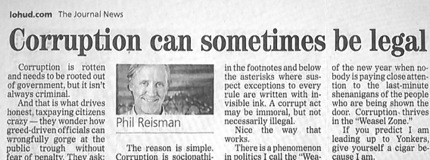
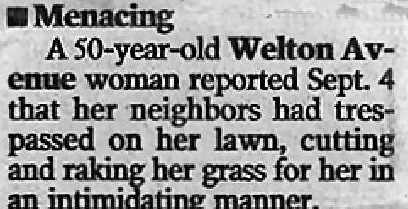
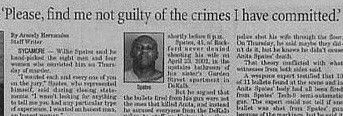
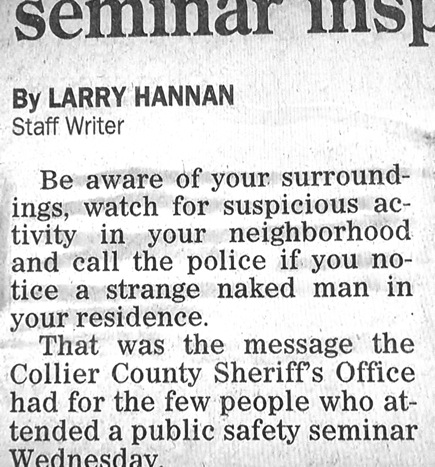

THE CROCE DOCTRINE AND THE BUTLER CORROLARY
July 12, 2012 § Leave a comment
The US 11th Circuit decision in Butler v. Sheriff of Palm Beach County and Collins, decided July 6, 2012, opens with these memorable lines:
In one of his ballads, Jim Croce warned that there are four things that you just don’t do: “You don’t tug on Superman’s cape/ You don’t spit into the wind/You don’t pull the mask off that old Lone Ranger/ And you don’t mess around with Jim.” He could have added a fifth warning to that list: “And you don’t let a pistol-packing mother catch you naked in her daughter’s closet.”
You can read the entire opinion, penned by Judge Carnes, which addresses whether or not Mr. Butler had a federal cause of action (answer = not).
In fiction writing, an opening like that is called a “hook.” It’s a paragraph or two that tease the reader with a tantalizing glimpse of what is to come, creating immediate interest, grabbing attention, and compelling the reader to read on. I think it goes without saying that most (nearly all) appellate decisions lack anything close to a hook.
I encourage our appellate judges to read the Butler opinion, at least the opening lines and the ensuing fact statement. Perhaps a couple of our more creative and intrepid appellate judges will take inspiration from Judge Carnes and add a creative twist to their work. It couldn’t hurt.
[Thanks to “Suzy Q” for the reference to the Butler opinion]
 The Better Chancery Practice Blog