AND THE OSCAR GOES TO …
February 25, 2011 § 8 Comments
Oscar weekend is nigh, which got me thinking about movies depicting lawyers, courts and the law. So I made a list of my own, personal favorites to share with you.
- TO KILL A MOCKINGBIRD. (1962) Small-town lawyer Atticus Finch accepts the almost impossible task of representing a black man accused of assaulting a white woman in 1930’s Alabama. The nobility, integrity and perserverance with which he carries out his duty as an officer of the court earn the mythical Finch universal admiration and respect. Gregory Peck is branded in our mind as Finch.
- INHERIT THE WIND. (1960) Remarkable rendering of the infamous Scopes “monkey trial” in Dayton, Tennessee, that pitted Clarence Darrow, (Spencer Tracy) aka Drummond in the movie, against William Jennings Bryan (Frederic March) aka Brady. Tracy and March were phenomenal in their portrayal of the two courtroom warriors. The trial was about the right to teach evolution in the public schools, but the movie was a fairly transparent criticism of and parable about McCarthyism.
- JUDGMENT AT NUREMBERG. (1961) The courtroom scenes reverberate with drama in this depiction of the post-World War II trials of Nazi officials in Germany. Perhaps the most compelling acting is that of Maximilian Schell as a German defense attorney who raises some troubling questions about individual responsibility in the milieu of a criminal state. Spencer Tracy portrays an all-too-human American presiding judge who is singlemindedly devoted to the rule of law. Burt Lancaster, James Widmark, Marlene Dietrich, Judy Garland and Montgomery Clift all deliver powerful performances.
- THE VERDICT. (1982) Paul Newman is a boozy, broken-down lawyer on the downside of a mediocre career. He takes on a medical malpractice case hoping for a big payday, but learns as the case develops that he has a chance, perhaps the last in the twilight of his career, to accomplish something really good.
- 12 ANGRY MEN. (1957) The dynamics of jury deliberation in a murder case. Henry Fonda is the holdout who will not vote to convict, and as tension builds, with some jurors only wanting to finish their job and go home, the discussion begins to change minds. Lee J. Cobb plays a juror determined to convince the others to convict.
- MY COUSIN VINNY. (1992) Hilarious depiction of a rural Alabama murder trial that is anything but routine, with Fred Gwynne as the trial judge and Joe Pesci as the improbable, inexperienced lawyer who stays on the wrong side of the judge. Marisa Tomei won an Academy Award for best supporting actress for her role as Pesci’s cute girlfriend who unexpectedly holds the key to the case.
- ANATOMY OF A MURDER. (1959) Jimmy Stewart is a trial lawyer defending a veteran charged with murder, and as the trial unfolds, so does his understanding of his client, the man’s wife, the victim and his family. The trial judge was played, somewhat woodenly, by an actual state trial judge. You may have to suspend your disbelief at some of the court room scenes, but the drama is worth it.
- THE CAINE MUTINY. (1954) It’s a case of the victim becoming the villified in the court martial trial for mutiny aboard the USS Caine. The ship’s captain, Humphrey Bogart, becomes the one on trial for all of his flaws and lapses in judgment at sea. José Ferrar is brilliant as defense lawyer Lieutenant Barney Greenwalt, who ably and zealously defends the mutineers, even though he despises them.
- PHILADELPHIA. (1993) Tom Hanks is a young and upcoming lawyer who finds his career at an end when he is diagnosed with AIDS. One of the first Hollywood films openly on the subjects of HIV and homosexuality. Hanks, as Beckett the lawyer, finds his work being sabotaged by his homophobic colleagues, and his legal career itself placed on trial when charges are brought against him.
- A MAN FOR ALL SEASONS. (1966) Sir Thomas More, Chancellor of England in the reign of Henry VIII, has come to epitomize the lawyer who is faced with having to resolve conflicts between his duty to the law and government, and his duty to faith and his conscience. Paul Scofield gives a powerful performance as the man who would not be swayed by political intrigues and conniving men.
- THE PAPER CHASE. (1973) Once you have recovered from the post-traumatic stress following your law school graduation, you may be able to relax and enjoy this now somewhat dated look at what it is like to suffer through being a student at Harvard Law School.
- A FEW GOOD MEN. (1992) Another court martial film. Prosecutors Tom Cruise and Demi Moore have to conquer a conspiracy of silence and misplaced loyalties to win the conviction of two Marines charged with murdering a fellow Marine. Jack Nicholson is diabolical in his depiction of Colonel Nathan Jessep, who defends the soldiers’ actions.
- AND JUSTICE FOR ALL. (1979) A suicidal trial judge packing a .45, a lawyer who admits — no, insists — during trial that his client is guilty, and the unforgettable line, “You’re out of order! You’re out of order! This whole trial is out of order!” Al Pacino is a trial lawyer amidst a justice system careening crazily out of control.
- A TIME TO KILL. (1996) Violence begets violence in a racially charged Mississippi murder trial. Based on the first novel by John Grisham.
- AMISTAD. (1997) Courtroom drama set in 1839 showing the trial over ownership of a slave vessel that had been commandeered by rebellious slaves. Based on a true story, in which both Martin Van Buren and John Quincy Adams participated. Retired Supreme Court Justice Henry Blackmun played the role of Justice Joseph Story.
- THE MAGNIFICENT YANKEE. (1950) Bio-pic showing the life of Oliver Wendell Holmes from his acceptance of a seat on the U.S. Supreme Court at age 61, through the next 25 years.
- INTOLERABLE CRUELTY. (2003) George Clooney and Catherin Zeta-Jones in a zany Coen Brothers movie about a cagy divorce lawyer who sets and springs traps on opposing parties, only to find himself trapped in one of his own devices. Or is he?
- ERIN BROCKOVICH. (2000) This one is for the paralegals. Julia Roberts plays the indomitable Brockovich, who takes on Pacific Gas & Electric on behalf of an indigent woman who is powerless (no pun intended) against the energy giant. The movie crackles with energy and idealism.
- THE PEOPLE VS. LARRY FLYNT. (1996) It’s hard to find anything to like about Larry Flynt (Woody Harrelson), the publisher of Hustler magazine. Yet his battle to defend his First Amendment rights, all the way to the US Supreme Court, in which he was a victim of a crippling assassination attempt, is a fascinating chapter in American law.
- A CIVIL ACTION. (1998) John Travolta is a lawyer who starts out to clean up a local water supply only to find himself engaged in an epic battle against big business that leaves his legal career and personal life in ruins. He ultimately prevails, but was the cost worth it?
- GHOSTS OF MISSISSIPPI. (1996) Hollywood’s version of the Byron de la Beckwith trial for the murder of Medgar Evers is instructive for its glimpse into Mississippi’s ascent from the abyss of violent racism, even though the film relies on stereotypes and cliches to make its points. It’s interesting to view the film 16 years after the event knowing that the protagonist who brought the assassin to justice, Bobby DeLaughter (Alec Baldwin), would later suffer his own downfall.
- ADAM’S RIB. (1949) Spencer Tracy and Katherine Hepburn in a farcical legal tangle. Tracy is a prosecutor, and Hepburn, his wife, is defending a woman that Tracy is prosecuting. The competitive couple use every ploy possible to prevail in the case, and the manic competition naturally infects their personal lives.
- KRAMER VS. KRAMER. (1979) It would not likely turn out the same way under Mississippi law, but in this story Dustin Hoffman gets custody of his son so that his ex-wife, Meryl Streep, can “find herself.” He later loses custody to her in a court fight based on a finding that she has indeed “found herself.” Great Academy Award-winning acting and a heart-tugging story.
- MICHAEL CLAYTON. (2007) George Clooney is Clayton, a lawyer whose sole job is to clean up messes made by his large firm’s clients and the lawyers themselves. When he gets too close to the truth after one of his law partners is found dead of an apparent suicide, Clayton finds himself in the crosshairs.
- YOUNG MR. LINCOLN. (1939) Lincoln the lawyer, played by Henry Fonda. The court room scenes are supposedly authentic re-enactments of the practice and procedure of the period, although the story itself is apocryphal.
There are some others that could make the list. The court room scenes in A FISH CALLED WANDA are some of the best ever, but the movie is not really about the law and courts. LEGALLY BLONDE has some great chuckles about law school, but it’s more about a young woman’s pursuit of her botfriend. And THE WAR OF THE ROSES is an outrageous tragi-comedy about the atrocities committed against each other by a divorcing husband and wife, but the lawsuit is merely the framework for the conflict.
Any other nominees?
ELVIS IN MERIDIAN: THE PINK CADILLAC
November 5, 2010 § 1 Comment
I posted about Elvis Presley’s appearance in Meridian in 1955 here.
Several people who saw the Meridian parade with Elvis in person told me they remembered that the car was pink. Turns out their memories were on target.
According to this Elvis fan’s website, Elvis had purchased the car, a 1954 pink and white model, in March, 1955, only 2 months before the Meridian parade photos that I posted. He used it to transport himself and his back-up musicians, Scotty Moore, D. J. Fontana and Bill Black, who were billed as the Blue Moon Boys, to various gigs around the south. Elvis had made it known to all of his friends and fellow performers that it was his dream to own a pink Cadillac. The one he rode in Meridian was his first.
On June 5, 1955, Elvis and his band had completed a show at Hope, Arkansas. The next show was in Texarkana, and Elvis invited a local girl to ride with him in the Cadillac, while Moore, Black and Fontana rode in another car with some friends. Near Fulton, Arkansas, about half-way to Texarkana, a brake lining on the Cadillac caught fire, and the car burned up.
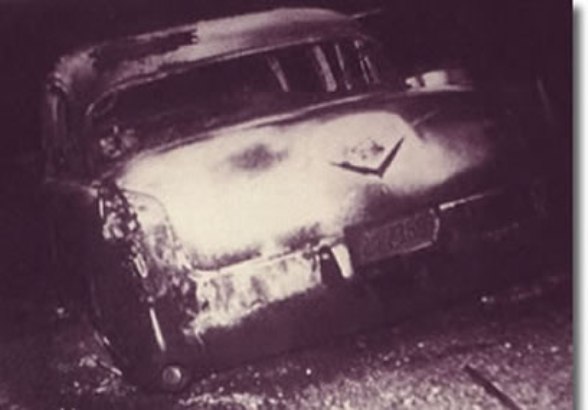
Elvis's dream car goes up in smoke
Neither Elvis nor his passenger were hurt, but Elvis was probably sad to see his dream car, the one he rode on in the Meridian parade, in flames.
On July 7, 1955, Elvis bought his second pink Cadillac. Actually, it was a blue 1955 Fleetwood Series 60 with a black top. He had a neighbor formulate a pink color for it that the neighbor named “Elvis Rose,” and the neighbor painted the car for him. This second Cadillac is the famous Pink Cadillac that Elvis gifted to his mother and became her proudest possession. It is still on display in the auto museum at Graceland.

Gladys Presley's "Elvis Rose" Cadillac in the driveway at Graceland
WEIDMANN’S & SUCARNOCHEE REVUE
August 7, 2010 § 1 Comment
We made it to the newest version of the new Weidmann’s last night. The food was pretty good. The company was great. I’ll withhold a review while they get through their shakedown period. We’ll be back, and I am eager to try them out for lunch. Here are a few pics …
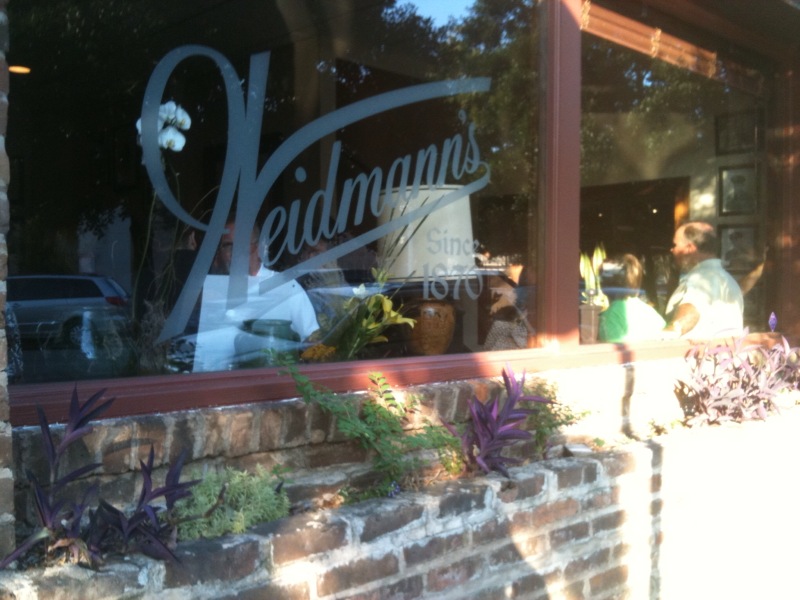
The old logo is back

An old icon returns
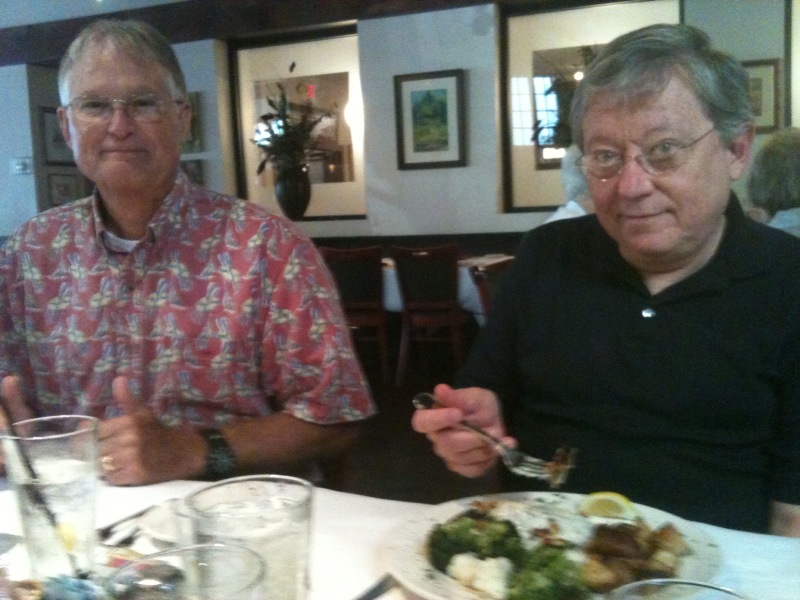
Enjoying the meal

Stuffed flounder
After dinner, we ambled over to the Sucarnochee Revue at the Temple Theater, beginning their seventh year. As it happened, the show was being recorded by MPB for airing later, and it was announced that the public network will televise 26 shows. Last night’s production featured music of Elvis and Meridian’s Jimmie Rodgers. It was the first time for Lisa and me. The music ranged from bluegrass, to mountain folk, to jug band, to blues, to rock and roll, to country. The quality was surprisingly good, although that should not be surprising, given Meridian’s history of talented musicianship.
The show was a great reminder that Mississippi is indeed, the birthplace of America’s music, and that Jimmie Rodgers played a major role.
Performers included Britt Gulley and Water Mocassin, Jakeleg and the Stompers, Dr. Jim Matthews, and Track 45. There were many others, but I never could put my hands on a program, before or after the show, and I didn’t have pen and paper to write them down. Next time I’ll try to do better. Here are a couple of pics …

Audience grows

Entertained by the house grand organ before the show
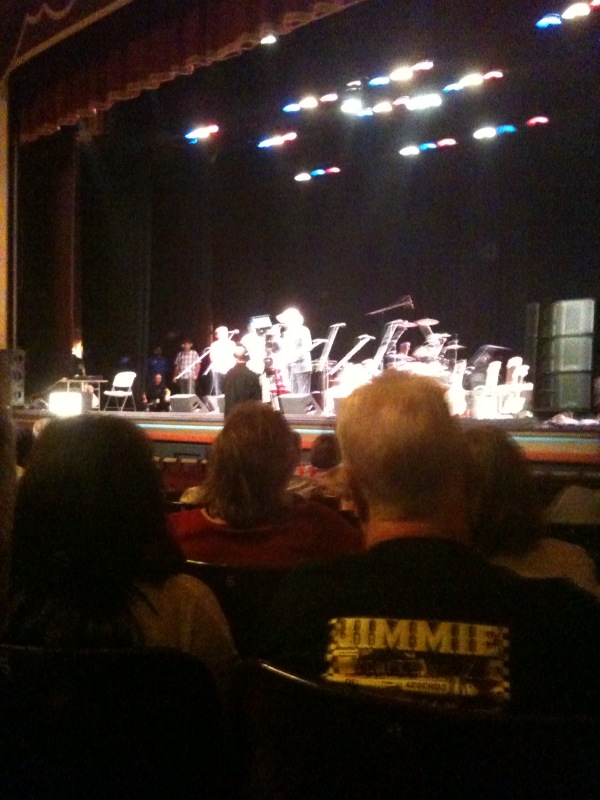
The show
 The Better Chancery Practice Blog