JOINT CUSTODY IN THE CHILDREN’S BEST INTEREST
June 19, 2012 § 3 Comments
The case of Easley v. Easley, decided by the COA June 5, 2012, is the latest iteration of the principle that the trial court may award joint legal custody in an irreconcilable differences consent divorce even where there is no specific joint request for it by the parties.
In Easley, the parties consented to an irreconcilable differences divorce and submitted the issue of child custody to the chancellor for adjudication. The chancellor found that joint custody would be in the best interest of the children, but concluded that he could not award it because of the language of MCA 93-5-24(2), which reads, “Joint custody may be awarded where irreconcilable differences is the ground for divorce, in the discretion of the court, upon application of both parents.” Since the Easleys had not both applied to the court specifically for joint custody, the chancellor awarded custody to the father and the mother appealed.
The COA reversed and remanded, citing and quoting Crider v. Crider, 904 So.2d 142, 147 (Miss. 2005), as follows:
It is logical and reasonable that “application of both parties” exists when both parties consent to allowing the court to determine custody. The fact that the parties request that the court determine which parent is to receive “primary custody” does not alter this. The parties are allowing the court to determine what form of custody is in the best interest of the child. If joint custody is determined to be in the best interest of the child using court-specified factors, i.e., the Albright factors, the parties should not be able to prohibit this by the wording of the consent. It would be the same if the parties requested that the court determine which party will receive “all marital assets.” The chancellor has the responsibility to determine how to best distribute the assets according to court-specified factors (the Ferguson factors) and must not be bound by the wording of the consent to award all marital assets to one party.
The COA opinion goes on to reject the appellee’s argument that he prevailed slightly in trial court’s adjudication of the Albright factors, so that the award of exclsuive custody to him should be upheld. Judge Fair’s opinion cited and quoted Jackson v. Jackson, 82 So.3d 644, 646 (Miss.App. 2011), as contrary authority:
[The father’s] argument appears to be based on the mistaken assumption that joint custody cannot be awarded if more of the Albright factors favor him, however slightly. We see no reason why some marginal advantage of one parent should preclude the chancellor from awarding joint custody, so long as both parents are fit and joint custody is found to be in the children’s best interest[]. See Phillips v. Phillips, 45 So. 3d 684, 694 (¶30) (Miss. Ct. App. 2010). “The Albright factors are a guide. They are not the equivalent of a mathematical formula.” Lawrence v. Lawrence, 956 So. 2d 251, 258 (¶23) (Miss. Ct. App. 2006) (citation and quotation omitted).
The COA opinion closes with a remand to the trial court to consider the children’s present circumstances as well as those existing at the time of the November, 2010, trial, and closes with this language at the end of ¶11: “If joint custody remains in the children’s best interest, the chancellor should not hesitate to award it.”
A previous post focusing on Crider is here.
As for the Crider court’s reference to the term “primary custody,” you should keep in mind that the addition of the term “primary” to custody adds no legal meaning whatsoever. You can read a post on that point here.
A previous post about decision-making in joint legal custody arrangements is here.
And some general observations about joint custody are in a post you will find here.
I think Crider is clear that any time you submit custody to the court for adjudication in an irreconcilable differences divorce via consent you are opening the door to an award of joint custody, no matter what the language of the consent, and you can not word the consent in such a way as to rule it out.
FORTY-ONE DON’TS IN A DIVORCE
June 18, 2012 § Leave a comment
I could not possibly say it any better than Clinton attorney Randy Wallace, who lays out “40……make that 41 things NOT to do during your divorce” in his blog.
CLEARLY CONVINCING
May 24, 2012 § Leave a comment
Several chancery matters require proof by clear and convincing evidence.
- Every ground for divorce but habitual cruel and inhuman treatment requires clear and convincing evidence. See, Bell on Mississippi Family Law, 2nd Ed., §4.02[1][b].
- Proof of the elements of adverse posession requires clear and convincing evidence.
- Proof of undue influence in inter vivos gifts between spouses requires clear and convincing evidence.
- Undue influence and confidential relationship in a will contest requires clear and convincing evidence.
- Lack of mental capacity to make a deed or will must be proven by the challenger’s clear and convincing evidence, although the proponenet of a will needs to prove capacity only by a preponderance.
There are others, I am sure, but you get the point. Muster the necessary quality of proof or fail.
So, what exactly does constititute clear and convincing evidence, anyway? The COA in Hill v. Harper, 18 So.3d 310, 318 (Miss. App. 2005), defined clear and convincing evidence as:
“That weight of proof which produces in the mind of the trier of fact a firm belief or conviction as to the truth of the allegations sought to be established, evidnce so clear, direct and weighty and convincing as to enable the fact finder to come to a clear conviction, without hesitancy, of the truth of the precise facts of the case. Moran v. Fairley, 919 So.2d 969, 975 ¶24 (Miss. Ct. App. 2005) (quoting Travelhost, Inc. v. Blandford, 68 F.3d 958, 960 (5th Cir. 1995)). ‘Clear and convincing evidence is such a high standard that even the overwhelming weight of the evidence does not rise to the same level.’ Id. (Citing In re C.B., 574 So.2d 1369, 1375 (Miss. 1990).”
30 Am.Jur.2d, Evidence, §1167, provides this:
“The requirement of “clear and convincing” … evidence does not call for “unanswerable” or “conclusive” evidence. The quality of proof, to be clear and convincing has … been said to be somewhere between the rule in ordinary civil cases and the requirement of criminal procedure — that is, it must be more than a mere preponderance but not beyond a reasonable doubt. It has also been said that the term “clear and convincing” evidence means that the witnesses to a fact must be found to be credible, and that the facts to which they have testified are distinctly remembered and the details thereof narrated exactly and in due order, so as to enable the trier of facts to come to a clear conviction, without hesitancy, of the truth of the weighing, comparing , testing, and judging its worth when considered in connection with all the facts and circumstances in evidence.
SHORTCUT TO FAILURE
May 16, 2012 § 6 Comments
Sanford v. Sanford, decided May 8, 2012, by the COA is the latest in a line of cases that mandate a written agreement settling all issues between the parties before the trial court may grant an irreconcilable differences divorce.
I will spare you a recitation of the convoluted procedural history that led to the appeal. You can read it for yourself. In essence, what happened is a fairly familiar script:
- Parties and attorneys assemble for some proceeding, perhaps a temporary hearing;
- In the course of negotiations, the attorneys sense that the whole case can be settled. It may be that one or both parties have been intransigent up to this point and the lawyers sense that if they push ahead, maybe they can get the case resolved;
- The lawyers shuttle back and forth cajoling and wheedling, cobbling together a rough product, doing their best to smooth the edges, with uneven success;
- Finally, in hopes that the “settlement” can be held together against the stresses, they recite it into the record, get the parties to mumble their assent numbly, have the court approve it, and get the court reporter to transcribe it as the “written agreement.”
In Sanford, however, Samantha reconsidered and filed a withdrawal of her “consent.” The chancellor denied it, she appealed, and the COA reversed, reiterating its rule that the consent must be in writing, and that it is not sufficient to have the court reporter take the dictated agreement and treat it as an enforceable consent to divorce and/or PSA. In making its decision, the court distinguished a couple of cases that have upheld announced agreements.
Judge Fair dissented, joined by Judges Carlton and Barnes. They would have held that the procedure satisfied the written agreement requirement of the statute. I think most practitioners who have been in that hot-box situation would join in the dissent. But the majority of the court is more comfortable with the formality of a separate, written, signed agreement.
Many lawyers come to court toting along a laptop or at least a zip-drive (i.e., thumb-drive, or USB-drive) or other storage device with form files so that they can hammer out a PSA or agreed judgment or consent while the judge waits. Those of you who are handicapped by being chained to 19th-century technology (pen and paper or quill and parchment) will either have to drag along a secretary with the necessary skills, or upgrade your skills into the 21st century, or tell your client a settlement will just have to wait until some less opportune time.
In any event, the message Sanford sends is pretty clear: get a written agreement signed by the parties if you expect it to pass appellate muster. Shortcuts will not be tolerated.
I used to tell my clients,” We can do it quick or we can do it right.” Translation: “We can cut corners, or we can take a tad longer and make sure we do it in such a way that it can’t be undone.”
THE MARITAL DEBT CONUNDRUM
April 11, 2012 § Leave a comment
I posted here about allocating marital debt. Debts that are clearly for the benefit of the household are debts that the court should assign to one or both parties in a divorce, applying the equitable principles laid out in Ferguson. No distinction is made between secured and unsecured debt.
Under our case law, we treat debts the same as we do assets for the purposes of equitable division. We classify them as marital or non-marital, place a valuation (the loan balance) on them, and equitably assign responsibility for them. That approach works well in general for debts that are secured by assets that are subject to equitable distribution. The debt in most instances reduces the asset value and goes with the person who gets the asset. Fair enough.
But what about where the debt is for expenses such as day-to-day living expenses or other family expenses that do not result in an asset in the household? I’m talking about credit card debt to pay the light bill, or to buy Christmas presents, or to pay for a family weekend in Gatlinburg, or to buy groceries at Wal-Mart? None of that kind of debt produces an asset. It’s debt that produced cash that was spent up in the ordinary course of living. Had the parties lived within their means, those expenses would have been paid out of ordinary income by the parties, but they chose to incur debt for them instead.
Expenses of the types described immediately above are part of routine, everyday life. If it is reasonable to allocate marital debts for those kinds of expenses to the parties, then why would it not be reasonable to track back through the marriage and account for all expenses, whether charged on a credit card or not, and allocate them between the parties? Say, for instance, that the parties in a hypothetical case spent $30,000 in a hypothetical year on groceries, household goods, utilities, toys for the children, medicine, cable tv, internet access, yard work, medications, property taxes, and on and on and on. If they filed for divorce, why would it not be reasonable, under the same logic we apply to marital debt, to go back and investigate how much they each contributed and then charge the one who contributed less with the difference? And if it is reasonable to do that, why do we not do it in all cases, even where the parties have been married 10, 20 or 30 years or more? Why not examine each year of the marriage, reconstruct the expenditures and equitably allocate the expenditures? Imagine what it would be like to try such a case. Horrors.
As absurd as the above sounds, we take exactly that approach in regard to marital debt. There is no limit on it. There is no threshhold. Whatever the debt is, and however long it took to amass it, we allocate it equitably. As it stands now, there is no limit to how far one can go back to claim reimbursement for or an allocation of marital debt or for how much.
It is logical, of course, that the debt is merely the residue left over after the expenses have been paid. In a divorce, debt is literally the ashes of a failed marriage. The debts are still there long after the expenses have gone away, and equity requires that the parties who enjoyed its benefits should share its burden. I understand that. What I don’t understand is that we have not imposed any reasonable parameters on it.
THE CURSE OF HCIT STRIKES AGAIN
April 4, 2012 § Leave a comment
Amanda Alexander filed for divorce charging her husband, Khari, with the sole fault ground of adultery. She had discovered amorous emails on Khari’s computer. For his part, Khari admitted being attracted to other women, and even having flirtations with them, including one episode in which he was alone in a hotel room with a woman and put on a condom, but he denied adultery.
Amanda also testified that Khari threatened her and used profane language, slapped a phone out of her hand when she attempted to call the police, and took her car keys so that she had to get the help of police to get them back.
At the conclusion of the trial, the special chancellor found that Amanda had not proven adultery and suggested that she move to amend her pleadings under MRCP 15 to seek a divorce on the ground of habitual cruel and inhuman treatment, which she immediately did, and the judge granted Amanda the divorce on that ground.
Khari appealed, complaining that it was improper to allow the amendment because the requirements of MRCP 15(b) were not met to allow an amendment.
The COA reversed. In Alexander v. Alexander, decided March 27, 2012, Judge Lee, writing for the court, said, beginning at ¶8:
“Mississippi Rules of Civil Procedure Rule 15(b) states that “when issues not raised by the pleadings are tried by expressed or implied consent of the parties, they shall be treated in all respects as if they had been raised in the pleadings.” We find the ground of habitual cruel and inhuman treatment was not pled by express or implied consent of the parties. The bulk of the testimony in this case centered around Khari’s e-mails to other women from his personal computer. Acts of adultery may be used as a factor to prove habitual cruel and inhuman treatment. Fisher v. Fisher, 771 So. 2d 364, 368 (¶13) (Miss. 2000). However, the chancellor found Amanda failed to prove adultery.
¶9. Further, even if habitual cruel and inhuman treatment was tried by express or implied consent of the parties, the evidence does not support a divorce on this ground. In order to establish the basis for a divorce on the ground of habitual cruel and inhuman treatment, the claimant must show by a preponderance of the evidence conduct that:
either endanger[s] life, limb, or health, or create[s] a reasonable apprehension of such danger, rendering the relationship unsafe for the party seeking relief, or in the alternative, be so unnatural and infamous as to make the marriage revolting to the offending spouse and render it impossible for that spouse to discharge the duties of the marriage, thus destroying the basis for its continuance.
S. Hand, Mississippi Divorce, Alimony and Child Custody § 4-12 (2d ed. Supp. 1991); Gardner v. Gardner, 618 So. 2d 108, 113-14 (Miss. 1993). A causal connection between the treatment and separation must exist. Fournet v. Fournet, 481 So. 2d 326, 329 (Miss. 1985). “It is an extreme set of facts that will prove a divorce based upon habitual cruel and inhuman treatment.” Moses v. Moses, 879 So. 2d 1043, 1047 (¶9) (Miss. Ct. App. 2004) (quoting Keller v. Keller, 763 So. 2d 902, 908 (¶29) (Miss. Ct. App. 2000)).
The court went on to find that Amanda’s proof did not meet the standard required to prove habitual cruel and inhuman treatment (HCIT). As Judge Lee pointed out, Amanda, when asked in her testimony what was the reason she was seeking a divorce, answered “Adultery,” and said that the reason for the separation was the inappropriate relationships with other women. Judge Lee noted that the conduct that is the ground for divorce must be the cause of the separation, not some other ground, and he pointed out that, although adultery can be considered HCIT, in this case the trial judge had found that there was inadequate proof of adultery.
This is yet another case that hammers home 2 points: (1) Make sure your pleadings are in order and map out what you are going to try to prove at trial and how to get there; and (2) You might as well not even try to get an HCIT divorce unless you have the requisite proof.
Judge Ishee wrote a dissent, joined by Judge Carlton, concluding that the chancellor did have adequate proof to support a finding of HCIT, but the dissent did not carry the day.
Two more points:
First, this case is another unfortunate example where the chancellor tried to do what he felt needed to be done, but did not have either the proof in the record or proper pleadings to go on. It’s up to the attorney to make sure that the pleadings cast a wide enough net to cover everything that needs to be covered, and that there is sufficient direct and corroborating evidence to support the judge’s ruling.
Second, I had to laugh out loud when I read this statement by the special chancellor: ” … but under the new rules an amendment can be made right up to the final order.” No, I’m not laughing at the distinguished and respected former chancellor and COA judge who made that statement. I’m laughing at myself. Here’s why: several months ago I was talking with a young lawyer about a procedural matter, and I commented that “Under the new rules … ” we now have to do so and so. Her face clouded up, and I asked her whether I had confused her. “It’s not that,” she said “it’s only that I didn’t know we had some new rules.” I explained that I still called the MRCP, put into effect in 1983 (that’s almost 30 years ago), the “new rules.” She laughed innocently and said, “1983? I was still in diapers then!” Yikes. I have since tried to purge my speech of any reference to the “new rules,” at least until we actually do have some new rules. Still, it’s hard not to feel old as Moses when someone tells you something like that.
ALLOCATING MARITAL DEBT
April 2, 2012 § 1 Comment
Chancellors are often called upon to adjudicate issues of marital debt between warring divorce combatants. Many times the debt is secured by an asset, such as a car, or a home, or an appliance, and the debt often follows the asset with the effect of reducing its value in equitable division.
More and more frequently, though, I am seeing cases where the court is asked to divide marital debt that did not result in the acquisition of an asset. Some examples: Credit card debt for living expenses; credit card debt for a trip to Disney World; a loan to pay off pre-marital debts; or an IRA loan that paid a spouse’s credit card.
So what exactly is the state of Mississippi law vis a vis allocation of credit card debt in a divorce? Here are some cases that I think aptly set out the law on the point:
- “The courts of this state have consistently held that expenses incurred for the family, or due to the actions of a family member, are marital debt and should be treated as such on dissolution of the marriage.” Shoffner v. Shoffner, 909 So.2d 1245, 1251 (Miss.App. 2005). In that case, the court affirmed the trial judge’s order that Mrs Shoffner pay $6,486.04 of marital credit card debt based on extensive lists, prepared and offered into evidence by Mr. Shoffner, showing expenditures for automobile maintenance, holiday gifts for the family, gasoline, meals for the family, and so on.
- In Turpin v. Turpin, 699 So.2d 560, 565 (Miss. 1997), the Mississippi Supreme Court upheld the chancellor’s order that each party pay one-half of the marital debt in the absence of evidence that the debt primarily benefitted one or the other.
- In Bullock v. Bullock, 699 So.2d 1205, 1212 (Miss. 1997), the court affirmed an order for the husband to pay the wife’s credit cards where they had been used to purchase a television, sheets and other household items for the marital dwelling, and to pay for two nights in a hotel when he locked her out of the house.
- In Harbit v. Harbit, 3 So.3d 156, 161 (Miss.App. 2009), the court of appeals upheld the chancellor’s order classifying the debt in the wife’s name on her vehicle as marital, since she had borrowed the money to pay household expenses during a period when the husband was unemployed.
- There is a presumption that all debt is marital, since there is a corollary presumption that all assets are marital. Horn v. Horn, 909 So.2d 1151, 1165 (Miss.App. 2005).
- The fact that the spending may have been unreasonable or out of control is not dispositive. Wasteful spending and negligence in financial affairs are factors that the chancellor may consider in dividing the marital estate, but they are not controlling. Prescott v. Prescott, 736 So.2d 409, 418 (Miss.App. 1999).
- Debts incurred by a spouse pursuing goals other than the general welfare of the marriage are considered separate, and not marital, debt. Garriga v. Garriga, 770 So.2d 978, 984 (Miss.App. 2000).
- Debt incurred to pay a spouse’s gambling debts is separate debt. Lowrey v. Lowrey, 25 So.3d 274, 289 (Miss. 2010).
- Debt incurred to pay off a party’s pre-marital debt should be classified as non-marital. Fitzgerald v. Fitzgerald, 914 So.2d 193, 197 (Miss.App. 2005).
- Post-separation debt to pay pre-separation obligations may be considered marital only if there is adequate evidence to support a finding that the underlying debts were, in fact, marital. Phillips v. Phillips, 45 So.3d 684, 698-99 (Miss.App. 2010).
- In making a determination of how to allocate the marital debt, the court has to apply the Ferguson factors. Pulliam v. Smith, 872 So.2d 790, 796 (Miss.App. 2004).
- In Gambrell, v. Gambrell, 650 So.2d 517, 522 (Miss. 1995), the court said that “The liabilities as well as the assets of the parties must be taken into consideration when the chancellor effects an equitable distribution of marital [assets] and any other relief that may be appropriate such as alimony or child support.”
So, in a nutshell, our law is that the debts that are clearly for the benefit of the household are debts that the court should assign to one or both parties, according to the equitable principles laid out in Ferguson.
For my part, I question the wisdom of treating marital debt for living expenses the same way we do assets, but that’s the subject of another post. For now, as they say, it is what it is.
LIMIT: ONE DIVORCE PER CUSTOMER
March 12, 2012 § Leave a comment
Lane and Cristal Kimbrough appeared before a special chancellor to present their case for divorce. The case was apparently bifurcated, with the court hearing first only the divorce grounds, and the remaining issues to be tried later.
As for divorce grounds, Cristal charged Lane with habitual cruel and inhuman treatment and habitual drunkenness. Lane counterclaimed that Cristal had been guilty of habitual cruel and inhuman treatment and adultery.
At trial, after having heard the proof only on the grounds for divorce, the special chancellor dismissed all of the pled grounds and held that the parties were divorced “one from the other on the grounds of desertion.” The basis for his ruling was that both parties had recognized that the marriage was broken by virtue of having filed for divorce against each other, and they had in essence lived separate and apart within the same residence for more than two years, “abandoning the marital relationship.”
Both parties appealed.
In Kimbrough v. Kimbrough, decided by the COA February 28, 2012, the COA reversed and remanded, saying that “The chancellor’s grant of the divorce to both parties on the equal fault ground of desertion was clear error.” Judge Russell, writing for the majority, stated:
“The Mississippi Supreme Court has held that a chancery court may not grant a divorce based on each party’s fault-based grounds. Hyer v. Hyer, 636 So. 2d 381, 383-84 (Miss. 1994). This Court has stated: “There can be but one divorce granted. Where each party has requested a divorce and offers proof sufficient to establish a basis for divorce, the chancellor must then determine which of the parties will be granted a divorce.” Garriga v. Garriga, 770 So. 2d 978, 983 (¶23) (Miss.App. 2000).
The court reversed and vacated the trial court’s judgment, declining to address any other issues.
Judge Griffis dissented for the reason that the COA should not have accepted and ruled on the appeal at all, since the trial court’s judgment disposed of less than all the issues pending (i.e., custody, child support, equitable distribution, etc.). He agreed that, if the COA should keep the appeal, the chancellor’s grant of a mutual divorce should be reversed, but he would have held that Cristal should have been granted a divorce based on the record.
Quite often lawyers present agreed Irreconcilable Differences divorce judgments granting both parties a divorce. That does not fly in the face of Hyer and Garriga because Irreconcilable Differences is not a fault-based ground.
In fault-based cases, however, the court can grant only one divorce per case. Mutual divorces are forbidden.
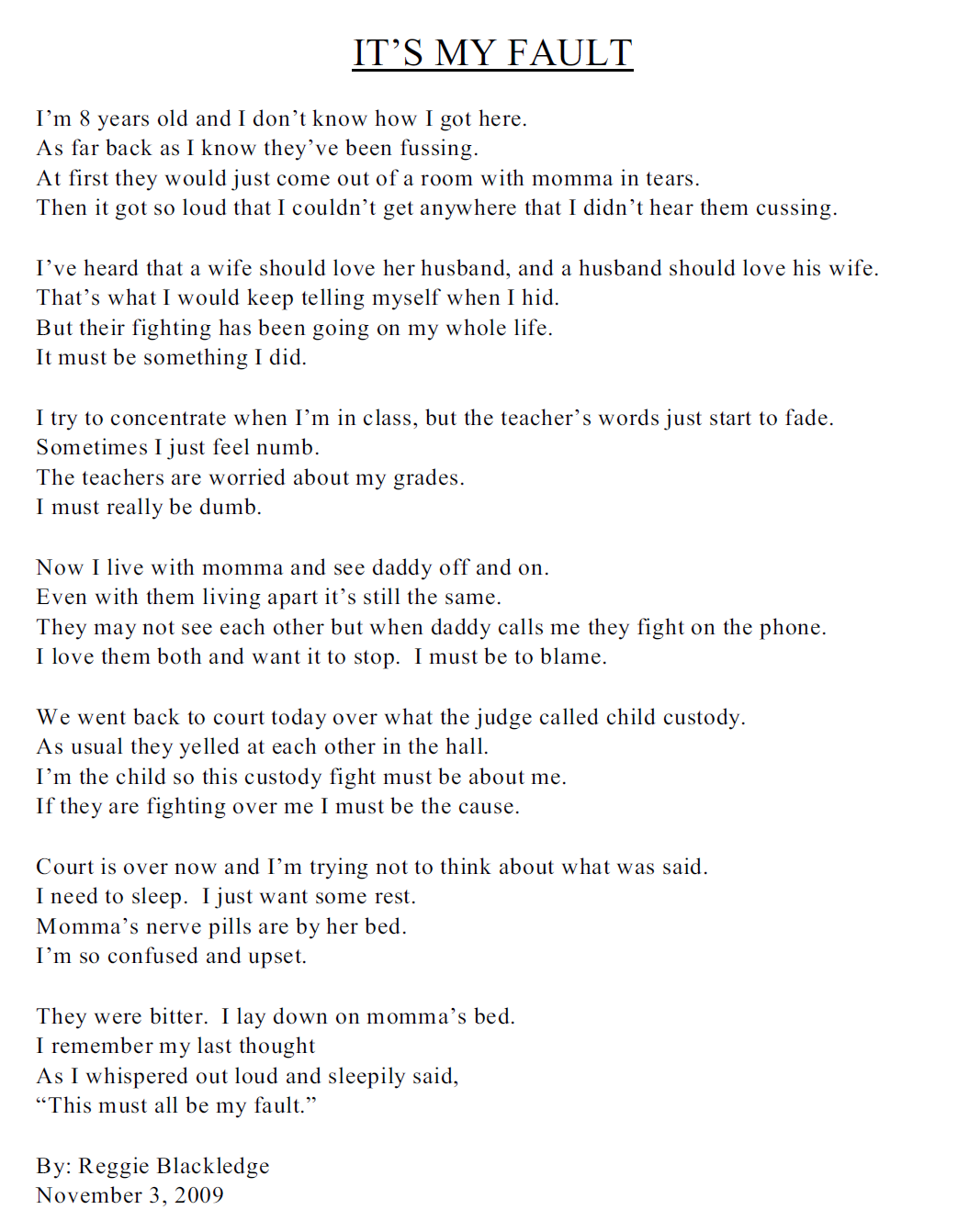
CHILDREN IN THE VORTEX, PART TWO
February 2, 2012 § Leave a comment
Yesterday I posted about children caught in the middle of divorce conflict. In response, Reggie Blackledge, a lawyer in Collins, MS, sent me this poem he wrote, with permission to share it with you.
CLARIFYING ATTORNEY’S FEES IN CONTEMPT ACTIONS
January 19, 2012 § Leave a comment
I’ve talked here before about some confusion (in my opinion) on the part of the COA as to the criteria to award attorney’s fees in contempt cases as opposed to other cases. The question that gave rise to the confusion was whether proof of the McKee factors and/or inability to pay would be required to support an award of attorney’s fees in a contempt action.
In Williamson v. Williamson, decided January 10, 2012, the COA set the record straight. Judge Carlton’s opinion sets it out at ¶ 28:
Furthermore, we find no merit to Will’s contention that the chancellor erred in awarding attorney’s fees to Mary due to a lack of consideration of the McKee analysis. Will’s argument fails to differentiate the chancellor’s award of attorney’s fees in a divorce action as compared to a contempt action. In Mabus v. Mabus, 910 So. 2d 486, 490 (¶13) (Miss. 2005), the Mississippi Supreme Court explained that, generally, in divorce actions, appropriate attorney’s fees are awarded in an amount to secure a competent attorney. However, in contempt actions, attorney’s fees are awarded “to make the plaintiff whole.” Id.; see also Patterson, 20 So. 3d at 73 (¶26) (stating that an award of attorney’s fees is appropriate when there is a finding of contempt, and “[n]o showing as to the McKee factors is required”); Bounds v. Bounds, 935 So. 2d 407, 412 (¶18) (Miss. Ct. App. 2006). As stated, Mary introduced an itemization of attorney’s fees into evidence at trial. Will failed to provide sufficient evidence showing that the attorney’s fees testified to by Mary were unreasonable. Therefore, we find no abuse of discretion by the chancellor in finding Will in contempt and in awarding Mary the attorney’s fees she incurred in bringing her petition for contempt. See Mabus, 910 So. 2d at 489 (¶8) (“Where a party’s intentional misconduct causes the opposing party to expend time and money needlessly, then attorney[’s] fees and expenses should be awarded to the wronged party.”).
I think that language pretty well clarifies the law on the point. In contempt cases, contrary to other cases such as divorce, proof of the McKee factors is not required, nor is proof of inability of the wronged party to pay; however, you must put on proof to show the fees incurred and the reasonableness so that the trial judge has some objective standard to apply.
There is one often overlooked avenue for establishing the reasonableness of attorney’s fees. It’s set out in MCA 9-1-41, which reads as follows:
In any action in which a court is authorized to award reasonable attorneys’ fees, the court shall not require the party seeking such fees to to put on proof as to the reasonableness of the amount sought, but shall make the award based on the information already before it and the court’s own opinion based on experience and observation; provided, however, a party may, in its discretion, place before the court other evidence as to the reasonableness of the amount of the award, and the court may consider such evidence in making the award.
In my opinion, the statute is something you can use to your advantage in a contempt case, since McKee proof is not required. But be careful in trying to apply it in other kinds of cases. In Doe v. Doe, 644 So.2d 1199, 1209 (Miss. 1994), the supreme court said:
It is true that Miss.Code Ann. § 9-1-41 (1972) allows an award of attorney fees based “on the information already before it and the court’s own opinion.” However, such discretion still requires some guidelines. Guidelines help to insure that the chancellor’s award is based on factual information and is not arbitrary. This Court accordingly holds that chancellors should grant attorney fees under Miss.Code Ann. § 9-1-41 (1972) after considering the factors for attorney fees as stated in McKee v. McKee, 418 So.2d 764, 767 (Miss.1982).
Doe was not a contempt case. It was an action for termination of visitation rights based on allegations of sexual abuse. In non-contempt actions the rule is that you will need to put on the proof required by the case law. In divorce cases, for example, that means proof of the client’s inability to pay as well as McKee proof.
 The Better Chancery Practice Blog