DEDICATION DAY
September 26, 2010 § 1 Comment
The renovated “old courtroom” upstairs in the Clarke County Courthouse was dedicated today in a program attended by Clarke Countians and elected officials.
This is what the official program said about the renovation:
“Clarke County’s present Court House was constructed in the heart of the county seat in 1912. Nearly 60 years later, in 1969, the courtroom was remodeled, closing in the full-length windows on the east and west walls, and covering the balcony by the addition of a suspended Celotex ceiling. This provided a location for the large boiler system to heat and cool the building, since the third floor offices were no longer in use, except for use as storage space.
“By the year 2000, county officials discovered the availability of federal and state grants to be used for improvements to government buildings. Through grants provided by the Mississippi Department of Archives and History and the Historic Preservation Division of the “Save America’s Treasures” Act, work was begun to restore our historic 1912-era courtroom to its original grandeur.
“In 2008, Supervisor Tony Fleming organized the demolition process, using county employees and inmates from the Clarke County jail, to gut the area so that accurate blueprints could be produced. By January of 2009, local architect David Henderson of AEDD Plus and contractor BP Roofing and Construction of Laurel, Mississippi, had begin work.
“Since all historic structures are required to adhere as closely as practicable to the original design, every effort was made to replicate the original handiwork. Most of the flooring is original to the building, as are the large ceiling beams. The metal ceiling panels are exact duplicates of those used in the original construction.
“Today we proudly present our newly-restored courtroom to the people of Clarke County. Let us remember to be grateful for the foresight of our county officials in providing a stately and securebuilding in which to conduct our county’s business.”
My previous post about the renovation is here.
Photos from the program:

The crowd gathers for the program
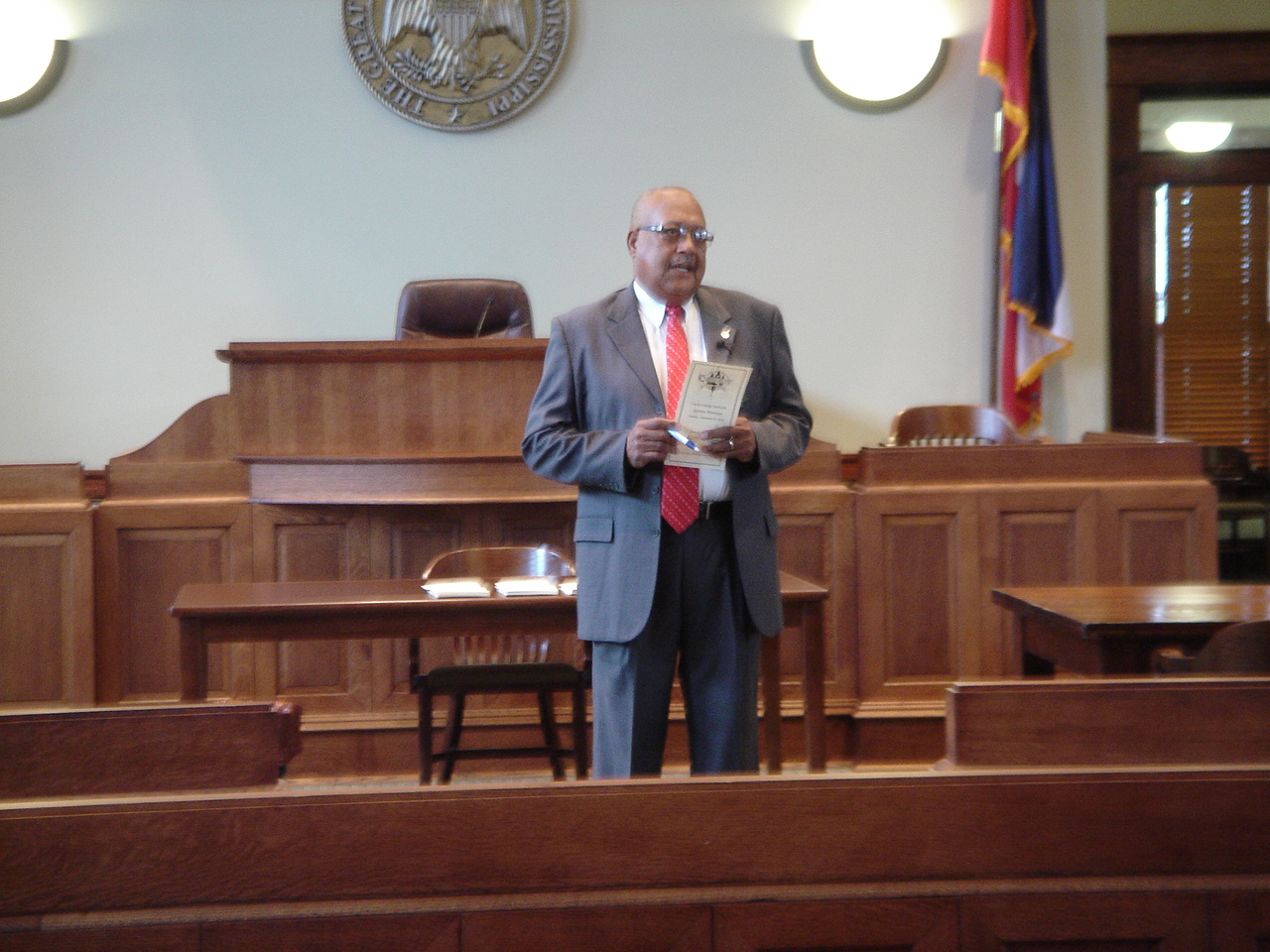
Board of Supervisors President Arthur Nelson chairs the program
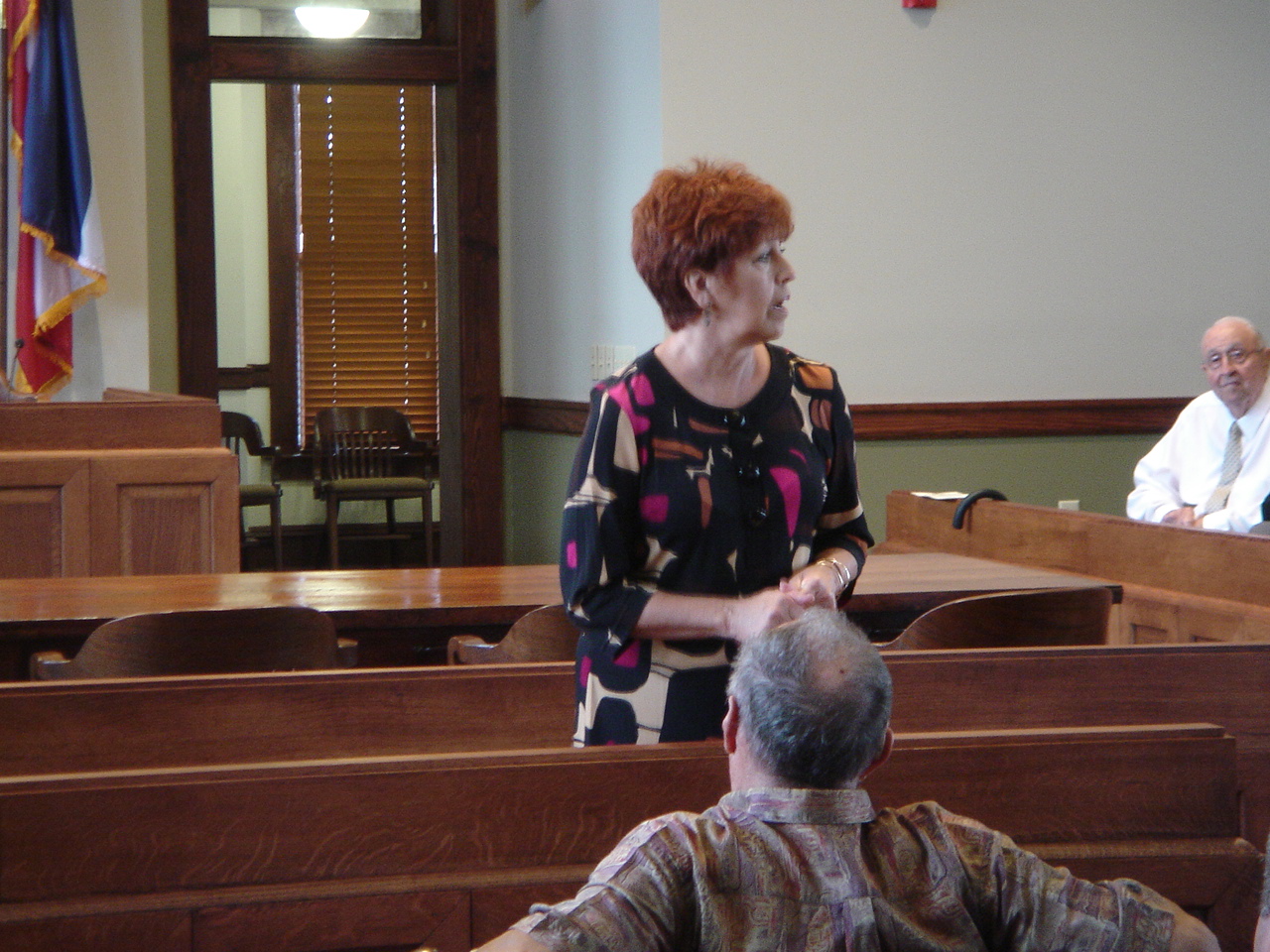
Circuit Clerk Beth Doggett recognizes the judges and elected officials

L to R, Chancellor Primeaux, Circuit Judge Bailey, retired Ciruit Judge Williamson, Circuit Judge Williamson, retired Chancellor Warner
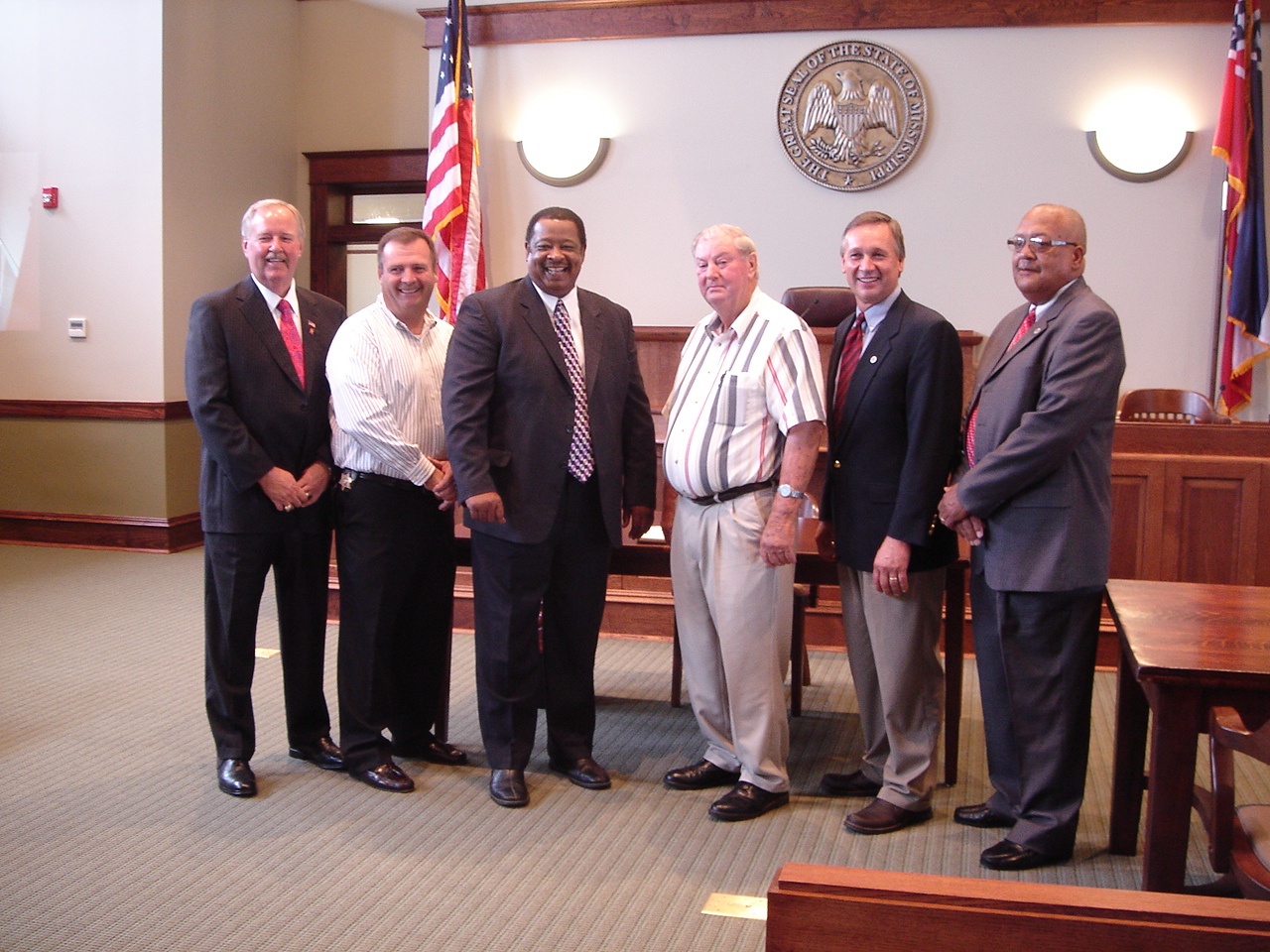
L to R, Dist. 4 Supervisor Paul Mosley, Sheriff Todd Kemp, Dist. 2 Supervisor Cleveland Peebles, Dist. 3 Supervisor Willie Roberson, Dist 5 Supervisor Tony Fleming, and Dist 1 Supervisor and Board President Arthur Nelson

Chancery Clerk Angie Chisholm hosts the reception refreshments downstairs
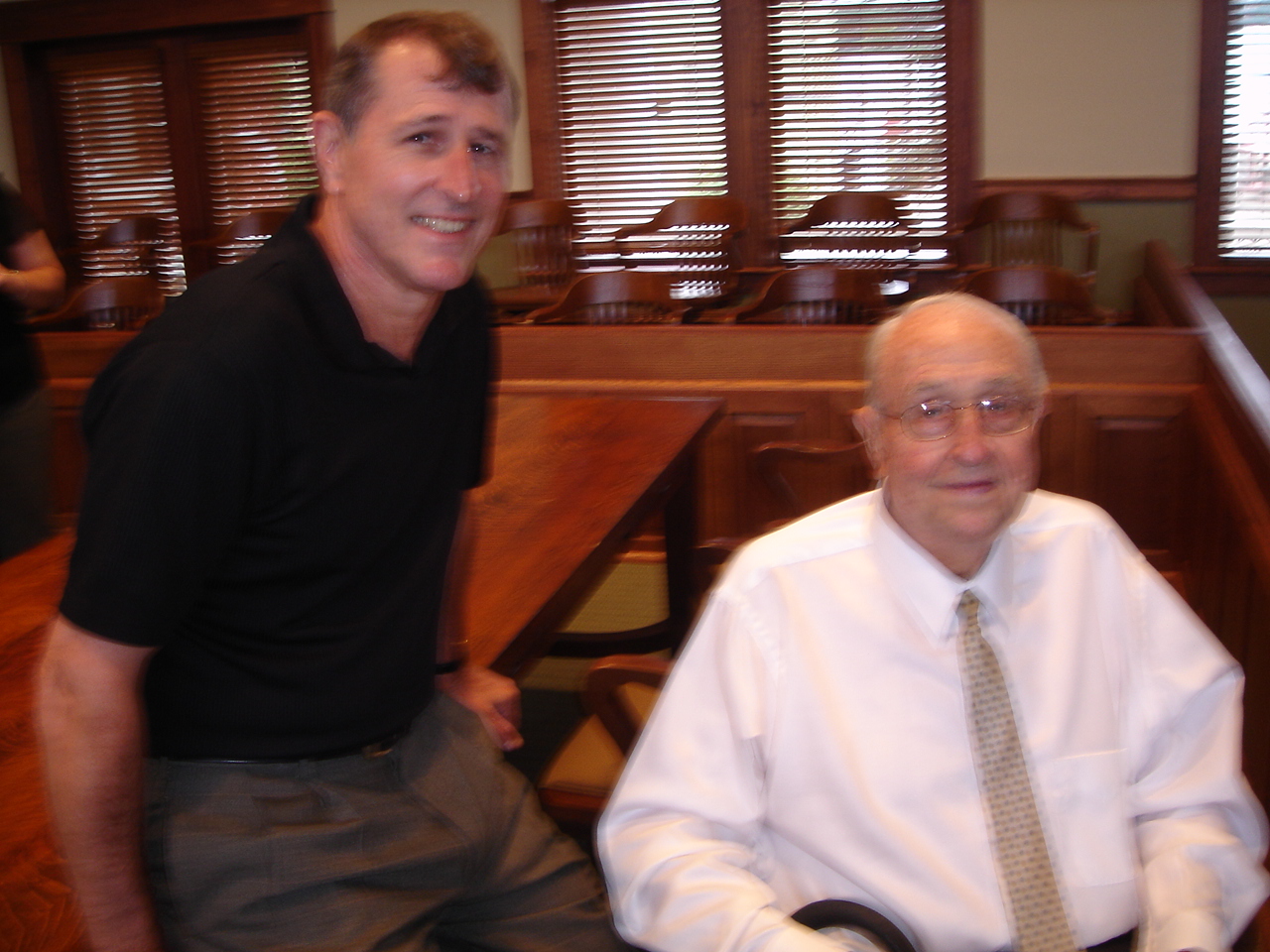
Father and son: Circuit Judge Lester F. WIlliamson, Jr. on the left and retired Circuit Judge Lester F. Williamson, Sr. on the right
CHANCERY COURT IN DAYS OF YORE, PART DEUX
September 10, 2010 § 2 Comments
[Chancery Court in Days of Yore, Part One and “High Waters” and Burlap Suits are two older posts that touch on some of these same themes]
Recently in a ramble through the Uniform Chancery Court Rules (UCCR) I stumbled on a couple of curious throwbacks to pre-MRCP practice. You can read and scratch your head over these historical anomalies in Chapter 2 of the rules, dealing with pleadings. I won’t repeat them here, but they include references to bills of complaint, cross-bills and demurrers, as in “Trial not Delayed Because Demurrer Overruled.”
The references to those ancient and outmoded engines of the law got me thinking about that pre-MRCP era when the practice of law was, well, quainter than it is today. So travel back in time with me to 1979, when the “new rules” were not even yet a rumor, being two years away from adoption and four years from going into effect. Things were different then. Or maybe they were really the same, in a different way.
In 1979, Judge Neville ruled his courtroom like a Teutonic prince. He was sovereign, dictator, despot and all-wise, solomonic adjudicator. There were no “factors” for the Chancellor to consider. The Supreme Court understood the role of the Chancellor as finder of fact in complex human relationships and respected him as such. That was back in the day when most appellate judges had trial court experience, including Chancery experience, and the Court of Appeals had not yet been invented.
It’s trial day in a divorce you filed for a friend’s sister. Counsel opposite, a grizzled veteran, has filed a demurrer attacking your Bill of Complaint for Divorce, and the demurrer will be taken up in chambers before the trial. Whether the demurrer is granted in whole or in part, the trial will follow as night follows day because, “Trial not Delayed Because Demurrer Overruled.” The judge could grant a postponement if your case is gutted by the demurrer, but you know Judge Neville isn’t likely to do so, and your client wants this over with anyway.
You settle your client into the courtroom (now Judge Mason’s courtroom) for the duration. You’ve already explained to her that the judge may strike out part of the pleadings you filed on her behalf, but that you’re confident everything will be fine. That’s what you told her, not what you really feel. What you really feel is a knot in your stomach the size of Mount Rushmore.
You gather your file and leave your client in the dark-panelled court room, where dour portraits of previous Chancellors who practiced their alchemy in that chamber, their medieval visages glowering down disdainfully as if they sniff disagreeably the fetid aroma of the weaknesses in your case, stare balefully down on your misery.
In Judge Neville’s dim chambers (Cindy James’ office today), you wait while he relieves himself in the facilities. The air is redolent with fragrance of his ever-present pipe. There are wisps of smoke clinging to the ceiling like disembodied spirits. On the dark-panelled wall is a plaque that reads:
“If you are well, you have nothing to worry about; If you are sick, you have two things to worry about: whether you will live or whether you will die; If you live you have nothing to worry about; If ou die, you have only two things to worry about: whether you will go to heaven or whether you will go to hell; If you go to heaven you have nothing to worry about; If you go to hell, you’ll be so busy greeting your old friends that you won’t have time to worry!”
Before long, your older and more experienced opponent, wielding his superior knowledge of the byzantine rules of pleading, has prevailed, and the negative pregnants and other flaws in your pleading have been lopped away like infected warts. Before you know it, the 36-page Bill of Complaint for Divorce that you proudly filed has been whittled town to a dozen miserable pages.
Before turning you loose for the court room, the judge takes the opportunity to use his best cajolery skills to try to settle the case, telling you how he would rule on this issue and that, and even cussing you good for wasting the court’s precious time. He runs his hand over his balding head, adjusts his glasses, and you can see the trademark red flush spreading up his cheeks toward his forehead, but you stand your ground because you’ve already tried to no avail to talk your clint into a reasonable settlement.
You emerge into the comparatively brightly-lit court room and flash a brave smile at your client. Her attempt at looking brave looks more like crestfallen to you.
The floor is cork, scarred from years of cigarette burns. Brass spitoons, polished and emptied weekly by a jail trusty, are set on each side of the court room, one for the complainant and one for the defendant. In a corner plainly visible to the lawyers is a Coca-Cola clock; the art deco clock built into another wall stopped years ago at 10:05.
In the court room, the old lawyer has taken his place. He is chain smoking cigarettes. As he finishes one, he drops it on the floor and grinds it out under the sole of his two-tone wing-tips on the cork floor. He lights another and removes his linen jacket, revealing his short-sleeve shirt. He is wearing a cheap clip-on tie with Weidmann’s soup stains. His polyester slacks are held up by suspenders. His greased head gleams in the court room light. He is no fashion plate, but he is a dangerous adversary who only a few minutes ago gutted your case. He will smoke like that through the trial, his jacket hanging limply on his chair as he carves up your witnesses.
Your office file has only a few papers in it. There is no voluminous discovery, because you don’t get to propound interrogatories and requests for production. The only discovery is to ask for a Bill of Particulars. The rules of pleading are so arcane and complex that a misplaced adjective just might doom an essential element of your case. The older lawyers have mastered the strange warcraft of pleading and gleefully ambush you from the legal thickets, catching you unawares and pillaging the smoking ruins of your lawsuit.
As the older lawyer tends to other preparatory business, he lays his cigarette on the edge of the table, and the burning end inflicts yet another scar into counsel’s table, adding one more to the many other burn marks. He sticks the cigarette back into his mouth and approaches you to show you some document, wreathing your face in a fog of smoke and raining ashes on the natty pin-striped suit you bought from Harry Mayer (the elder) only last week.
Judge Neville takes the bench, his smoking pipe emitting inscrutable signals, clad in his customary dark suit. Chancellors did not wear a black robe back then, but he is wearing his black suit today, probably in mourning for my case, you muse. Your voice quavers as you read your pleadings into the record for the court, followed by the older lawyer. While you are struggling through the reading, Judge Neville is puffing pensively on his pipe and whittling strenuously on a cedar plug. Shavings curl slowly at first, and then furiously, as the pleadings pour from your mouth into the record for God and all the world to hear, the flaws and weaknesses drawing into clear focus with every heretofore and to-wit, and your spirits sag at the prospect of sour defeat.
By agreement the grounds for divorce are presented first, and the judge will rule whether a divorce will be granted. You call the opposing party first and he denies everything. Your client then testifies unconvincingly about her husband’s mistreatment. Her performance on cross is frightful. The corroborating witness might as well have been in Peru when the offending conduct is alleged to have occurred. Judge Neville ponders and whittles, maufacturing acrid clouds from his pipe. Tension builds until the judge intones his opinion that, “The grounds for divorce are not strong, but the court finds that these parties need to be divorced, and so I will grant the Complainant a divorce.” Whew. It was fairly common for Chancellors to do that back then, but it’s still a relief to get over that hump.
You rise to call your first witness on the remaining issues, but Judge Neville interrupts you in his stentorian tone, “Suh, I will see the lawyuhs in chambuhs,” and he leaps to his feet and bounds out of the court room and into his office, his pipe jutting decisively out of his face. You know what is coming. It’s the arm-twisting conference where the Judge, now that he’s granted the divorce, will bring all of his considerable persuasive power and intimidation to bear. In chambers he wheedles, threatens, sweet-talks, cajoles, cusses and pounds his desk, demanding that you settle, or else.
You confer with your client who is now more amenable to a settlement, having been tenderized by opposing counsel. A few more sessions with the Chancellor and the case is settled.
Somehow you paint the best face on your performance for your client. She’s not thrilled with the settlement, but it’s not really bad for those days: She gets her divorce and custody of the baby; her ex-husband will have to pay a respectable $35 a week for child support (her best friend got a divorce last month and got only $60 a month; after all, there were no statutory child support guidelines then); her ex gets the house because it is titled only in his name (no equitable distribution then; title controlled); she gets the 1971 Dodge, and he will pay the $65 monthly note; she will have to pay the $120 McRae’s bill; she will get the living room and bedroom suites, baby furniture and the 19-inch RCA black-and-white television, and he will get the 19-inch Westinghouse color tv. She’s not terribly happy, but all in all, she’s fairly satisfied that she got good value for the $250 that she paid you to handle her contested divorce.
In the clerk’s office, you stop to visit with Mr. M.B. Cobb, the gentlemanly Chancery Clerk, and deputy clerk Joyce Smith, who try to console you about your misfire in court. That new young deputy clerk, Rubye Hayes, is disgruntled about something, so you try not to lay your already-bruised ego in her path.
Leaving the court house, you meander over to the Southern Kitchen where you find the company of jovial lawyers and even your older adversary scarfing down coffee and pie, as they do every day. You pull up a chair and order a comforting slice of lemon icebox pie, and before your first forkful, you are the butt of their ribbing about how you folded your hot hand when Neville called your bluff. You fight not to blush, but you can’t help but smile with the satisfaction of knowing that they only treat colleagues that way, and that much of their humor is part painful experience and part shared pain.
It’s nearly 10:30, and you head back to your office. You wonder whether you’ll get to finish reading that new John D. MacDonald detective novel or whether you’ll have some work to do.
Back at the office, you have two new clients awaiting, and you receipt them and open files in time for lunch. But before leaving, you ask your secretary to type up the pleadings, which will be on legal-sized paper, the original on bond, and the several copies made with carbon paper on onion-skin; you can’t yet afford the latest technological advance: an IBM memory typewriter. Word processors and computers are unknown. You prefer carbons to photocopies (all of which were called “xerox copies” back then) because your copier, like most, makes sepia-colored copies on slick, coated paper from a roll in the machine, and the copies are not favored by the judges because they tend to curl up and are hard to handle, but worst of all, they tend to turn dark or black over time and become illegible.
Ordinarily you would head over to Weidmann’s to sit at the lunch counter over a vegetable plate with cracklin bread and see many of the people you know, or to the Orange Bowl for a cheeseburger, but today you’ve decided to recover from your court room wounds by spending the afternoon on a friend’s lake, casting crickets on a quill with a fly rod for chinkapins and having a few cool ones. You stop at the bait shop next to Anderson Hospital and visit with James Elmer Smith while he scoops up your crickets. One great thing about being out on the lake: no one will bother you there because there were no cell phones then; in fact, many people still had dial telephones.
On your way out to the lake you think to yourself what a good life you have and how even a disappointing day in court is not so bad in the whole flow of things. And tomorrow is a whole, new day.
LAY OPINION TESTIMONY SOMETIMES LAYS AN EGG
September 7, 2010 § 3 Comments
Some lawyers argue that lay opinion testimony should be strictly proscribed as not helpful to the court and an invasion of the court’s fact-finding province. Others attorneys respond that those concerns are overblown and that the court can filter out any ill effects. Here is a rough transcript of an exchange that happened in my courtroom recently. Judge for yourself:
Q: Now, you said a moment ago that you plan to file for bankruptcy. Do you know what effect bankruptcy will have on your income?
Opposing counsel: Objection. He can’t possibly know what effect bankruptcy would have on his income. He is not an expert.
Counsel: But, judge, he can state his understanding based on what he trying to accomplish by filing bankruptcy.
Court: I believe that any ordinary person with walking-around sense would know what effect bankruptcy would have on their income. I will overrule the objection. Repeat the question for the witness, please.
Q: Do you know what effect bankruptcy will have on your income?
A: No.
SAVE THE DATE: CLARKE COUNTY DEDICATES ITS NEW “OLD” COURTROOM
September 1, 2010 § 2 Comments
A dedication, open house and reception will be held in the newly renovated “old” courtroom upstairs in the Clarke County Courthouse on Sunday, September 26, 2010, from 2-4 pm. Lawyers, judges and the public are invited to participate in the dedication and to view the restoration of the upstairs courtroom to its former glory in advance of its being put into operation.
I would hope that there would be a good turnout of Lauderdale County lawyers for the event, considering the numbers who practice in our neighboring county to the south.
An earlier post about the renovation work is here.
IS THIS THE SOLUTION TO PRO SE LITIGATION?
August 25, 2010 § 7 Comments
A post about proposed changes to the pro bono rules for lawyers is here. There is a thoughtful comment to that post that highlights some dimensions of the situation.
It’s no secret that pro se litigants are appearing more and more frequently in Chancery Court. Whenever I ask a self-represented litigant why he or she did not hire an attorney, cost is always the response.
In our district, it’s not uncommon for a simple, irreconcilable differences (ID) divorce to cost upward of $1,500 to $2,500, plus court costs, although I have heard of some lawyers charging as little as $250 plus costs for an ID divorce with no children.
Self-representation, however, is not limited to routine, uncomplicated matters like ID divorces involving no children, no property, no joint debts and no other problems. I see pro se litigants in all kinds of matters. I presided over a termination of parental rights case not too long ago where the father represented himself and lost. I have seen pro se litigants in an adverse possession case, contempts, paternity, and even in a partition suit where, believe it or not, both sides were pro se. I can say unequivocally that I have never seen a party who proceeded pro se in a contested case leave the courtroom in better shape legally or equitably than he or she was when they walked in.
Although most all say that they choose to proceed pro se due to the rising cost of legal fees, I find in the course of things that others simply underestimate the complexity of the issues involved and think that legal matters are little more than filling out a few sheets of paper and filing with the court. Still others are lured by the siren-song of the internet sites that push cheap fill-in-the-blank do-it-yourself legal proceedings. The common denominator among all of these is that they are looking for a cheap, one-size-fits-all, easy solution to what may be a complicated situation.
These are the people who wind up in court pro se. In many cases, those pro se parties are getting simple ID divorces using kits they purchased on-line. Some are getting pleadings prepared by “secretarial services,” in violation of state law prohibiting practice of law without a license. The simple cases with no children do not usually give rise to later litigation. Pro se litigants with children, however, are a recurring problem.
Problems with child support provisions, joint and sole custody provisions, division of property, and allocation of debts are all common problems in these do-it-yourself cases. I have one pair of parties in Clarke County that I have sent back to the drawing board four times, and, although they are my most extreme case, they are by no means the only case that I have had to treat that way. I have just about decided that, if there are children, I will require the parties either to have an attorney or I will appoint a guardian ad litem at their expense.
The self-represented parties seldom understand why they can’t simply have their papers signed, and they are invariably frustrated when I tell them that I can not advise them how to draft an acceptable child support provision, or why that waiver filed a week before the complaint won’t cut it, or why they need a property settlement agreement when they don’t have any property.
How do we make legal services more affordable, thus reducing the pool of pro se litigants? Some claim that “limited scope representation,” also known as “unbundling” is the answer to lower legal fees. In essence, it is a representation arrangement in which the respnsibility of the lawyer is limited and the fee is resultingly lower. The attorney may, for instance, agree only to advise one of the parties about the language of the property settlement and child support agreement, or simply to prepare pleadings. The clients buy only as much legal service as they feel they need.
The Supreme Court’s Commission on Access to Justice proposed an amendment to Rule 1.2 of the Rules of Professional Conduct to allow for limited-scope representation. They met on Monday, August 23, and since the comment period has expired, I assume they will pass the rule on to the Supreme Court for adoption. I am all for it.
Although the proposed rule approves and encourages the practice, it does not address how a representation agreement would read so as to cover all of the ethical concerns that might arise. There is information available online, however, that may provide a starting point for lawyers. The LAWYERS USA website offers some information. The ABA has some info. The Civil Justice Network also has some info. A paper presenting the pros and cons of the practice is here.
Whether limited scope representation is the answer to the growing numbers of pro se litigants, I have no way of knowing. I do believe that it has the potential to help dramatically because it will decrease the amount of time judges will need to devote to scrutinizing pro se litigants’ pleadings and paperwork.
One caveat: I will not approve a limited-scope representation arrangement in any probate matter. Rule 6.1 of the Uniform Chancery Court Rules requires that every fiduciary retain an attorney, and you will be expected to continue in your role as counsel once you are in until you find substitute counsel. I will not allow the operation of the new rule (if it is enacted) to create an end-run around Rule 6.1.
An approach to the pro se phenomenon that I can not endorse is continued encouragement of laypeople to tackle more of their own legal matters. I saw a bar-produced video of smiling legal professionals encouraging people to handle their own “routine” legal matters, and making it sound as easy as folding a paper airplane. I don’t understand this approach. The American Medical Association does not promote do-it-yourself tonsillectomies, but then medical ethics includes the fundamental proscription, “Do no harm.” To me, the solution is not to encourage people to do their own legal surgery. The answer is to make it more likely that they will have a competent surgeon.
I am not a fan of pro se litigation. Even seemingly simple, routine matters may have serious implications for the parties, and I assure you that they have absolutely no clue about those ramifications. Self-represented litigants seldom have a grasp of the ramifications and complexities of equitable distribution, the various forms of child custody, or joint debt, to name but a few of the many legal snares that await the unwary. Also, the parties are under no duty to be honest and forthright with the court, leaving open the very real possibility of fraud or worse. Without legal advice and the check that an ethical attorney provides, the parties’ paperwork can create more problems than it solves, and even in the absence of lawyers it is clearly not the duty of the judge to advise them about the possible mess they may be creating. Yet, every day, inexorably, we see more and more self-represented litigants.
I am a firm believer in access to justice, but in our commendable haste to discover a way to do that, let us not lose sight of what it is we are trying to achieve: access to justice. Not access to disaster. Limited scope representation may be a good first step toward alleviating this problem.
PROPOSED CHANGES TO RULE 8.05
August 24, 2010 § Leave a comment
The Supreme Court has posted proposed revisions to Uniform Chancery Court Rule 8.05 and your comments are invited.
There is, arguably, no Uniform Chancery Court Rule that affects Chancery practitioners more strongly than 8.05. If you have a position on this proposal, you need to make it known before final action. The deadline is September 20, 2010.
PROPOSED RULE CHANGES THAT MAY AFFECT YOU
August 17, 2010 § 10 Comments
The Mississippi Supreme Court is considering two rule changes, one of which will definitely affect you, and the other might indirectly.
The first is a change to Rule 6.1 of the Rules of Professional Conduct that would make pro bono service mandatory and would increase the fee to be paid in lieu of doing pro bono work from $200 to $500.
The second is a change to the appellate rules to increase the pro hac vice admissions fees from $200 to $500.
Your comments are invited by the Supreme Court, and may be submitted via this link.
If you don’t care what I think about these measures, stop reading here.
My opinion is that it is a good thing to make some level of pro bono service a professional requirement. And no, I am not talking about the deadbeat clients who will not pay their fees and are losses on your books. I am talking about the deliberate decision to volunteer through the Mississippi Pro Bono Project or to give your services free to a needy litigant or non-profit who needs legal help and legitimately can not pay. The numbers of pro se litigants are growing every day; if you don’t believe me, ask any Chancery Clerk or judge. Every time I ask a pro se litigant why they did not get an attorney, the answer is the same: “I can’t afford a lawyer.” Mandatory pro bono attacks the problem at its source by providing access to a lawyer, which in turn means access to court, to people who otherwise would not have it. And I am not talking about taking on an anti-trust suit or the like. You can do a couple of simple no-fault divorces and do a lot of good, both for the client and for the court. (Side note … I have a blog post coming about the dimensions of the pro se problem and one approach to solving it).
As for the $500, I think the practical effect will be that a lot of solo and small-firm practitioners and small-town lawyers will end up doing pro bono work, and a lot of high-powered and big-city lawyers will buy their way out of their duty. On one level, I find it repulsive that it would work that way because it’s not fair to lawyers of modest means, and it’s repugnant to think that one can meet a professional and what I consider a moral obligation with filthy lucre. On another, more practical level, you have to admit that even if there were no “buyout” provison, and every lawyer were required to do pro bono, there would be lawyers of means who would shuffle their duty off on a subordinate. In that case, we might as well reap their money and do something worthwhile with it. And before you ask me, I do not know what the Supreme Court is doing with that money.
As for the fee for pro hac vice lawyers, I would not mind seeing it doubled, tripled or increased by ten or more. If there is litigation in Mississippi, out-of-state attorneys should have an incentive to turn it over to Mississippi lawyers. Too often the out-of-state lawyer pays the Mississippi attorney a pittance to be a figurehead, reaps the gold and scoots. I would like to see that pattern reversed.
EVOLUTION OF THE LAUDERDALE COUNTY COURTHOUSE
July 30, 2010 § 2 Comments
When Lauderdale County was established in 1833 out of Choctaw lands ceded in 1830 at Dancing Rabbit Creek, there was already a settlement at Marion, named for the famous South Carolina “Swamp Fox” of Revolutionary War fame. Since the community was located near the center of the new county, it was the logical place to name as county seat.
Meridian was incorporated in 1860, and, except for a setback in 1864 thanks to General Sherman, grew rapidly. In 1870, as a result of a public referendum, the county seat was relocated to Meridian, a few miles to the southwest of Marion.
The county’s first courthouse was built in 1890 at the present site, where it stood until 1903, when it was destroyed by fire. If there is a photograph of that first building, I have been unable to locate it, even after checking with the Lauderdale County Archives.
In 1904-1905, a new courthouse was built on the original site. It was in the Beaux Arts style in fashion at the time, and featured a dome with cupola and sculpted figures.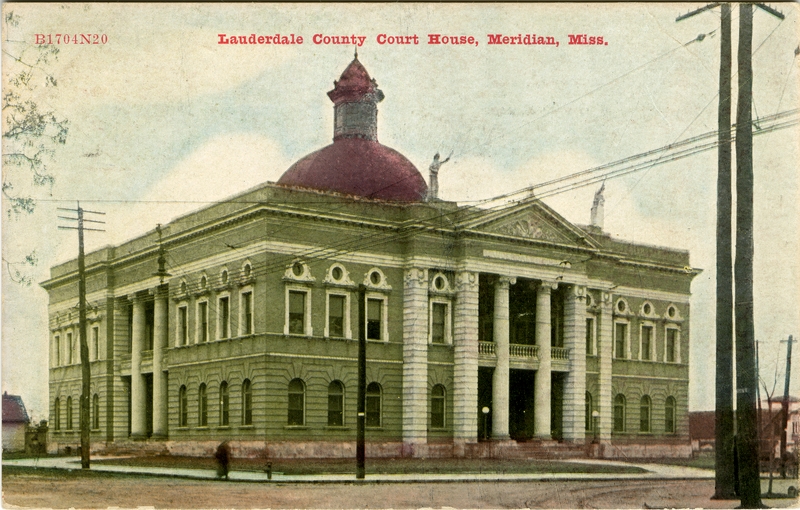

Some time later, the statues were removed, and even later, probably in the 1920’s, a Confederate memorial was erected on the northwest corner of the site. You can click on the photos for larger, more detailed view.

In 1939, the building was enlarged and extensively remodeled in Art Deco style. A jail was added on the top floor. The work was part of President Roosevelt’s federal works projects aimed at creating jobs to get the country out of the Great Depression.
 The building has remained essentially unchanged in appearance since the 1939 renovation. The photo to the left shows the west entrance in the early 1950’s.
In the 1970’s, a ramp was built at the west entrance for handicap accessibility. The ramp originally bore the inscription LAUDERDALE COUNTY COURTHOUSE, but the lettering was replaced in the 1980’s by a marble memorial honoring and naming the military of Lauderdale County who were killed in war.
A porch with benches was added at the south entrance in the 1980’s.
In the late 1990’s, before the new jail on Fifth Street could be built, a metal fire escape enclosed by chain-link fencing was constructed on the east side, giving jail inmates an escape onto Nineteenth Avenue into a chain-link enclosure in case of fire. The fire-escape apparatus was removed after the new jail was completed and put into operation.
The courthouse was designated a Mississippi Landmark on April 6, 1999, and is listed on the National Register of Historic Places as a contributing element of the Meridian Downtown Historic District.
The photos above, along with around 4,600 others showing scenes from all around Mississippi during the period from 1892 to the 1940’s, are available at the Mississippi Department of Archives and History’s website here.
 Above is a view of the courthouse as it appears today. It shows the DA’s office lit up in trial preparation on a rainy evening. This unusual photo was taken by Meridianite Ken Flynt, and is used with his permission.
 The Better Chancery Practice Blog
SHOULD WE RETHINK ALIENATION OF AFFECTION?
July 29, 2010 § 3 Comments
Philip Thomas, the Jackson lawyer who blogs at MS Litigation Review & Commentary has posted some trenchant thoughts about the cause of action for alienation of affection in Circuit Court that is sometimes used either for vengeance or to coerce a settlement in Chancery.
I found his comments so thought-provoking for family law practitioners that I have copied and pasted it below rather than simply providing a link.
I recommend Mr. Thomas’s blog to you as a regular read.
Sick of Alienation of Affection Lawsuits?
I’m sick of alienation of affection lawsuits. Who’s with me?
I’m sick of this one, which ironically was filed by a former Miss. Supreme Court Justice (McRae) who advocated abolishing the cause of action while he was on the Court. I’m sick of this one, which is just getting started. I’m sick of the one involving my old law firm that recently was the subject of a Supreme Court decision. I’m sick of the entire cause of action.
Here are just a few of the problems that I have with the cause of action:
In summary, it’s a bad cause of action that should be abolished