Testamentary Capacity
March 14, 2017 § Leave a comment
Lack of testamentary capacity is a common line of attack against wills.
The recent COA case Estate of Gardner: Callington, et al. v. Gardner, decided February 21, 2017, includes a nice exposition of the law on the subject, which I am providing for you in condensed form — a sort of hornbook-ette on the subject. From the opinion by Justice Wilson:
¶21. “For a will to be valid, the testator must possess testamentary capacity.” Noblin v. Burgess, 54 So. 3d 282, 291 (¶32) (Miss. Ct. App. 2010). To have testamentary capacity, an individual must be of “sound and disposing mind.” Miss. Code Ann. § 91-5-1 (Rev. 2013). “Testamentary capacity is determined based on three factors: (1) whether the testator had the ability at the time of the will to understand and appreciate the effects of his act; (2) whether the testator had the ability at the time of the will to understand the natural objects or persons to receive his bounty and their relation to him; and (3) whether the testator was capable of determining at the time of the will what disposition he desired to make of his property.” In re Estate of Laughter, 23 So. 3d 1055, 1061 (¶20) (Miss. 2009). In addition, “[r]ecognizing that a testator may not always possess testamentary capacity, [the Supreme Court has] held that he may nevertheless execute a valid will during a lucid interval.” In re Estate of Edwards, 520 So. 2d 1370, 1373 (Miss. 1988). “The key to testamentary capacity is mental competency at the time the will is made.” Lee v. Lee, 337 So. 2d 713, 715 (Miss. 1976).
¶22. “The burden of proving testamentary capacity is on the proponents of the will, who can present a prima facie case simply by offering into evidence the will and the record of probate.” Laughter, 23 So. 3d at 1061 (¶18). “Once a prima facie case has been established, the burden of going forward shifts to the contestants to overcome the prima facie case.” Id. The ultimate burden of proof remains on the proponent, who “may . . . present rebuttal proof if necessary.” Edwards, 520 So. 2d at 1373. The Supreme “Court has held that the testimony of subscribing witnesses is entitled to greater weight than the testimony of witnesses who were not present at the time of the will’s execution or did not see the testator on the day of the will’s execution.” Id. “In fact, the subscribing witnesses to a will may testify as experts on the question of testamentary capacity.” Id.
¶23. “Furthermore, . . . opinions of lay witnesses regarding testamentary capacity [must] be supported by ‘facts as a basis for the witnesses’ conclusion.’” Estate of Rutland v. Rutland, 24 So. 3d 347, 353 (¶20) (Miss. Ct. App. 2009) (quoting In re Estate of Briscoe, 293 So. 2d 6, 8 (Miss. 1974)). “Overly broad or generalized testimony indicating a lack of capacity will be deemed insufficient where it is contradicted by competent evidence and is ‘obviously based upon the infirmities of advancing age rather than upon any abnormal conduct indicative of mental aberration.’” Id. (quoting Briscoe, 293 So. 3d at 8).
After noting that the contestants had offered only vague and general proof that the decedent’s physical condition was “terrible” at the time of making the will, the court continued:
¶24. … the children failed to come forward with evidence “to overcome the prima facie case” of testamentary capacity. Laughter, 23 So. 3d at 1061 (¶18). … physical weakness does not preclude one from making a will, and a bare and unexplained assertion that a testator’s mental state was “terrible” does not raise a jury issue as to his mental capacity.
The court next pointed to the specific testimony of the subscribing witnesses:
¶26. The subscribing witnesses to the will—Sanders and Roussel—had both known Richard for many years, and both testified that he was mentally alert and capable of understanding what he was doing when he executed his will. Sanders further testified that Richard was clear and specific regarding his wishes. Moreover, in addition to the absence of any evidence that Richard lacked testamentary capacity, we note that the mental capacity required to execute a general power of attorney is essentially the same as the capacity required to execute a will. See Dowdy v. Smith, 818 So. 2d 1255, 1258-59 (¶16) (Miss. Ct. App. 2002). With Linda’s encouragement, Sylvia took Richard to Sanders’s office for the specific purpose of signing a general power of attorney, and Sylvia testified specifically that she believed that her father had the mental capacity to sign the power of attorney. Yet neither Sylvia nor Linda was able to explain at trial why they thought Richard had the capacity to sign the power of attorney but not the will.
¶27. In short, the children presented no evidence that Richard lacked testamentary capacity at the time he executed his will. All testimony relevant to his mental capacity on March 2, 2009, indicates that he had sufficient capacity to execute both a general power of attorney and a will. Accordingly, the chancellor’s ruling granting Mae Otha’s motion for JNOV was correct as it relates to the issue of testamentary capacity. See Hayward v. Hayward, 299 So. 2d 207, 209-11 (Miss. 1974); Noblin, 54 So. 3d 291-95 (¶¶34-45); Rutland, 24 So. 3d at 351-53 (¶¶10-22); In re Estate of Pigg, 877 So. 2d 406, 410-11 (¶¶12-23) (Miss. Ct. App. 2003).
Prescription for an Easement
March 13, 2017 § 1 Comment
Mississippi is dotted with old churches that have fallen into disuse and even been abandoned as the congregation ages, moves away, and finds other associations. I posted about a typical example here only last month.
Some of the left-behind buildings are lovingly maintained by former members and family, but what keeps people involved with them in most cases is the church cemetery where ancestors and loved ones are interred.
Such was the case with Old Liberty Baptist Church, which had been established before 1854. In that year, Aaron Lott and his wife, Martha, deeded the 2 acres upon which the church had been built, and which included the adjacent cemetery, to the church’s “Committee of Arrangements.” The church later moved away, and the building was torn down, but the cemetery, which fronted on a public road, continued to be visited by people with an interest. Even so, there were only one or two burials there in the preceding 60-70 years. The cemetery was enclosed by a fence, with a gate that was accessible from the public road.
The Lott property, which surrounded the Old Liberty cemetery, descended to Johnnie Lott and his three daughters: Rita Deloach, Linda Douglas, and Cathy Grantham. After the daughters quitclaimed their interest to Johnnie, he later conveyed his interest to Cathy, reserving a life estate. “less and except 2 acres, more or less, comprising the cemetery.”
Johnnie Lott died in 2011, and in 2013, Cathy filed an instrument claiming that she controlled access to the cemetery. The Liberty Baptist Church formed an association to take responsibility for permanent maintenance, and the church deacons deeded its interest in the cemetery to trustees of the association for the purpose. The deed claimed a tract of 1.55 acres, as shown on an attached plat. Rita, sister of Cathy, participated in the process.
In the meantime, Cathy began locking the gate to the cemetery. After the lock had been cut off the gate seven times, Cathy’s husband removed the culvert and pushed dirt up blocking the gate.
Cathy filed suit, claiming that the cemetery property consisted of 1.25 acres, not the 1.55 acres claimed by the church. She claimed absolute authority and discretion in determining who, when, and how anyone should access the property. The association counterclaimed.
Following a trial, the chancellor granted the association title to the cemetery property by adverse possession, along with a prescriptive easement from the public road to the cemetery entrance. He also confirmed title in Cathy to certain other property in dispute. Cathy filed a R59 motion raising for the first time that she should be granted a prescriptive easement across the cemetery property, and a claim for slander of title. The chancellor overruled the motion, and Cathy appealed.
In Grantham v. Old Liberty Cemetery Association, decided February 21, 2017, the COA affirmed. On the issue of Cathy’s belated claim for a prescriptive easement, Judge Fair wrote for a unanimous court:
¶11. Grantham first argues she was entitled to a prescriptive easement across the Association’s property. “The evidentiary burden to establish a prescriptive easement is high.” King v. Gale, 166 So. 3d 589, 593 (¶20) (Miss. Ct. App. 2015). Grantham had to show by clear and convincing evidence she used the Cemetery tract to get to her property. Id. See Thornhill v. Caroline Hunt Tr. Estate, 594 So. 2d 1150, 1152 (Miss. 1992). Further, she had to prove her use was “(1) under claim of ownership; (2) actual or hostile; (3) open, notorious, and visible; (4) continuous and uninterrupted for a period of ten years; (5) exclusive; and (6) peaceful.” Id. (citations omitted). We note that she did not assert any claim for an “easement of necessity” because she has significant access to a public roadway, and makes claim for a “non-exclusive” prescriptive easement, even though exclusivity is a required element of a prescriptive easement.
¶12. The chancellor notes pointedly that Grantham denied any claim to the Cemetery land itself, only asserting the location of boundaries and easements to it and arguing that the Cemetery occupied 1.25 of the 1.55 acres the Association claimed. And there was no evidence presented that Johnnie, from whom she derived her title, ever claimed any ownership of the Cemetery. In her appellate brief, she restates that she “has decided not to appeal the determination . . . that the fence lying south [of] the access road is the cemetery’s south boundary, but does appeal the denial of her ‘non-exclusive easement’ over the road to access her property.” Grantham had stated her father always fenced his property, and that the northern boundary of the property she inherited is also the southern boundary of the Cemetery. She also testified that he had a concrete pad poured to feed his cows and admitted that the concrete pad stopped just south of the fence in the very southeast corner of the fenced-in area of the disputed property. Occasionally, Johnnie let the cows out through the Cemetery gate. Prior to her father’s death, Grantham returned to the property once or twice a month and had little knowledge of what was going on while she was away.
¶13. A “prescriptive easement,” as noted above, is an easement obtained by adverse possession over another’s land. Like any other adverse possession claim, an owner’s permission to use the easement defeats a party’s claim. See Kendall v. May, 199 So. 3d 697, 700 (¶8) (Miss. Ct. App. 2016). The general public (or at the very least the descendants of those buried in the Cemetery) had entered the Cemetery without interference and with implied permission of the church for more than a century – until Grantham locked it and removed the culvert. Anyone who had ancestors buried in the Cemetery had the right to enter onto “family cemetery” property and visit an ancestor’s grave as well as to be buried in the Cemetery. Grantham, a direct descendant of Aaron Lott, specifically has such a right, with the same permission as any other descendant of an ancestor buried in the Cemetery, to drive across roads crossing Cemetery property. She has presented no evidence of any open, notorious, or exclusive occupancy of any portion of the Cemetery property for more than ten years, as determined by the chancellor. Consequently, she is entitled to no greater or lesser interest in an easement over parts of the Cemetery than any descendent of anyone buried there.
I brought this to your attention for several points:
- In order to establish a prescriptive easement, it must be shown that the elements of adverse possession have been met as to the easement property. That in and of itself is a high bar. To make it even higher, the burden of proof is by clear and convincing evidence. This opinion is a good reminder of what must be shown.
- To me, the chancellor was exceedingly generous to entertain Cathy’s claim for a prescriptive easement, raised as it was for the first time on a R59 motion. You simply do not get to reopen the case to raise new legal issues and claims on a R59 motion that could and should have been litigated at trial, unless there is newly discovered evidence that was unavailable at trial. The COA does not elaborate on the basis for the R59 motion, so we are in the dark as to what motivated it, but if it was simply to assert a new issue, it was out of bounds.
- Likewise, at trial Cathy took the position that she asserted no interest in the cemetery property. She reversed that position in the R59 motion and asserted a claim for a prescriptive easement. That maneuver was barred by judicial estoppel, which holds that one may not take one position at one stage of the proceedings, and then take a contrary position at a later stage.
- Finally, Cathy asked for a “non-exclusive easement” to the cemetery. That was really unnecessary, as Judge Fair pointed out, because she was entitled to access the property along with everyone else with ancestors buried there.
The COA also affirmed the chancellor’s dismissal of both parties’ slander of title claims.







Betty Allen and the Gift of Toney: Their Role in the Modern Rights of Married Women
March 9, 2017 § 4 Comments
In 1830 the Mississippi Legislature abolished the tribal character of the Choctaws and Chickasaws and conferred upon them the rights of citizenship, subjecting them and their property to the operation of Mississippi law. One section of the law provided:
“That all marriages and matrimonial connections entered into by virtue of any custom or usage of the said Indians, and by them deemed valid, should be held as valid and obligatory as if the same had been solemnised [sic] according to the laws of the state.”
In 1830, Mississippi followed the common law principle of coverture, which provided that married women and their property were under the absolute control of their husbands.
Some time in the 1780’s, Elizabeth Love, also called Betty or Betsy, was born in the territory of the Chickasaw Nation in what was to become the State of Mississippi. Her parents, Thomas Love and Sally Colbert, were Chickasaws who owned slaves, and Betty came to own many slaves herself. Around 1797, Betty married James Allen, also known as John, in a Chickasaw ceremony. Allen was a North Carolina widower who had moved to Mississippi. Together they had eleven children, and they resided on Love property in Chickasaw territory.
In November, 1829, Betty Allen made a gift to her daughter Susan, a minor, of Toney, who was one of her slaves. The transaction was part of gifts she made to her children, and title was properly recorded according to the law at the time. Betty, I am sure, gave the transaction little thought, since Chickasaw custom and usage was that married women retained separate ownership of property in their own name.
John Allen became involved in a lawsuit and retained the services of a lawyer, John Fisher. When Allen failed to pay his fee, Fisher sued and obtained a default judgment against Allen for $200 in March, 1831, in the Circuit Court of Monroe County. Fisher executed on the judgment by having a writ issued for seizure of any property belonging to John Allen to sell at auction in satisfaction of the judgment. In response, the sheriff seized the slave Toney on the basis that Toney was John Allen’s property under coverture, and the conveyance by Betty to her daughter was ineffective.
George Allen, Susan’s brother, sued on her behalf for trial of right of property, and the case was decided in Susan’s favor by jury verdict. Fisher appealed to the High Court of Errors and Appeals of Mississippi.
In Fisher v. Allen, 2 Howard 611, 3 Miss. 611 (1837), the court held that, under the customs of the Chickasaws, a husband acquired no right to the property belonging to a woman at the time of the marriage. Under the acts of 1830 mentioned above, the state could not alter the conditions of persons whose marriages were validated by the acts, nor could it extend the rights of husbands. Property belonging to the wife under Chickasaw customs is not liable for the debts of the husband. The effect of the appeal was to affirm the trial court’s ruling.
The case had an impact on Mississippi law, and, indeed, on American law.
In 1839, Mississippi Senator T.B.J. Hadley was involved in a dispute with his creditors, and he introduced two bills in the legislature: one provided for married women’s rights with respect to their property; the other asked protection from his creditors. The two are apparently related. His wife, who moved to Mississippi from Louisiana, where the civil law did not recognize coverture, was not happy that a boarding house she owned could be jeopardized by Hadley’s debt problems. The bill relieving him of his debts passed easily, no doubt due to cronyism, but the property bill was voted down twice before it finally passed. Hadley argued persuasively that, if the Chickasaws and Choctaws were exempt, all Mississippi citizens should be also. He used the Fisher v. Allen case as his template. The legislature adopted his law, and upon its passage Mississippi became the first common law state to depart from the rule of coverture. The statute provided:
“[t]hat any married woman may become seized or possessed of any property, real or personal, by direct bequest, demise, gift, purchase, or distribution, in her own name, and as of her own property, provided the same does not come from her husband after coverture.”
Other states soon followed suit. England itself abrogated the common law rule with its own statute some years later.
In 1880, the Mississippi Legislature adopted a statute completely abolishing the disability of coverture (MCA 93-3-1).
When the 1890 Mississippi Constitution was adopted, its Article 4, Section 94 included a permanent prohibition against re-enactment of any coverture concepts. It provides:
The Legislature shall never create by law any distinction between the rights of men and women to acquire, own, enjoy, and dispose of property of all kinds, or their power to contract in reference thereto. Married women are hereby fully emancipated from all disability on account of coverture …
It was Betty Allen’s gift to Susan back in 1829, and Susan’s fight for her rights, that started the impetus to change.
There is an Historical Marker on Highway 278/6 in western Pontotoc County that is pictured below. Betty Allen’s grave had been adjacent to Highway 6, with a bronze marker, but had to be moved when the highway was widened.
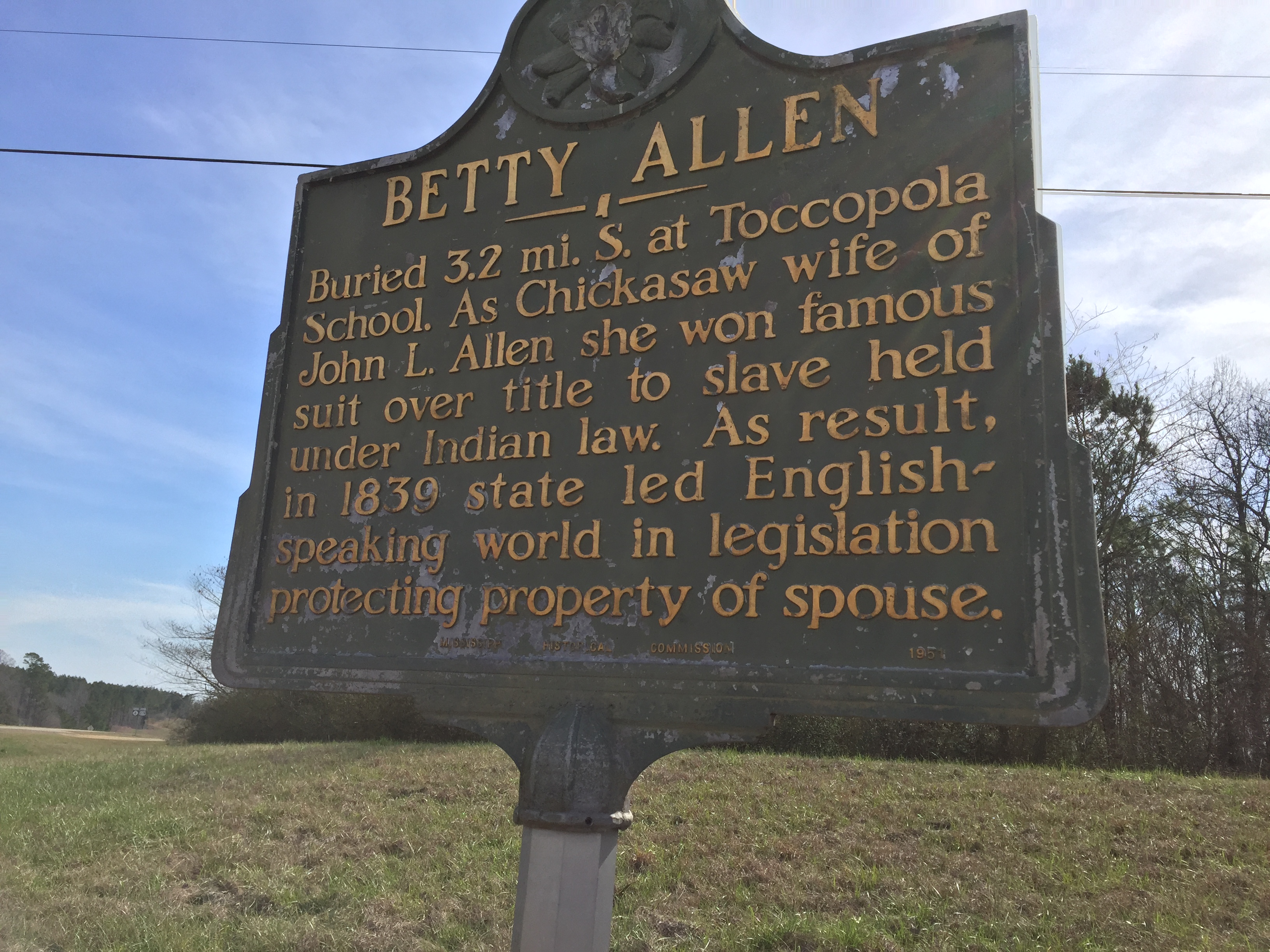
Although the Fisher v. Allen case does involve property rights in a slave, an issue considered repugnant by today’s standards, the legal conflict reflects the prevailing law and culture of that time, and must be seen in that context. Regardless of how we view it today, Betty Allen’s legacy has benefitted generations of Mississippi women.
MPB has a series of historical sketches in honor of Mississippi’s bicentennial this year. One such piece, presented by Marshall Ramsey, tells Betty Allen’s story. It’s a story that touches on many themes of early Mississippi: the derecognition of the indigenous tribes; slavery and the incidents of slave ownership; legal disabilities of women; and — yes — Mississippi’s relative progressivism in the formative years of its law and jurisprudence.
Lump-Sum Alimony Without a Lump
March 7, 2017 § Leave a comment
In the divorce judgment between Herman and Lillie Scott, the chancellor equitably divided the marital estate, awarding Herman most of the unencumbered real property and one small debt, and awarding Lillie the encumbered real property and the bulk of the marital debt. There was a large disparity in income in favor of Lillie.
In his judgment the chancellor said:
“All of the Armstrong factors mentioned above which suggest the appropriateness of an award of alimony to Herman have been considered by the Court to entitle him to a modest award of lump sum alimony. The Court considers that the division of the marital estate outlined below incorporates an equitable division of the estate and an award of such lump sum alimony.”
The chancellor’s ruling, however, did not state an amount or otherwise describe of what the lump-sum award consisted.
Herman appealed, complaining that the chancellor erred in not awarding him periodic alimony. In Scott v. Scott, handed down December 13, 2016, the COA affirmed with an opinion by Judge Greenlee. It’s a routine opinion that you will not likely find very useful.
The special concurring opinion by Judge Lee, however, makes some good points about how a trial judge should address alimony:
¶17. I concur in result with the majority’s decision to affirm; however, I find that the chancellor’s decision to categorize a portion of the equitable division of the marital assets as lump-sum alimony was incorrect.
¶18. First, the chancellor did not provide for a specific amount of lump-sum alimony. Whether lump-sum alimony is “used either as alimony or as part of property division,” it must be a “fixed and irrevocable sum.” Beezley v. Beezley, 917 So. 2d 803, 806 (¶10) (Miss. Ct. App. 2005) (citing Wray v. Wray, 394 So. 2d 1341, 1345 (Miss. 1981)). The chancellor did not designate a specific amount of lump-sum alimony; rather, he divided the marital assets, giving Herman the majority of the unencumbered assets. The chancellor simply stated that “the division of the marital estate . . . incorporates an equitable division of the estate and an award of such lump sum alimony.”
¶19. Second, the nature of the award is, in reality, equitable distribution. This Court in East v. East, 775 So. 2d 741, 745 (¶9) (Miss. Ct. App. 2000), determined that the chancellor incorrectly labeled an equity transfer from the husband to the wife as lump-sum alimony, when, “in effect, it is a portion of the . . . equitable distribution of the estate.” We affirmed the transfer but corrected the labeling error. Id. Here, I would affirm the equitable distribution award but decline to accept the chancellor’s decision to label any amount thereof as lump-sum alimony.
Judge Lee’s opinion was joined by Judge Wilson and by Judge Fair, who is the sole former chancellor on the court.
Making the Cap Fit
March 6, 2017 § Leave a comment
Chancery courts can award punitive damages. It doesn’t happen every day, and it doesn’t happen often, but it does happen. When they do award punitive damages, chancery courts are as bound as other courts by MCA 11-1-65(1)(a), which imposes a cap of 2% of the defendant’s net worth for defendants with net worth of $50 million or less.
The case of Moore v. McDonald, handed down February 7, 2017, the appellants argued that the trial court erred in assessing punitive damages in excess of their claimed net worth. We’ve already posted about this case here, here, and here, because there’s a lot to talk about in it. It’s the property-line dispute in which the Moores had violated a previously affirmed judgment setting the parties’ boundary line. The Moores appealed, and Judge Wilson’s opinion will fill you in on the applicable facts:
¶8. The Moores do not dispute that their conduct was malicious such that an award of punitive damages was appropriate. Miss. Code Ann. § 11-1-65(1)(a). Their only objection is that the punitive award exceeds two percent of their net worth in violation of Mississippi Code Annotated section 11-1-65(3). See id. § 11-1-65(3)(a)(vi) (“[N]o award of punitive damages shall exceed . . . [t]wo percent (2%) of the defendant’s net worth for a defendant with a net worth of Fifty Million Dollars ($50,000,000.00) or less.”). On appeal, they argue that the chancellor was required to accept at face value their own representations of their net worth and cap punitive damages at $1,268. However, in the court below, the Moores failed to raise the issue of the statutory cap on punitive damages. The Moores also failed to introduce any reliable evidence of their net worth. Accordingly, they were not entitled to the benefit of the statutory cap on punitive damages.
¶9. On March 20, 2015, at the conclusion of the hearing on the McDonalds’ contempt petition, the chancellor found that an award of $10,000 in punitive damages would be appropriate. After that hearing, the Moores, who had been proceeding pro se, decided to hire a lawyer. At a hearing on May 8, 2015, the Moores’ recently retained counsel argued that the burden was on the McDonalds to prove the Moores’ net worth before the court could award any amount of punitive damages. Indeed, counsel asserted that “[t]he case law is clear” on this point. At the Moores’ request, the chancellor then continued the case to July 7, 2015, for a hearing on attorneys’ fees and the Moores’ net worth for purposes of assessing punitive damages.
¶10. At the July 7 hearing, counsel for the Moores acknowledged that his argument at the prior hearing was mistaken and that proof of net worth is not necessary to support an award of punitive damages. Counsel then argued that either side could offer such evidence, which the court should then consider in assessing punitive damages. However, in all of the proceedings in the chancery court, the Moores never—at any hearing or in any pleading—mentioned the statutory cap on punitive damages or argued that punitive damages must be capped at two percent of their net worth or any other number. “It is a long-established rule in this state that a question not raised in the trial court will not be considered on appeal.” Adams v. Bd. of Sup’rs of Union Cty., 177 Miss. 403, 170 So. 684, 685 (1936). “Moreover, it is not sufficient to simply mention or discuss an issue at a hearing. The rule is that a ‘trial judge cannot be put in error on a matter which was never presented to him for decision.’” City of Hattiesburg v. Precision Constr. LLC, 192 So. 3d 1089, 1093 (¶18) (Miss. Ct. App. 2016) (quoting Methodist Hosps. of Memphis v. Guardianship of Marsh, 518 So. 2d 1227, 1228 (Miss. 1988)). Accordingly, the Moores waived any argument that the chancellor should have applied the statutory cap.
¶11. Procedural bar notwithstanding, the Moores also failed to present evidence sufficient to require the chancellor to apply the cap. The only evidence that the Moores introduced of their net worth was a Uniform Chancery Court Rule 8.05 financial statement that they apparently signed on the morning of the hearing. The Moores’ 8.05 statement estimated the value of their home and land as $85,000 with a $22,000 mortgage balance; claimed household goods, furniture, and clothing worth $400; disclosed checking accounts with a combined balance of $325 or less; and listed two vehicles—one worth $5,600 or less with a $5,600 loan, and the other worth $1,500 with an $1,800 loan. The Moores gave a total value of their assets of $0, although the assets listed totaled $63,425.
The court went on to describe: Carolyn Moore’s evasive answers to questions about $17,000 cash on hand and her admission that their 8.05 was inaccurate; the evasive testimony of her husband about false and misleading bankruptcy filings; their failure to offer tax returns or a copy of a loan application they had submitted to a local blank shortly before trial; and the Moores’ smirking and mocking demeanor at trial. The COA concluded:
¶15. The chancellor did not err by reaffirming her $10,000 punitive award. “[P]roof of net worth is not required to award punitive damages. . . . [F]or a defendant to mitigate potential punitive damages, it is his responsibility to present proof of his net worth and financial condition.” Woodkrest Custom Homes Inc. v. Cooper, 108 So. 3d 460, 469 (¶¶41-42) (Miss. Ct. App. 2013) (citing C&C Trucking Co. v. Smith, 612 So. 2d 1092, 1102, 1105 (Miss. 1992)); accord Coleman & Coleman Enters., 106 So. 3d at 320 (¶33). Furthermore, the “evidence must be sufficient to enable the trial court to determine the defendant’s current net worth, according to generally accepted accounting principles.” In re Miss. Medicaid Pharm. Average Wholesale Price Litig. (“AWP Litig.”), 190 So. 3d 829, 846 (¶40) (Miss. 2015) (opinion of Chandler, J., joined by Kitchens and King, JJ., affirming). The Moores failed to meet their burden. They presented only one self-serving and admittedly inaccurate document of their own creation. Clearly, they did not present “evidence . . . sufficient to enable the [chancellor] to determine [their] current net worth, according to generally accepted accounting principles.” Id.
Not much more needs to be said. If you want to preserve a point for appeal, it must have been presented to the chancellor in trial or pre-trial in a form suitable for the judge to rule on it, or you have waived it. And the burden is on you to prove net worth so as to apply the punitive damages cap.
“Quote Unquote”
March 3, 2017 § Leave a comment
“It is better to be poor and walk in integrity than to be stupid and speak lies.” – Proverbs 19:1
“Never attribute to malice that which is adequately explained by stupidity.” – Robert J. Hanlon
“Stupidity is a more dangerous enemy of the good than malice. One may protest against evil; it can be exposed and, if need be, prevented by the use of force. Evil always carries within itself the germ of its own subversion in that it leaves in human beings a sense of unease. Against stupidity we are defenseless. Neither protests nor the use of force accomplish anything here; reason falls on deaf ears; facts that contradict one’s prejudgment simply need not be believed – in such moments the stupid person even becomes critical. And when facts are irrefutable they are just pushed aside as inconsequential, as incidental. In all this the stupid person, in contrast to the malicious one, is utterly self-satisfied and, being easily irritated, becomes dangerous by going on the attack. For that reason, greater caution is called for when dealing with a stupid person than with a malicious one. Never again will we try to persuade the stupid person with reasons, for it is senseless and dangerous.” – Dietrich Bonhoeffer

Attorney’s Fees in a Related Case
March 1, 2017 § 1 Comment
In the midst of their long-running property-line feud with the McDonalds, about which we have previously posted here and here, Kenneth and Carolyn Moore filed for bankruptcy, making it necessary for the McDonalds to file adversary proceedings in bankruptcy court. After the case returned to chancery from its bankruptcy detour, the case was heard on the merits and the chancellor ruled against the Moores, assessing them $13,336.55 in actual damages, $10,000 in punitive damages, expert expenses of $1,700, and attorney’s fees of more than $65,000. The attorney’s fee award included legal work by the McDonalds’ attorneys in the bankruptcy case.
The Moores appealed, contending that it was error for the chancellor to assess bankruptcy attorney’s fees against them in the chancery contempt proceeding. The COA affirmed in Moore v. McDonald, et al., handed down February 7, 2017. Judge Wilson wrote the opinion on the point:
¶4. On May 16, 2014, the McDonalds filed a motion for summary judgment supported by exhibits and affidavits. Eleven days later, the Moores filed for bankruptcy. As a result, all proceedings in the chancery court were stayed and the impending trial was cancelled. Counsel for the McDonalds entered an appearance in the bankruptcy case and filed an adversary complaint to preserve the McDonalds’ claim against the Moores. See 11 U.S.C. § 523(a)(6) (2012) (providing that a debt for “willful and malicious injury” to the person or property of another is not dischargeable in bankruptcy). The McDonalds’ counsel also attended the meeting of creditors and filed a motion for sanctions based on the Moores’ alleged misrepresentations in the bankruptcy case. In response to hearing notices in the McDonalds’ adversary proceeding, the Moores appeared before the bankruptcy court and asked that their bankruptcy petition be dismissed. The court granted their request, which permitted the chancery case to proceed.
¶5. The chancellor found “that the Moores intentionally stalled [the chancery] action by filing [a petition for] bankruptcy which was dismissed after considerable time and effort by [counsel for the McDonalds].” The chancellor therefore found that “attorney time and expenses expended . . . in the Moore bankruptcy case were properly incurred on behalf of the McDonalds and should be awarded as part of the fees and costs awarded in this case.” On appeal, the Moores do not challenge the chancellor’s factual basis for awarding attorneys’ fees incurred in connection with the bankruptcy case. The Moores’ only argument is that “[t]he Pearl River County Chancery Court was not the appropriate forum to request attorneys’ fees for work related to the bankruptcy.” They argue that approximately $3,975 in fees that the McDonalds incurred related to the bankruptcy proceeding could only be recovered in the bankruptcy court.
¶6. The Moores’ argument is without merit. The Moores do not dispute that the McDonalds were entitled to an award of attorneys’ fees, and they cite no authority for their argument that such fees are not recoverable simply because they were incurred in a related bankruptcy proceeding. Although not directly on point, our Supreme Court recently held that a state court can award fees incurred in federal court in connection with a motion to remand the case to state court. See O.D. v. Dillard, 177 So. 3d 175, 189 (¶44) (Miss. 2015). In addition, other courts have held that a state court may award attorneys’ fees incurred in connection with a related bankruptcy proceeding. See Chinese Yellow Pages Co. v. Chinese Overseas Mktg. Serv. Corp., 170 Cal. App. 4th 868, 882 (Cal. Ct. App. 2009); Gill Sav. Ass’n v. Chair King Inc., 797 S.W.2d 31, 32 (Tex. 1990). Accordingly, we hold that the chancellor did not err by awarding attorneys’ fees related to the bankruptcy case.
In the absence of other Mississippi authority on point, then, the law in Mississippi is as stated above until the MSSC rules otherwise. On the particular facts in this case, I can’t disagree. The judge ruled that the detour “intentionally stalled” the chancery proceeding, so its connection with and direct relation to the chancery case is pretty clear. Still, I would hope we can have some parameters on how closely connected and related that other litigation needs to be to justify awarding attorney’s fees in another case.
 The Better Chancery Practice Blog