No Beneficiary = No Will
April 16, 2015 § 2 Comments
Ramon Regan was residing in a personal care home operated by Swilley. In 2008, Swilley arranged for a notary public to meet with Regan to help him prepare his will. The notary, Beckham, presented Regan with a pre-printed form, which Regan executed, and had properly witnessed. No attorney was involved.
The will specifically spelled out that it was Regan’s intent to make a testamentary disposition of his estate. It also mentioned that he had no surviving wife, and that he had had no children.
What the will failed to spell out, though, was who were to be the beneficiaries of his bounty. There were no specific or residuary beneficiaries named in the will.
After Regan died in 2011, Swilley filed a petition to probate the will. Elsie LeBlanc, Regan’s aunt, was determined to be his sole surviving heir. After Elsie died in 2013, her son Kenneth filed a caveat against probate of Regan’s will.
Kenneth filed a motion to declare Regan’s will invalid due to absence of any beneficiaries. Swilley responded that the document met the requirements of testamentary intent and attestation, and that parol evidence of Regan’s intent should be considered by the court.
The chancellor ruled that he was to look first to the four corners of the document to determine Regan’s intent. Since the document was not susceptible to multiple interpretations, but merely failed to name any beneficiaries, the court refused to consider parol evidence. The judge pointed out that he could not add language to the will, and that the absence of any named beneficiaries left him with nothing to interpret. He ruled that it was invalid to serve as a testamentary instrument. Swilley appealed, complaining that the chancellor erred in ruling the document invalid, and in refusing to consider parol evidence of Regan’s intent.
The COA, in the case of Estate of Regan: June Swilley v. Estate of LeBlanc, decided April 7, 2015, affirmed. Judge Carlton wrote for the unanimous court:
¶15. In the present case, Regan’s “Last Will and Testament” stated the following regarding the disposition of his property: “Upon my death, I want my property distributed as follows: All my estate, this includes monetary and real property.” As in In re Roland, [920 So.2d 539, 541 (Miss.App. 2006)] our review of Regan’s last will and testament reveals that the document contains no ambiguous language or imprecise description of a beneficiary. Instead, as the record reflects, Regan’s purported last will and testament simply failed to devise or bequeath Regan’s property because Regan failed to name or otherwise identify a beneficiary.
¶16. Because Regan’s last will and testament lacks ambiguity, we find that the chancellor correctly refused to allow parol evidence as to Regan’s testamentary intent. As the record reflects, to give effect to Regan’s will, this Court would have to insert a beneficiary’s name where the will completely failed to provide one. Although our precedent establishes that we construe a will in light of the circumstances surrounding the testator at the time he wrote the will, our caselaw also recognizes that “[c]ourts may not amend or reform a [w]ill, neither may courts add to or take from a [w]ill or make a new [w]ill for the parties.” Hemphill v. Robinson, 355 So. 2d 302, 306-07 (Miss. 1978) (citations omitted).
¶17. As reflected in the record, the invalidity of Regan’s purported last will and testament is rooted in the document’s failure to distribute any of Regan’s assets upon his death. Since Regan’s last will and testament failed to devise or bequeath his property to a named beneficiary, and since the document reflects no attempt within its four corners to identify a beneficiary, we affirm the chancellor’s decision declaring the will invalid and his refusal to admit parol evidence. Accordingly, this assignment of error lacks merit. [Footnote omitted]
Earlier in the opinion, the court noted that MCA 91-1-13 requires that all property, “real and personal, not devised or bequeathed in the last will and testament of any person shall descend and be distributed in the same manner as the estate of an intestate; and the executor or administrator shall administer the same accordingly.”
There is some other authority in the opinion pertaining to parol evidence that you might find useful.
I have had several cases in which someone wanted me to vary the unambiguous terms of the will via parol evidence. The usual situation is that dad had made it abundantly clear to everyone that he was going to change his will, but he died before he got around to it. Their argument is that the will was no longer his testamentary intent. If the document is unambiguous, that parol evidence simply will not vary the written document’s terms.
Naming Names
April 15, 2015 § 8 Comments
Requests for name changes are something every family practitioner encounters.
There are two general categories: (1) the change of name only; and (2) correction or change of birth certificate.
If you are seeking to change a person’s name only, without affecting the birth certificate, you proceed under MCA 93-17-1(1). Most often, this type name change is in the context or wake of a divorce action, where the woman wants her surname restored to her former name. That is an ex parte matter, since there is no other interested party. Except, however, in the context of the divorce, in which the estranged spouse may object. I represented a woman in an ID divorce once, and her husband adamantly and quixotically refused to agree to any provision in the PSA allowing her to change her name. I advised her to agree, and threw in a separate name-change action after the divorce was final.
Divorces are not the only reason for a name change. Some people simply don’t like their given name, or want to honor someone. I signed a judgment not long ago for a young man who wanted to change his surname to that of his step-father, who had raised him and was the only father he had ever known. If you are changing the name of a child, both parents must join.
In neither of the above scenarios does the birth certificate change. In order to change the birth certificate, more is required.
If you wish to change any birth fact on the birth certificate, then you proceed under MCA 41-57-23, which requires that you make the State Registrar of Vital Records a party. Typically, lawyers simply mail a copy of the complaint to the State Board of Health with a request for a response, and the agency will file an answer, most often either admitting the relief sought or leaving it up to the court. If you fail to make the agency a party, the judge will send you back to the drawing board.
Keep in mind that changing birth facts requires some proof, more than mere assertions. If you are trying to correct an incorrect name on the birth certificate, produce driver’s license, Social Security card, school records, and affidavits showing the correct information. If you are trying to correct a birth date, baptismal records, affidavits, school records, and the like will support your claim.
Another kind of birth certificate change is set out in MCA 93-17-1(2), which allows the court to “legitimize” a child when the natural father marries the natural mother. Again, you must make the State Registrar of Vital Records a party.
Name changes are fairly simple. Just keep in mind that if it’s for an adult, it’s ex parte. If it’s for a child, the parents must be joined. If it effects a change in a birth certificate, the state must be made a party. It’s embarrassing and costly to drive two counties over only to have a judge say, “Sorry, you have to make the parents or the State Department of Health a party.”
Modification During a Pending Appeal
April 14, 2015 § Leave a comment
In 2011, Brad and Caroline Nurkin were divorced in Tennessee. Caroline later relocated to Mississippi, and brad to Georgia.
In 2012, Caroline filed a modification of visitation and contempt action against Brad. The chancellor ruled that the court had jurisdiction over the modification, but dismissed the contempt.
There was a hearing, and on September 20, 2013, the chancellor entered a judgment modifying the visitation schedule. Both parties filed post-trial motions, which the chancellor denied. Brad then filed his notice of appeal on October 21, 2013. Then, on November 22, 2013, Brad filed a contempt action that included a motion to clarify the September ruling to specify when his visitation would commence. The judge entered an order not only clarifying that point, but also further modified Brad’s visitation.
On appeal, Brad argued that the chancellor had no jurisdiction to modify his original judgment, since the case was on appeal. The COA agreed. Judge Lee, wrote for the unanimous court in Nurkin v. Nurkin, handed down April 7, 2015:
¶16. Brad contends that the chancellor did not have jurisdiction to modify the original judgment while the appeal was pending. As previously stated, the chancellor entered the order modifying visitation on September 20, 2013. Brad then filed a notice of appeal on October 21, 2013, which was the day his post-trial motion was denied. On November 22, 2013, Brad filed his motion for contempt asking for clarification regarding his weekend visitation schedule. On December 16, 2013, the chancellor modified the judgment and clarified Brad’s weekend visitation. The chancellor also awarded Brad one extra monthly visitation if it occurred in Hattiesburg. Brad now argues that the chancellor did not have jurisdiction to modify the original judgment while it was on appeal. We note that Brad sought clarification of his visitation schedule, and after receiving extra visitation, he is now arguing that the chancellor had no jurisdiction to order the extra visitation while the appeal was pending.
¶17. The supreme court has held that ordinarily the filing of a notice of appeal transfers jurisdiction of a matter from the lower court to the appellate court, and the lower court no longer has the authority to amend, modify, or reconsider its judgment. McNeese v. McNeese, 129 So. 3d 125, 128 (¶7) (Miss. 2013). If an appeal has no supersedeas bond, as in this case, a party may execute on the judgment, but the lower court cannot “broaden, amend, modify, vacate, clarify, or rehear the decree.” McNeil v. Hester, 753 So. 2d 1057, 1076 (¶68) (Miss. 2000). In McNeese, the supreme court held that an agreed order entered by a chancellor while an appeal was pending “merely specified how the previous [j]udgment of [d]ivorce should be satisfied. . . . [It] did not broaden, amend, modify, vacate, or clarify the judgment through the [a]greed [o]rder.” McNeese, 129 So. 3d at 129 (¶12). However, in this case, the chancellor modified the original judgment by awarding Brad extra visitation with Jake. Consequently, the order entered December 16, 2013, is void and must be vacated.
This is a subject about which we’ve talked here before, and here.
An In Loco Parentis Case with a Twist
April 13, 2015 § Leave a comment
Gene and Eunieca Smiley were awarded custody of a minor child, Christopher, in a Memphis Juvenile Court proceeding. In addition, Eunieca’s cousin signed an agreed order giving the couple custody of her daughter, Alaina, in 2005.
Gene and Eunieca separated in 2009, but they nonetheless filed a proceeding to adopt Alaina. After the separation, Gene had moved to Memphis with Christopher, and Eunieca resided in Tishomingo with Alaina.
In November, 2010, Eunieca filed for divorce. That same month the adoption was granted (the natural mother had consented; there is no mention of a natural father). The adoption, however, was set later aside for reasons undisclosed in the opinion.
During the pendency of the divorce, Christopher was removed from Gene’s home for physical abuse. Gene conceded that he had gone overboard in whipping the boy with a belt, leaving bruises on the child’s back.
There was testimony of some creepy behavior by Gene involving inappropriate touching and handling little girls at his church and in his own home, and some inappropriate conduct with Alaina.
After a trial, the chancellor ruled that Gene’s had no standing to contest custody because his claim was based on in loco parentis, which the judge said was not adequate to confer standing. She also found that Gene had a history of family violence, and that there were insufficient safeguards to ensure Alaina’s safety when with Gene, so that he should have no visitation with the child, per MCA 93-5-24(9)(d)(i).
Gene appealed. The COA affirmed in part, and reversed and remanded in part, in the case of Smiley v. Smiley, decided March 31, 2015.
On the standing issue, Judge Irving wrote for the majority (Carlton dissented) that Gene did have standing, but that the chancellor correctly adjudicated custody. The court held that the judge’s treatment of Gene’s request for visitation to be cursory, and noted that the GAL in the hearing had reserved the right to make a recommendation on visitation until after hearing all the evidence, but she never did so as to give the judge a basis for finding insufficient safeguards. The court remanded for the chancellor to determine whether “adequate provision” could be made for Alaina’s safety as in the statute.
You should read the opinion to gain an appreciation of the scope of this fact-intensive case.
A few thoughts:
- “I thought in loco parentis was dead” you might be thinking. Well, as between a natural parent and a third party, it is not alone enough to defeat the natural-parent presumption. As between two non-biological parents who have not adopted a child, however, in loco parentis is available.
- Does it bother anyone else that separated parents with a divorce filed were allowed to adopt a child? As noted, the opinion does not tell us why the adoption was set aside.
- The chancellor did not specifically address the Albright factors in ruling on custody; however, she did adopt the GAL report, which incorporated an Albright analysis, and the COA said that was good enough.
- You need to read the code section cited above. It places custody and visitation limitations on the ability of one found to have been guilty of a history of domestic violence.
Courthouses of Mississippi
April 10, 2015 § 3 Comments
Continued … Please send me yours.

Forrest – Kathy Wilkinson

Grenada – LP

Hinds at Raymond – Jon Powell
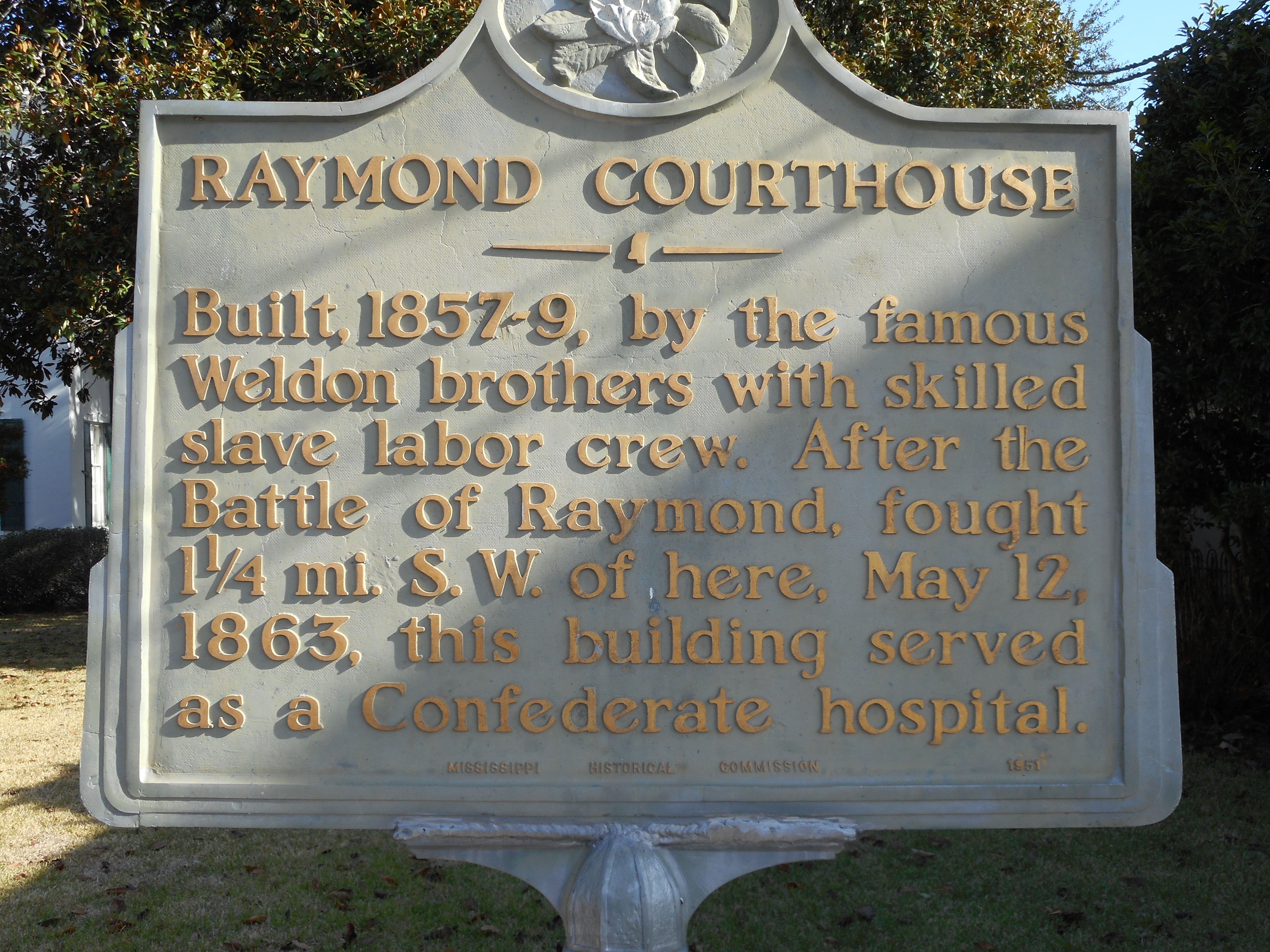
Hinds at Raymond – Jon Powell

Smith – LP

George – Kathy Wilkinson

Marion – Kathy Wilkinson

Noxubee – Scott Yoste

Jasper at Paulding – LP

Old Tishomingo (historical) at Jacinto – Beverly Kraft
Economics of the Do-It-Yourself Lawsuit
April 9, 2015 § 1 Comment
Nellie Pruitt died intestate in 1974. Her 24.12 acres of land was surveyed by Lambert, divided into five equal tracts, and deeded to Nellie’s five daughters, each of whom executed deeds that were recorded in the land records of Tishomingo County. In 2007, one of the daughters had the property surveyed by Guice, who discovered several errors in the deed descriptions. Freddie Dobbs, the heir of one of the original sisters, disagreed that there was any error in the descriptions, and obtained his own survey from Ledgewood that he claimed to support his position. Acting on his belief that the original description was correct, Dobbs bulldozed some trees, cleared land, and tore down a fence.
The other landowners (Crawford, et al.) filed suit against Dobbs in chancery court to reform the deeds, remove clouds, and quiet and confirm title. The complaint also sought damages, injunctive relief, expert witness fees, and attorney’s fees.
Dobbs represented himself.
Crawford filed a motion for partial summary judgment, and a hearing was held in which the judge apparently permitted testimony. Crawford put into evidence Guice’s survey with his affidavit, a deraignment of title, and the affidavit of the sole surviving Pruitt sister that the intent of the original partition was that each sister would receive an equal plot.
In response, Dobbs testified (apparently without objection) that Ledgewood had told him that the property lines were correct. He also testified (apparently without objection) that his mother had told him that she believed she owned more of her mother’s property, but did not want a family feud. He did not offer Ledgewood’s survey into evidence, and he offered no counteraffidavits, as required in R56(e).
The chancellor granted partial summary judgment reforming the deeds and quieting and confirming title according to the Guice survey.
A hearing was then held on the issues of injunctive relief, damages, court costs, expert witness fees, and attorney fees. Crawford et al. were represented by counsel. Dobbs, again, appeared pro se.
The Crawford plaintiffs put on detailed testimony and introduced documentary evidence to support their claims. In his defense, Dobbs again asserted that he had relied on Ledgewood. In ruling (predictably) for the plaintiffs, the chancellor observed that:
“Mr. Ledgewood did not testify and his survey was not offered nor admitted into evidence. There is no evidence whatsoever to support the explanation of the Defendant, Freddie Dobbs.”
The chancellor entered a judgment against Dobbs for nominal and actual damages totaling $17,746.20, for attorney’s fees in the sum of $13,000, and for expert witness fees in the amount of $3,250, for a grand total of $33,996.20. Each judgment was to bear interest at the rate of 8%.
Dobbs appealed, yet again representing himself.
On March 31, 2015, the COA handed down its decision in Dobbs v. Crawford, et al., in which Judge Irving observed for the unanimous court (Judge James not participating) that Dobbs ” … lists various grievances, but offers little argument and law.” Dobbs’ cornerstone contention was that, at the summary judgment hearing, he was “waiting for his chance to tell his side,” and that he did not know he was required to provide counteraffidavits with expert testimony. In other words, his lawyer (himself) was ignorant of the law. As you can guess, the COA did not buy that or any of his other contentions, and affirmed the trial court.
In case you’re not keeping count of Dobbs’ success as his own lawyer: Strike One, partial summary judgment hearing; Strike Two, damages hearing; and Strike Three, appeal. He’s Out.
So, let’s assess the wreckage:
- I am going to assume that a moderately experienced attorney would have settled this case in its earliest stages (some other defendants did exactly that) for far less than was ultimately assessed against Dobbs.
- No doubt an early settlement would have drastically reduced attorney’s fees. I note that there were two attorneys in the case, one of whom had fees of $10,000, and the other $3,000. My guess is that the former was the trial attorney, and the latter was the lawyer who did the title work and perhaps filed the initial pleadings in the unsuccessful hope that Dobbs would come to terms. If that’s so, then Dobbs cost himself $10,000 at least right there.
- Had he retained counsel early enough, that attorney might have been able to dissuade Dobbs from doing the bulldozer work on the plaintiffs’ property that ultimately cost him $17,746.20.
- If he had an attorney at the summary judgment proceeding, the Ledgewood survey (if it really existed) and some other supportive evidence would have been introduced that could have averted summary judgment and may have propelled the parties into settlement negotiations that would have saved Dobbs some serious money.
- I am willing to bet that Dobbs’ attorney’s fees would have been in the neighborhood of a few hundred dollars had he hired a lawyer when he got the Ledgewood survey, and a few thousand afterward. At any event, his total fees and judgment with assistance of a lawyer would not have approached $33,000, in my opinion.
“Penny wise and pound foolish” is one way to put it.
Rules for Comment
April 8, 2015 § 3 Comments
There are some proposed rule changes up for comment at the MSSC web site. You can access them at this link.
The changes would be to MRCP 16, primarily, with a couple of affected words fixed in R26. The other change is to the Circuit and County Court Rules.
The rule change is designed, as I understand it, to alleviate the lengthy waits that litigators experience in circuit court.
While the changes appear to be a probably effective one-size-fits-all solution to the kind of litigation involved that transpires in circuit court, I think if they were rigidly applied in chancery, it would actually have the effect of slowing down proceedings and clogging up the docket. I have been using scheduling orders for years, and our deadlines are much tighter than these proposed.
The rule changes specifically do not apply to R81 matters, which is a good thing. But divorces are R4 matters, although there is that language that says the MRCP has limited applicability to Title 93 matters, which includes divorce.
Anyway, the MSSC invites comment. You are cordially invited to the discussion. Take advantage of the opportunity.
Karma is a B****, or What Goes Around Comes Around
April 7, 2015 § 1 Comment
John Bowen got into the habit around 2005 of not paying his child support. His ex, Patricia, had to retain an attorney to file repeated petitions for contempt. When he did begin complying — more or less — with the court’s child support orders, he did so by paying the child support into the registry of the court, which required Patricia to retain an attorney to get a judge to sign a court order authorizing the Chancery Clerk to disburse the funds to her.
In 2009, the chancellor found John in contempt and slapped him with $10,000 in attorney’s fees. John appealed, and the COA, in Bowen v. Bowen, 107 So.3d 166 (Miss. App. 2012), affirmed the finding of contempt, but remanded for the chancellor to make findings on the McKee factors.
On remand, the chancellor awarded Patricia $7,350 in attorney’s fees. John again appealed.
In Bowen v. Bowen, handed down March 24, 2015, the COA affirmed. Judge Roberts, hitting the nail on the head, wrote for the unanimous court:
¶5. John’s sole issue on appeal is that the chancery court erred in awarding Patricia $7,350 in attorney’s fees. On appeal, we employ the abuse-of-discretion standard when reviewing a trial court’s grant or denial of attorney’s fees. Proctor v. Proctor, 143 So. 3d 615, 623 (¶34) (Miss. Ct. App. 2014) (citing Miss. Power & Light Co. v. Cook, 832 So. 2d 474, 478 (¶7) (Miss. 2002)). In McKee v. McKee, 418 So. 2d 764, 767 (Miss. 1982), the Mississippi Supreme Court provided factors for consideration when determining the proper amount of attorney’s fees to award:
The fee depends on consideration of, in addition to the relative financial ability of the parties, the skill and standing of the attorney employed, the nature of the case and novelty and difficulty of the questions at issue, as well as the degree of responsibility involved in the management of the cause, the time and labor required, the usual and customary charge in the community, and the preclusion of other employment by the attorney due to the acceptance of the case.
¶6. Following this Court’s mandate, the chancery court held a hearing on the issue of attorney’s fees. Nancy Liddell, Patricia’s attorney, submitted into evidence an itemized bill for her work related to the case. She testified that in any instance where modification was mentioned in the bill, she halved the fee charged; thus, only the time spent working on the contempt action remained. Liddell additionally submitted an affidavit from a local attorney confirming that the range of $150-$200 per hour was the usual and customary rate for DeSoto County. John’s attorney did not dispute that these were the customary rates for DeSoto County. Patricia testified that she believed Liddell’s rate was reasonable, and that she “probably worried [Liddell] to death” with her constant communication. Patricia further elaborated that without Liddell’s aid, she would have been unable to get the owed child support from John. Liddell also testified that she expended many hours on this case, as it was more than just an average contempt action, and she had to turn away potential clients to handle this particular case.
¶7. In addressing the McKee factors in its oral ruling, the chancery court noted that the case was a novel case for a contempt action and had been ongoing since 2005. According to the chancery court, Patricia had to repeatedly file petitions for contempt because John would not obey court orders to pay child support. The chancery court explained that each time John failed to pay child support, Patricia “would have to talk to her attorney, have a petition filed, and after the petition [was] filed, after [John or his attorney were] served, then before [they] actually would have a trial, [John] would pay that child support. But he would not pay it directly to [Patricia].” When John did pay the child support, he would pay it to the chancery court, which required a signed order to release the check to Patricia, again requiring Liddell to prepare a motion for release of funds and an order to release the funds. The chancery court further stated that John, “by his repeated intentional misconduct[,] caused [Patricia] to incur attorney[’s] fees that she did not have money to pay[, o]ver and over and over again[,]” and Liddell successfully obtained relief for Patricia each time John failed to pay. The chancery court also found that Liddell was a skilled lawyer with over twenty years of experience, who missed other employment opportunities due to the constant work and preparation of this case. According to the chancery court, while this amount of attorney’s fees appeared high for an average contempt action, the $150-$200 per hour was a reasonable fee, and the bill would not have been as high if it were not for John’s repeated misconduct.
Patricia’s lawyer did a nice job of addressing the McKee factors with substantial proof. That gave the chancellor an adequate basis to support her ruling.
Remember that proof of McKee factors is not, strictly speaking, required to support an award of attorney’s fees in a contempt action; however, there must be some evidence of reasonableness. In other words, the chancellor has to have some basis to say that the award is reasonable. The best and most expeditious way to do that is via the McKee factors, as the COA ordered in this case.
Oh, and getting back to our starting point, did you notice how spiteful and intransigent John appeared to be in how he responded to the court’s orders to pay child support? Well, that’s where karma comes into play. Judge Roberts addressed the karma factor:
¶8. Based upon the evidence presented, we find that the chancery court did not abuse its discretion in awarding Patricia $7,350 in attorney’s fees. As the supreme court noted in Mabus v. Mabus, 910 So. 2d 486, 489 (¶8) (Miss. 2005), in contempt actions, “[w]here a party’s intentional misconduct causes the opposing party to expend time and money needlessly, then attorney[’s] fee and expenses should be awarded to the wronged party.” The chancery court found that the itemized expensed entered into evidence were reasonably incurred due to John’s repeated misconduct.
Karma is, indeed, a B****. Or, as we say in chancery court: Who seeks equity must do equity.
The Proof is in the Pudding
April 6, 2015 § Leave a comment
Two recent COA decisions are flip sides of the same coin that you can not get a divorce on the ground of HCIT unless it is supported by substantial, corroborated proof.
The COA affirmed the chancellor’s R41(b) dismissal of a divorce action in Pittman v. Pittman, handed down March 24, 2015. Judge James expounded for the unanimous court:
¶11. A party seeking a divorce on the ground of habitual cruel and inhuman treatment bears the burden of proving his ground by a preponderance of the evidence. Hoskins v. Hoskins, 21 So. 3d 705, 707 (¶6) (Miss. Ct. App. 2009). We have defined habitual cruel and inhuman treatment as:
Conduct that . . . either (1) “endangers life, limb, or health, or creates a reasonable apprehension of such danger, rendering the relationship unsafe for the party seeking relief”[;] or (2) “is so unnatural and infamous” as to make the marriage revolting to the non-offending spouse and render it impossible for that spouse to discharge the duties of marriage, thus destroying the basis for its continuance.
Id. (quoting Kumar v. Kumar, 976 So. 2d 957, 961 (¶5) (Miss. Ct. App. 2008)). In addition, the Mississippi Supreme Court has held that “[h]abitual cruel and inhuman treatment may be established only by a continuous course of conduct . . . . [S]uch conduct must be habitual, that is, done often enough or so continuously that it may reasonably be said to be a permanent condition.” Holladay v. Holladay, 776 So. 2d 662, 677 (¶64) (Miss. 2000). Thus, the evidence required to support granting a divorce on the ground of cruel and inhuman treatment requires “more than mere unkindness, rudeness, or incompatibility.” Id.
¶12. In granting Ty’s motion for an involuntary dismissal, the chancellor, viewing the evidence fairly, found that the evidence presented did not meet the elements of cruel and inhuman treatment. The chancellor noted that, although Propst [the wife] claimed that Ty [the husband] forced her into bankruptcy, Propst testified that she was represented by counsel. The chancellor found there was no evidence that Ty coerced Propst into bankruptcy. As to physical abuse, the chancellor noted that Propst made general allegations of abuse without specificity, except regarding the occasion in which Ty grabbed her from behind when she attempted to leave his house with important papers and the occasion outside Propst’s accountant’s office when Ty forcefully took papers from Propst. However, the chancellor noted that at no time were the police called, nor were medical records produced documenting abuse.
¶13. “This Court must give great deference to the factual findings of the chancellor that are supported by substantial evidence.” Wilbourne v. Wilbourne, 748 So. 2d 184, 187 (¶5) (Miss. Ct. App. 1999). Upon reviewing the record of the proceedings below, we find that there is sufficient evidence to support the chancellor’s finding that Propst is not entitled to a divorce on the ground of cruel and inhuman treatment. Propst failed to demonstrate a continuous course of conduct that was so unkind, unfeeling, or brutal as to endanger her, or put her in reasonable apprehension of danger to life, limb, or health. Gallaspy v. Gallaspy, 459 So. 2d 283, 285 (Miss. 1984). Furthermore, many of her complaints were uncorroborated, except the incident at the Barn that was corroborated by Tyler. Nevertheless, even if taken as true, the complained of incidents are remote and isolated events and fail to rise to the level of conduct that is habitual or so continuous that it may reasonably be said to be a permanent condition.
¶14. We agree with the chancellor that the parties likely have irreconcilable differences; however, “mere incompatibility is not enough to show habitual cruel and inhuman treatment.” Id. “Habitual cruel and inhuman treatment is not the catch-all category to permit a divorce . . . [and,] [a]bsent an agreement . . . that would permit an irreconcilable differences divorce, neither party is entitled to be granted a divorce without providing the proof necessary to support the grounds that are alleged.” Crenshaw v. Crenshaw, 767 So. 2d 272, 276 (¶14) (Miss. Ct. App. 2000). Accordingly, we find that the chancellor did not abuse his discretion by dismissing Propst’s complaint for divorce on the ground of habitual cruel and inhuman treatment. This issue is without merit.
The other case is Walker v. Walker, also decided March 24, 2015. In that case, the COA reversed the chancellor’s ruling that granted a divorce, finding that it was unsupported by substantial evidence, and that the evidence was uncorroborated.
The takeaway is that you need to be sure that the conduct complained of was: (a) habitual, meaning regularly recurring and not isolated incidents; and (2) cruel and inhuman, meaning more than unkindness, with a discernible effect on the complaining party. And there must be corroboration. And all of that is at a minimum. There are some wrinkles, so before you go crashing off into court on an HCIT case, be sure to research the case law.
R.I.P. Chancellor Dan Fairly
April 3, 2015 § 2 Comments
… This day, April 3, 2015.
“May the souls of the faithful departed through the mercy of God, rest in peace. Amen.”
 The Better Chancery Practice Blog