WE HOLD THESE TRUTHS …
July 3, 2011 § Leave a comment
Please allow me to tell you about an experience I had that comes to mind every July 4, an experience that made literally true for me the phrase, “We hold these truths …”
Several years ago my daughter Aimée was living in Boston and working at the Massachusetts Historical Society. On one of our visits, she invited Lisa and me to visit her place of work, around the corner from hallowed Fenway Park, which has its own impressive history. Our son Mark, who was in school in Boston, joined us.
In the Society building, we saw the expected reading rooms where scholars pored over obscure texts. There were artifacts and oil portraits, many invaluable and irreplaceable. There were rooms of antique books and maps. Four or five floors of scholarship steeped in history.
We were introduced to Peter Drummey, Librarian of the Society. Peter is acknowledged by David McCullough in his book, 1776, as ” … the incomparably knowledgeable Librarian of the Massachusetts Historical Society …” for his help in reviewing the manuscript and suggesting revisions. Peter graciously took us in tow and shared his encyclopedic knowledge of early American history and the priceless collections stored in the building.
As we wound upward in the building, we moved from one mind-bendingly impressive item to another. Here in the cradle of the American Revolution, we were standing in the presence of some of its most cherished sacramentals.
On the uppermost floor, we came to a locked door, and Peter pulled out a ring of keys. We entered the room and passed among rows of library stacks until we arrived at a locked gate in an iron-grate, fence-like wall behind which we could see many books, manuscripts and other items.
Peter explained that this gated area protected the most rare and valuable works in the entire collection. Here he showed us some remarkable items. There was the entire, original, handwritten journal of the acerbic John Quincy Adams, documenting every day of his life from youth to his death. There were breathtaking, hand-colored sketches by American plains Indians depicting buffalo hunts, Indians in full regalia riding horseback, and Indian warriors in combat with Anglo soldiers. There was Thomas Jefferson’s day book, which included entries about selling slaves and buying various provisions; On July 4, 1776, the entry related the purchase of some gloves. On another day, the supreme rationalist’s entry noted only that on that day his mother had died.
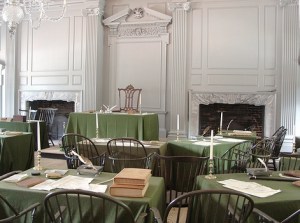
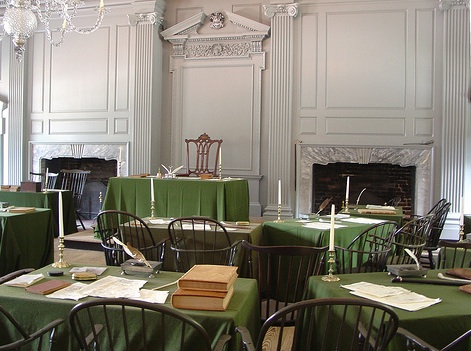
- Independence Hall, Philadelphia
Peter reached up and took down two manuscript boxes, opening one. He reached in, pulled out a piece of a parchment-like paper and offered it to me. Noting my reluctance, he encouraged me to take it in hand, assuring me that it was chemically treated so that handling it would not harm it in any way. I took the document and examined it. It was about 7″ x 5″, and was covered in almost microscopic writing. There were interlineations and lined-through words and phrases. The first line grabbed my eye: “When in the course of human events …” I looked questioningly at Peter and before I could ask he said, “You are holding Thomas Jefferson’s original handwritten notes of the negotiations leading to the drafting of the Declaration of Independence.” He explained that each of the five committee members charged with creating the document kept his own set of notes so as to keep track as ideas developed and to record his own ideas for further discussion. I could scarcely believe that I was looking at, much less handling, a document created by Thomas Jefferson himself. As I peered at it, Peter reached in the other manuscript box and pulled out a slightly smaller document, about 5″x 6″. It had the same kind of cramped handwriting and corrections. Peter handed it to me, and I noted that it bore the same phrase as Jefferson’s “When in the course …” Peter answered my unasked question: “John Adams’ handwritten notes.”
I can not catalogue all the emotions I felt as I held in my own hands these two ordinary-looking pages of notes that were anything but ordinary. They played a not-so-minor role in an event that changed the world and continues to reverberate through history even more than 230 years after the fact. I was awe-struck, of course, but mostly I felt a sense of how unfathomably remarkable and extraordinary were these two men who took care to get it right, knowing as they must have that the pronouncement they were fashioning must say exactly what needs to be said because it would live for many years thereafter. These were the self-recorded thoughts of two of the eyewitnesses to and participants in the creation of the republic.
I passed the two pages on to Lisa, Aimée and Mark, and they were as moved as I had been. We held in our hands these sacred papers that recorded profound truths.
This is what comes to my mind every July 4, the day we commemorate the signing of the Declaration of Independence. It’s the kind of experience that stays with you. It’s the kind of experience that gives fresh meaning to the words, “We hold these truths …”

 The Better Chancery Practice Blog
Leave a comment