
WATCHING SAUSAGE BEING MADE
July 13, 2010 § Leave a comment
You’d lose your taste for sausage if you saw what goes into it and how it’s made. The legislative process can be like that. Knowing what goes into laws and seeing the process by which they’re made can be stomach-churning.
Rep. Tom Moore was dismayed at how often his colleagues in the Texas House of Representatives passed bills without understanding them. So in April 1971 he sponsored a resolution honoring Albert de Salvo:
This compassionate gentleman’s dedication and devotion to his work has enabled the weak and the lonely throughout the nation to achieve and maintain a new degree of concern for their future. He has been officially recognized by the state of Massachusetts for his noted activities and unconventional techniques involving population control and applied psychology.
That’s true as far as it goes — Albert de Salvo is the Boston Strangler.
The measure passed unanimously.
Thanks to Futility Closet for this delectable morsel.
TRIAL BY CHECKLIST: ADVERSE POSSESSION
July 12, 2010 § 11 Comments
A practice tip about trial factors is here.
Section 15-1-13, MCA, sets out a six-part test that must be applied to determine whether adverse possession has occurred.
In order for possession to be adverse, it must be:
- Under claim of ownership. The possessing party must have acted with respect to the land as if he or she owned it. Jordan v. Peters, 986 So.2d 1018, 1022 (Miss. App. 2008);
- Actual or hostile. Actual possession is effective control over a definite area of land, evidenced by things visible to the eye or perceptible to the senses. Blankenship v. Payton, 605 So.2d 817, 819-820 (Miss. 1992);
- Open, notorious and visible. In order for possession to be open, notorious and visible, “An adverse possessor must unfurl his flag on the land and keep it flying so that the owner may see … that an enemy has invaded his domains, and planted the standard of conquest.” Sturdivant v. Todd, 956 So.2d 977, 982 (Miss. App. 2007);
- Continuous and uninterrupted for a period of ten years. Possession may be tacked on to the possession of predecessors in title. Jordan, at 1023;
- Exclusive. The law requires that the person possessing the property in question must intend to possess the land over all others and to the exclusion of all others. Sturdivant, at 992; and
- Peaceful. The adverse possession must be peaceful and unchallenged by the title owner. See, Sturdivant, at 987.
The claim of adverse possession must be established by clear and convincing evidence. Thornhill v. Caroline Hunt Trust Estate, 594 So.2d 1150, 1152 (Miss. 1992).
The adverse possession statute was enacted by the legislature to address the serious problems caused by landowners who ignore claims or encroachments over long periods of time. Clanton v. Hathorn, 600 So.2d 963, 966 (Miss. 1992).
There are various cases interpreting the adverse possession factors. The cases cited here are only a basic introduction.
HELLHOUND ON HIS TRAIL
July 11, 2010 § 2 Comments
1968 was a hellish year on many counts for our nation. It was the year that Bobby Kennedy was gunned down at a primary night victory celebration in California. The Vietnam War continued its grip on the nation and claimed Lyndon Johnson’s presidential career among its 50,000-plus casualties. The Democratic convention in Chicago was beset by violent demonstrations and police reaction that were broadcast live on television to the shock of millions. The heady “Prague Spring” came to a stunning and abrupt end when Soviet tanks rumbled into Czechoslovakia and crushed the fresh democracy that had sprung up, raising new fears of an east-west confrontation and adding to the chilly pall that the cold war had cast over our lives for more than twenty years.
But no event in the tumult of 1968 had more powerful repercussions than the assasination of Rev. Martin Luther King, Jr., on April 4, in Memphis.
Hampton Sides’ book, HELLHOUND ON HIS TRAIL is the meticulously researched and spellbinding retelling of how the drifter James Earl Ray stalked King, planned the murder, and carried it out, and the story of how the FBI, Royal Canadian Mounted Police and Scotland Yard painstakingly unravelled the knot of aliases and false trails that Ray threw in their path until his arrest at a London airport two months after the assasination. 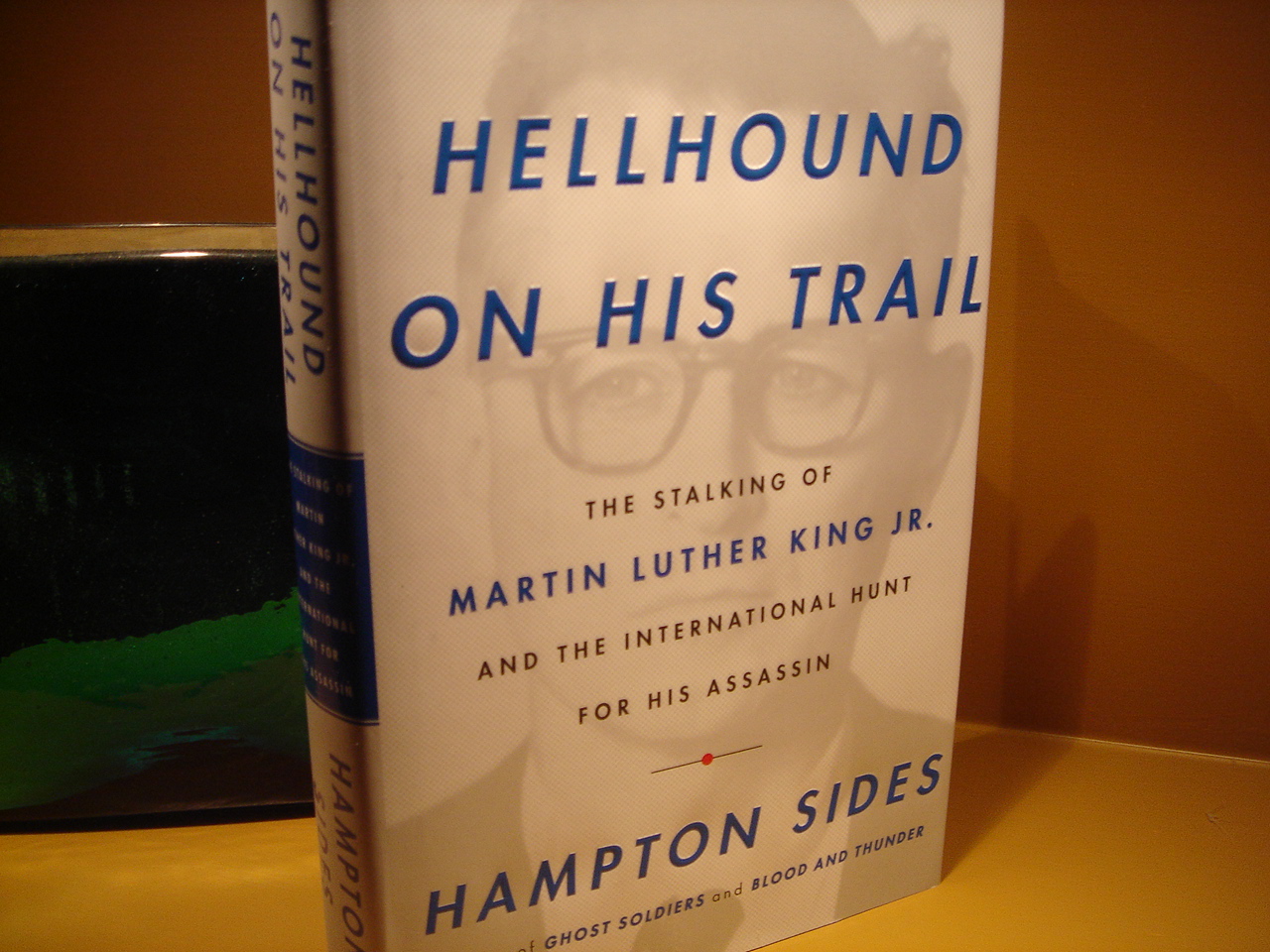
There is nothing really new here: no startling bombshell revelation of a conspiracy that has long been whispered about; no new eyewitness or piece of hitherto undiscovered shard of evidence; no new insight into the enigmatic Ray.
What is here in this book, and what makes it such a compelling read is how Sides lays it out like a detective novel, unfolding developments and clues in tantalizing morsels that whet the reader’s appetite and keep the pages turning for more. Sides draws on the many reams of investigative material, research, scholarly papers and personal interviews that rose out of this dark event and applies his considerable writing skill to craft a narrative that is hard to put down.
The characters are all here in bold relief: King himself, struggling to re-establish himself and non-violence as pre-eminent in the civil rights movement, against the rising tide of calls to racial violence; Ray, the murderous escaped con who swore he would kill the man he considered the leader of the race he hated; Ralph David Abernathy, King’s loyal friend and aide, but ultimately unequal to the task of being his successor; Coretta, the stoic widow; J. Edgar Hoover, who hated King and resisted taking over the murder investigation until he was ordered to do so by US Attorney General Ramsey Clark; Jesse Jackson, who would lie to try to claim the mantle of King’s successor; the FBI agents who undertook a seemingly impossible task and did a remarkable job of tracking down the killer in the largest manhunt in history; and the cast of casual bystanders who were caught up in the events. And, yes, there are some tawdry details about King’s personal life; those are an undeniable part of the true story.
Hampton Sides is a native Memphian with a good feel for the south. Despite the fact that he was only six years old when King was murdered, Sides is able to paint the landscape of racism and insensitivity to poverty that permeated the region in those days without resorting to the stereotypes and generalizations on which writers unfamiliar with southern folkways of the 1960’s so often fall back. His depiction of the south of 1968 is factual and stark. We thought we had come so far back then, but in retrospect some of the images are painful. There were Cal Alley’s racist and patronizing cartoons that I recall reading in the Memphis Commercial Appeal in those days. There is the depiction of the regal Cotton Carnival and its opulence set against the desparate poverty of the Memphis sanitation workers. There is the fact that racist groups raised hundreds of thousands of dollars for Ray’s defense and hailed him as a hero, a sobering reminder of a seamy underside of American society.
Reading this book will bring into focus how much America and the south have changed in 42 years. African-Americans are more incorporated into the mainstream now, in jobs, neighborhoods, schools and elected positions that were unimaginable in 1968. African-Americans are a growing segment of the middle class. It is not uncommon to see whites and blacks socializing together, something so innocuous today that would have raised eyebrows back then. Racial reconciliation is not an accomplished fact, but we have made a start thanks to the life and sacrifice of a man whose life was cut short by the very violence he repudiated.
TRIAL BY CHECKLIST: ATTORNEY’S FEES
July 9, 2010 § 20 Comments
A practice tip about trial factors is here.
If you are expecting an award of attorney’s fees in your case, you must put on proof of the quantity of work that was done to earn the fees, as well as the amount of the fees. In the case of McKee v. McKee, 418 So.2d 764, 767 (Miss. 1982), the Mississippi Supreme Court set out the following factors that must be considered by the court in determining the proper amount of attorney’s fees to be awarded:
- The parties’ relative financial ability;
- The skill and standing of the attorney;
- The novelty and difficulty of the issues;
- The degree of responsibility involved in management of the case;
- Time and labor;
- The usual and customary charge in the community;
- Preclusion of other employment as a result of accepting the case.
If McKee factor evidence is not submitted, the court may deny your prayer for attorney’s fee, and if the trial court does award it, it may be thrown out on appeal.
In a divorce case, an award of an attorney’s fee is properly made only to a party who proves inability to pay and there is proof of the McKee factors. In Turner v. Turner, 744 So.2d 332, 338 (Miss. App. 1999), the trial court’s award of attorney’s fees was reversed where no itemized account was introduced into evidence, and the only testimony of fees was that the fee charged was $1,500 and that the party seeking the award was unable to pay it.
In other cases, an award of attorney’s fees may be made regardless of ability to pay where the party is found in contempt, or is found guilty of dilatory behavior or behavior that causes the other party undue expense, or for frivolous litigation, or for unfounded allegations of domestic abuse. In such cases, the proof of attorney’s fees should be supported by proof of the McKee factors.
“QUOTE UNQUOTE”
July 8, 2010 § Leave a comment
“Everybody thinks of changing humanity, and nobody thinks of changing himself.” — Tolstoy
“‘Be yourself’ is just about the worst advice you can give some people.” — Tom Masson

Margaret Atwood
“You refuse to own yourself; you permit others to do it for you.” — Margaret Atwood
CHANGING LANDSCAPE IN CHANCERY COURT STATEWIDE
July 7, 2010 § Leave a comment
Lawyers from Meridian and Quitman often travel out of district to conduct business and try cases in other Chancery Courts. When they do in the coming year, they’ll have to adjust to some newcomers. Six Chancery Court Districts have contested races this judicial election year, and no matter who wins, several will result in new faces on the bench.
Nearby, in District 6, we have already bade farewell to Judge J. Max Kilpatrick, who retired effective June 30, and have welcomed new Chancellor D. Joseph “Joey” Kilgore, who was appointed by Governor Barbour to fill the post. Judge Kilgore had already qualified to run without opposition.
All of the other races across the state to replace retiring Chancellors,or, in one case, to fill a newly-created seat, are contested.
In District 7 (Tunica, Quitman, Coahoma, Tallahatchie and Leflore Counties), Place 1, Catherine Farris-Carter of Shaw and Tom T. Ross, Jr., of Clarksdale are vying to replace the retiring Judge William Willard.
Also in District 7, Place 3, W. M. Sanders of Greenwood and Jimmy Miller of Marks are facing off for a newly-created seat.
District 8 (Hancock, Harrison and Stone Counties) has six contestants to take the place of retiring Chancellor Margaret Alfonso. Qualified and running are: D. Scott Gibson, Jennifer Schloegel and Dara Skinner, all of Gulfport; and Robert G. Harenski, William E. Tisdale and Fran Yeatts, all of Biloxi.
In District 1o (Forrest, Lamar, Pearl River and Perry Counties), there are three candidates for Place 2, from which Judge Sebe Dale, dean of Chancellors, is retiring after a long and illustrious career. The candidates are Dawn H. Beam of Sumrall, Scott Phillips of Columbia, and Aaron L. Russell of Carriere.
There are only two incumbents facing opposition.
Chancery Judge Larry Buffington of Collins faces two opponents in District 13 (Covington, Jefferson Davis, lawrence, Simpson, and Smith Counties): Douglas MacArthur Magee of Mendenhall; and David Shoemake of Collins.
Chancery Judge Edwin H. Roberts, Jr. in District 18 (Benton, Calhoun, Lafayette, Marshall and Tippah Counties) is opposed by Helen Kennedy Robinson of Oxford.
TRIAL BY CHECKLIST
July 5, 2010 § 23 Comments
Some years ago an old Chancellor complained to me that we were being reduced to “trial by checklist,” what with all the cases being handed down that spelled out factors that the trial court must address in adjudicating certain issues. Over the years, those so-called checklists have multiplied, so that Chancellors are required to consider and address factors in determining:
- Child custody
- Equitable distribution
- Periodic and rehabilitative alimony
- Lump sum alimony
- Grandparent visitation
- Separate maintenance
- Modification of child support
- Adverse possession
- Attorney’s fees
Over time, I will be posting these factor “checklists” for your use.
Remember that these factors are the ones that must be decided by the judge in order to decide your case. In essence, the factors are the elements of the case that will determine its outcome. If you are not putting on proof as to each factor that applies in your case, you are running the risk that the Chancellor will find that there is not enough evidence to rule in your favor.
Practice Tip: When trying a case involving any of the foregoing issues, have a list of the factors applicable your case at hand, and methodically cover them in your questions for the witnesses. Give some thought to questions that will best develop evidence that will support a finding in your client’s favor for as many factors as possible, and how to minimize the impact of factors that are not in your favor.
July 4, 2010 § Leave a comment
We hold these truths to be self-evident, that all men are created equal, that they are endowed by their Creator with certain unalienable Rights, that among these are Life, Liberty and the pursuit of Happiness.

“QUOTE UNQUOTE”
July 2, 2010 § 2 Comments

Yes, this is she
“I would not live forever because we should not live forever, because if we were supposed to live forever then we would live forever, but we cannot live forever, which is why I would not live forever.” — Miss Alabama 1994
“The graveyards are full of indispensable men.” — Charles DeGaulle
“Death is the sound of distant thunder at a picnic.” — W.H. Auden
 The Better Chancery Practice Blog